“At The Roman Stone”

IMG_0493

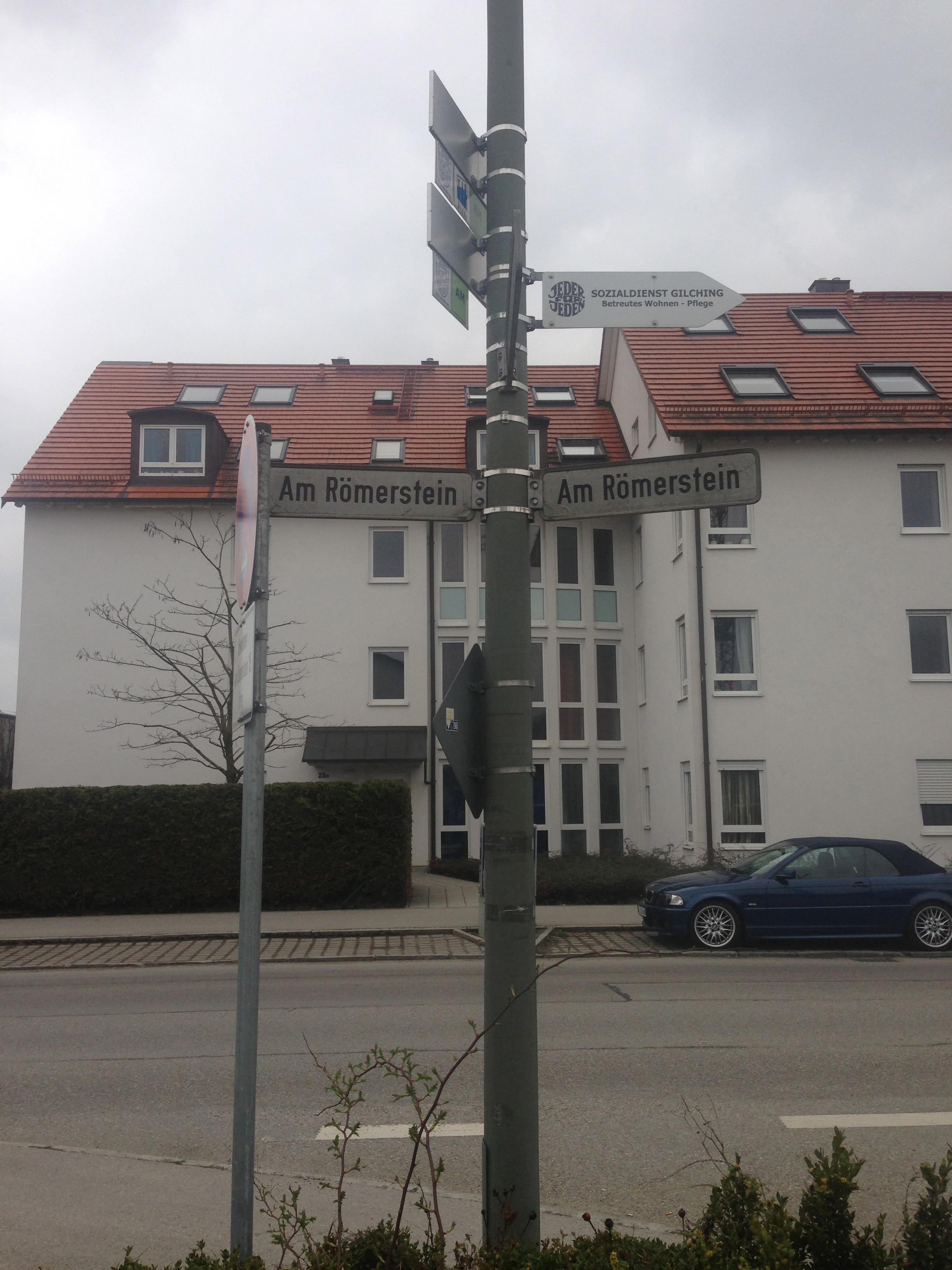
This post’s title is the translation of Am Römerstein, a street in the Bavarian town of Gilching. It’s a road the Beau takes regularly for business. The name always intrigued me — where is, or was, this Roman stone, anyway?

Gilching

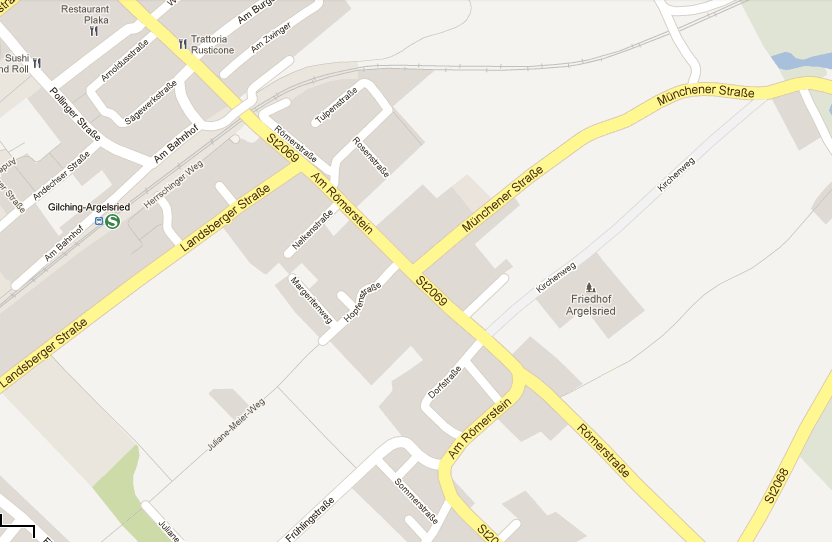
A look at a map of Gilching shows that Am Römerstein intersects (and for a short stretch follows) the old Roman road Via Julia from Salzburg to Augsburg (through Gilching it is named, appropriately, Römerstrasse. Click on the link above to see a simple map of the entire road. Gilching is on the red line just above the area between those two lakes.) So the street got it’s name from being at or near a milestone on the Roman road. Salzburg, not yet the summer destination of the Euro-chic, was important for it’s salt mines, salt in earlier times being a very valuable commodity. (Worth another blog post at a later time. The names of many places in Germany and Austria come from their importance in the salt trade.) Augsburg was Augusta Vindelicorum, the capital city of Roman province Raetia and all the Roman roads in and around the Alps lead not to Rome, but to there.

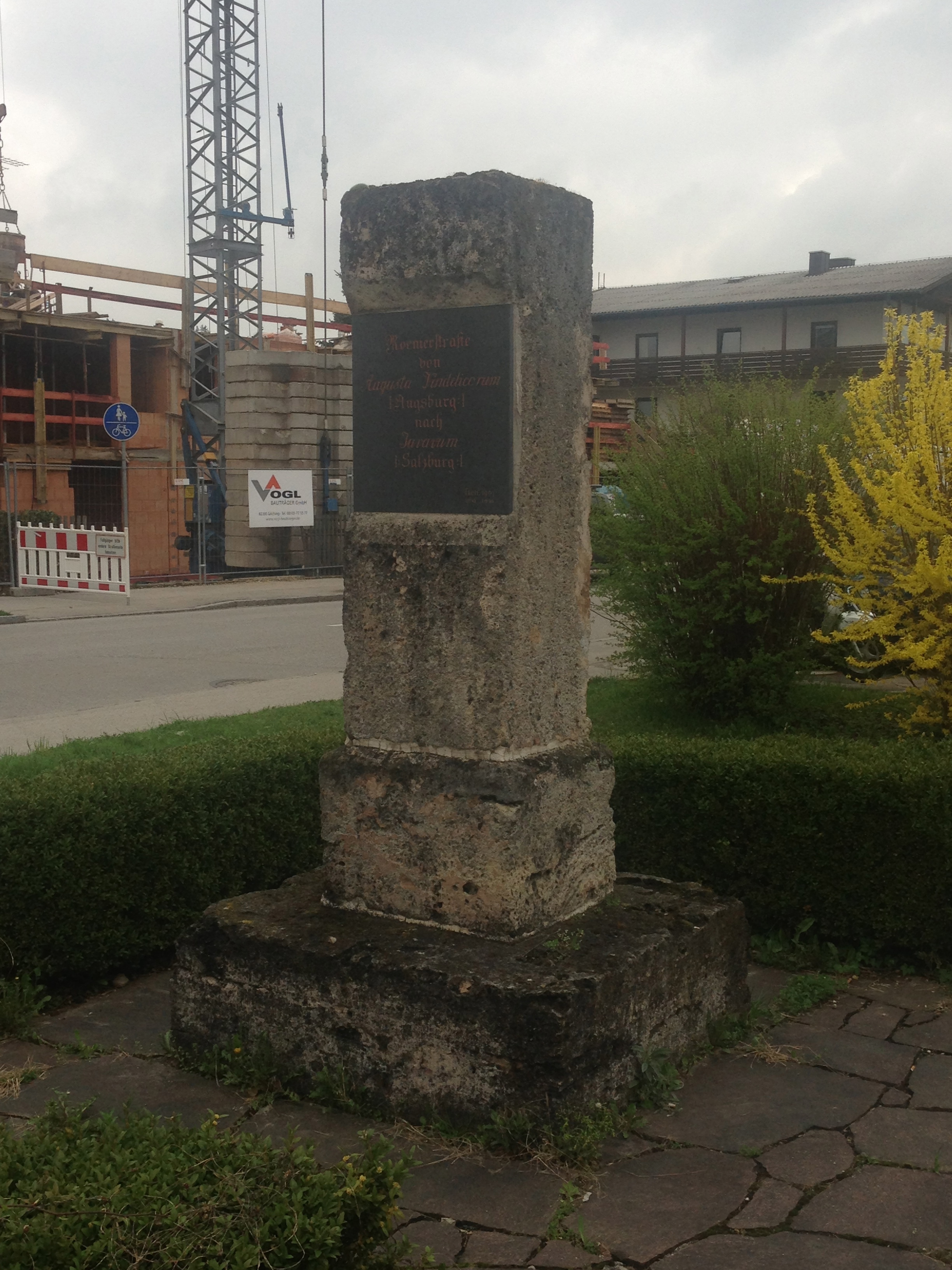
Back to my milestone. With the help of Zeitspringer (who blogs chiefly about archaeological outings in Bavaria and Baden-Württemberg, and who is a great source of information on the subject, his blog is well worth perusing if you read German), I learned that a stone erected in the 1860s and dedicated to the Roman Road is included in a list of monuments on Gilching, including it’s location. A trip over there brought us to Number 15 Am Römerstein, where we found this monument,

IMG_0491

Roman Road
from
Augusta Vindelicorum
(Augsburg)
to
Juvavum
(Salzburg)

This, by the way, is definitely not the same stone mentioned (and shown) in Gilching’s Wikipedia entry (g), a small tube-shaped stone with engraved Latin text, a copy made more recently than the monument at 15 Am Römerstein. So where is the milestone photographed and shown in the Wikipedia entry? Turns out, it’s just a bit further down the road (g), in the center of town.

I assume that the street Am Römerstein, therefor, is named after the 19th-century monument to the Roman road, and not for the site of the Roman milestone (although it’s also entirely possible that the former was erected on the actual site of the original, and the later copy was placed somewhere more convenient and available.) A sign erected near the copy stone gives a very interesting account of the original’s fate. Milestones have been hauled off and used as building stones since the Late Antiquity. This particular stone was taken to Hattenhofen (there are four communities in the area with that name, most likely they mean the one in Fürstenfeldbrück County) in the 16th century, and then used as a cornerstone in Günzlhofen Castle. After the castle fell to ruin it came it Munich, first in the Royal “Antiquarium” and later as part of the Bavarian national collection of prehistoric artifacts, and exhibited with it. Here is where it met it’s ultimate fate, on a date with an Allied bomb in 1944.

Maybe We Can Translate It As “Kakastrophe”

IMG_0495

One sees/hears a lot of English words which have been absorbed into the German language. Sometimes, like HD vs Blue Ray, you’ll hear competing German and English terms for certain things (“Computer” seems to have won out over “Rechner”, for example). But this one in the Tiroler Tageszeitung took me completely by surprise. I really would have expected to see it in quotation marks, since it probably came from the subject’s own Facebook posting (which would not have been in German).

The article, if you’re curious, states that the designated composer of a new anthem in honor of the upcoming Coronation in the Netherlands (the Queen is stepping down and handing the throne over to her eldest son. This is THE STORY up there right now) has withdrawn his composition after massive protest and ridicule from citizens. My Dutch friends assure me that it’s godawful. Hence the Anschiss.

Looking it up in the online German-English dictionaries, I find that the word “shitstorm” was named the 2011 Anglizismus des Jahres (Anglicism Of The Year), and not perfectly translatable, therefor accepted “as is” in the German language. There are links at the links, if you’re that interested.

“It’ll Be A Hot Day Today”

IMG_0352

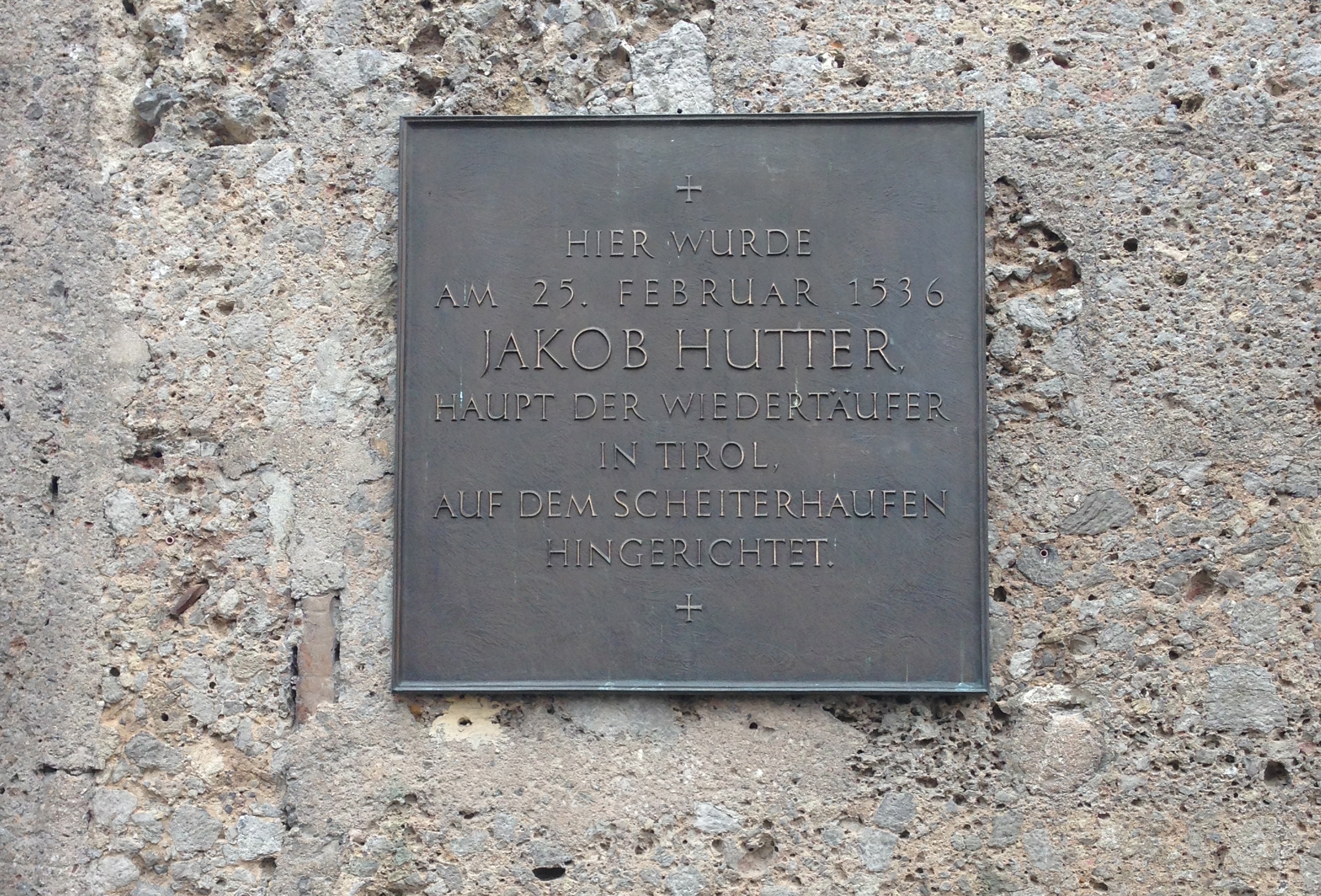
This plaque, found on the stone wall underneath the Golden Roof in Innsbruck’s old town, says: Here, on 25 February 1536, Jakob Hutter, head of the Anabaptists in Tirol, was burned at the stake.

Jakob Hutter was born in what is now South Tirol, in northern Italy. After he joined the Anabaptists, he began to preach and form small congregations in the region. Tirol was persecuting Anabaptists, so Hutter eventually followed many of his fellow believers to Moravia (part of what is now Czech Republic), where conditions were a little better for them. (The Moravian Church, not related not directly related but a possible antecedent to Hutter’s Anabaptists, got their name for this same reason — they had left Saxony for Moravia to escape religious persecution, and the name stuck when they moved elsewhere. Their founder, Jan Hus, was also burned at the stake.)

Good times in Moravia only lasted so long, however, and in 1535 the Hutterites were expelled. Jakob Hutter returned to Tirol, was soon afterward arrested, tortured, pressured to recant and inform on his fellow church members. He resisted, and was sentenced to burn. His wife was able to flee, was however later caught and executed at Schöneck Fortress in South Tirol. Online sources in German indicate that men were burned or beheaded, women drowned, and that 360 Anabaptists were executed in Tirol.

Yet another Tirolean burned at the stake was Mathias Perger, known as der Lauterfresser (g), which translates roughly to the Soup Eater. Perger was what one might call today a free spirit, occasionally working, learned in reading, writing, and astrology. In other words, someone the church considered dangerous. He was arrested on charges of witchcraft and “weather-making”, confessed under torture to such medieval horrors as “desecrating the Host”, and executed in 1645 in Mühlbach (near Brixen/Bressanone).

While Hutter was clearly pious (just the “wrong” religion), the Lauterfresser was odd enough (and perhaps heathen enough) for legends about him to crop up over time. He plays tricks on fellow inn patrons. He makes chickens fly over to the next field and lay their eggs for their owner’s neighbor. He changes at will into a bear and, for sport, chats with the hunting party trying to track it down. The legends make him a sympathetic, clever figure, a sort of alpine combination of Till Eulenspiegel and Fred and George Weasley, if you will. The quote in this title are his alleged words — “Das wird ein heißer Tag heute” — as he was fetched to be taken to the pyre.

BONUS LINK: And speaking of legends, a 1,200-year-old Coptic Egyptian text, recently translated, is found to tell the story of a shape-shifting Jesus who dined with a well-intentioned Pilate before his death. I suppose that it shows, like the stories of the Lauterfresser, that we humans want to hear these stories and be amazed.

“Witch Burning”

My local newspaper reports (g) on an upcoming event called the Hexenverbrennung, or Witch Burning, an old traditional custom in the somewhat remote region of Tirol called Ausserfern. I translate directly from the article, somewhat loosely for comprehension:

On the first Sunday after Ash Wednesday, to cries of “Vivat hoch, die Hex hat Durst — sie will auch eine lange Wurst!” (“Hurrah, the Witch is thirsty, and she wants a long sausage!”*) the communities of Jungholz, Musau, Pinswang and Weißenbach bring back an old heathen custom, driving the winter away with bonfires and Witch Burning.
In earlier times, boys went on “rag Thursday” from house to house, collecting rags “for the Witch”. The Witch — an effigy of hay and straw — would be made, dressed in a gown created from the colorful rags, and hoisted up on a long pole over the pyre. The fire is lit at nightfall. The custom symbolizes the driving out of Winter and is in no way connected to the witch burnings of the Middle Ages.
This old custom from Celtic times has become a popular event with the both the local population and tourists. Above all the social part, the party which lasts late into the night.
The fire is made to drive the evil Winter spirits from the fields and epitomizes the people’s yearning for warmth.

I assumed that this custom must be an old pagan one (bonfire) with some Medieval, early Christian stuff that had attached itself to it over time (the witch), until I remembered the Wicker Man. Roman sources alledge that the Druids made burning human sacrifices to Taranis, the god of thunder. Taranis’ influence apparently covered Gaul, the British Isles, and the Rhineland and Danube regions.
One difference is that the Druids, it is written, burned men.

Supporting sources at Sagen.at (g).

*I’m sorry, but does this sound like gang rape to you?

Forgotten Tirol: PlayCastle

UPDATE: PlayCastle is now Magic Castle, and here is its website, with events and information.

OLYMPUS DIGITAL CAMERA

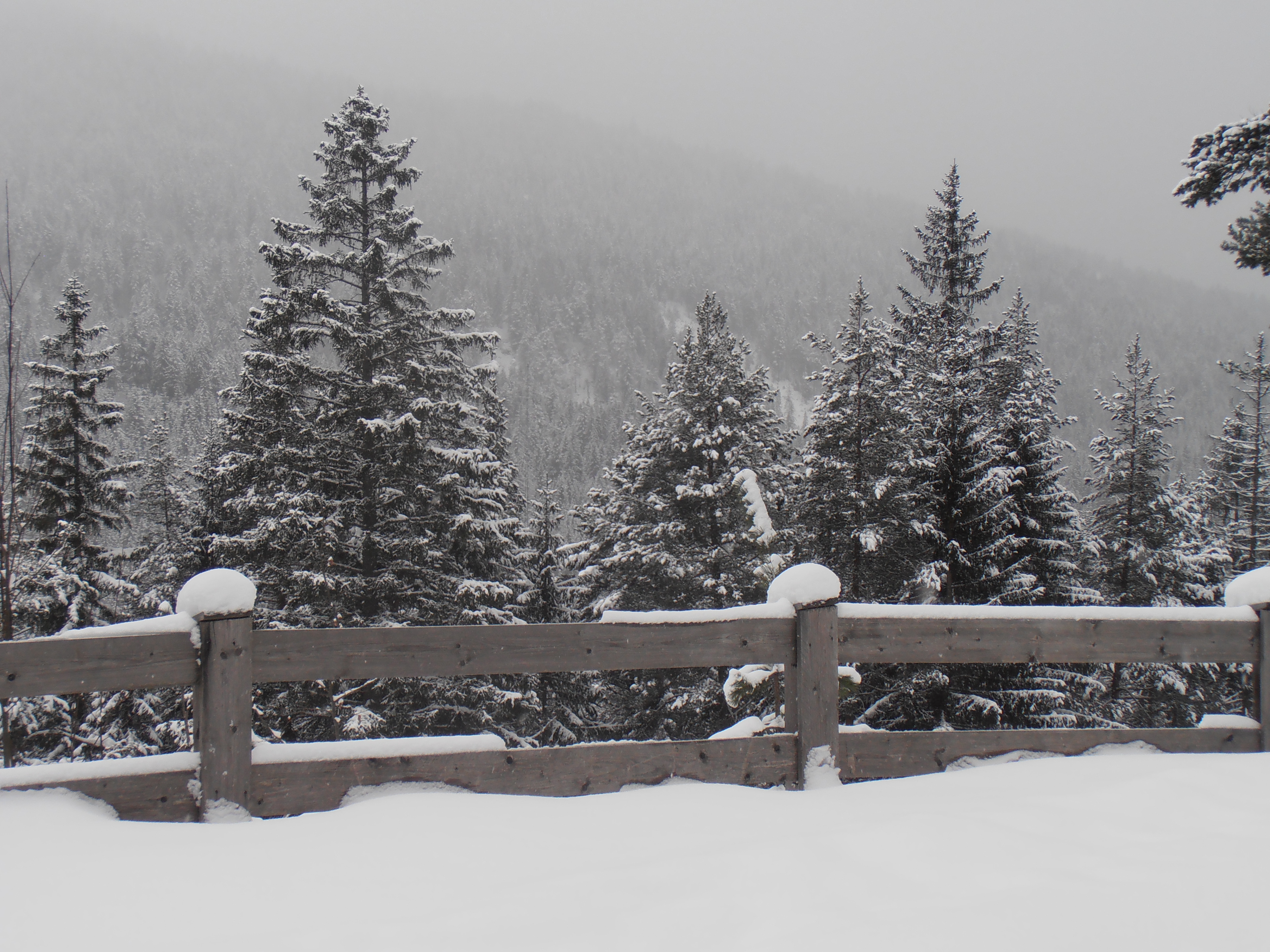
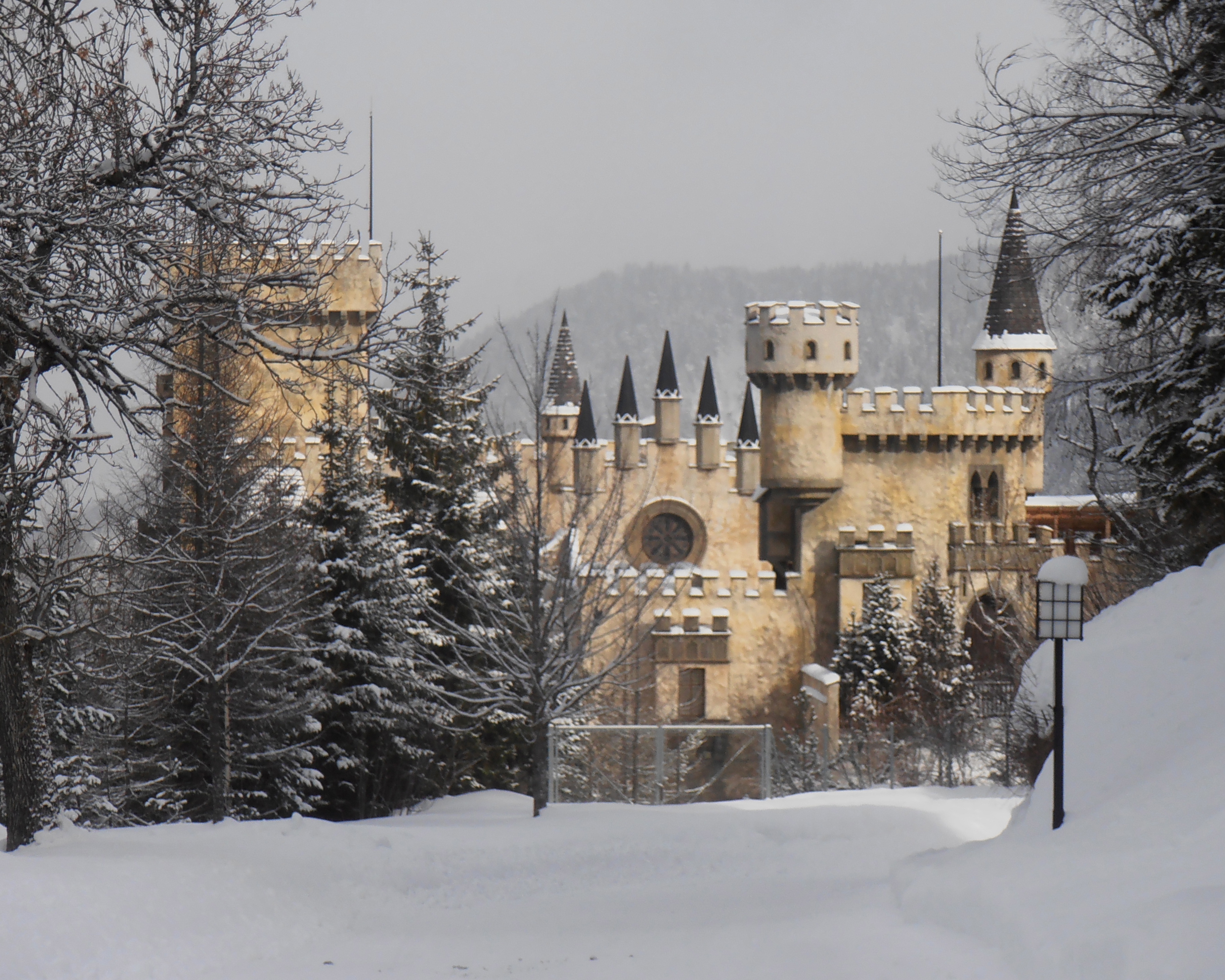
What was I thinking? The snow in Seefeld in Tirol is three feet deep, and where I wanted to go hadn’t been plowed all winter. But on the first official free day in two weeks (three if you factor in that I was actually home sick for those last free days), I was going stir crazy. So even though I was up to my knees in snow, I wasn’t going to let that stop me.

OLYMPUS DIGITAL CAMERA

Did you know that Sleeping Beauty’s castle lies in Tirol? Well, not the original (if there were one) but more like the Disney version, sitting alone in the woods, locked up and dark, waiting for a prince with enough capital to come and rescue it. This was actually a 1990s business venture called PlayCastle, a sort of Tirolean Sesame Place, an indoor-outdoor amusement park for children. It had a “Fun Dome” with online skating on three levels, a climbing wall, an “Adventure World” with video simulations, and who knows what else, prominently situated just outside of an alpine tourist resort town. Something for the family to do on a rainy day.They had expected 250,000 to 300,000 visitors annually. The place shut down after one year, and has been closed since I can remember. According to this site it’s currently being used as an events rental space and disco, although nothing looked remotely in use to me.

OLYMPUS DIGITAL CAMERA

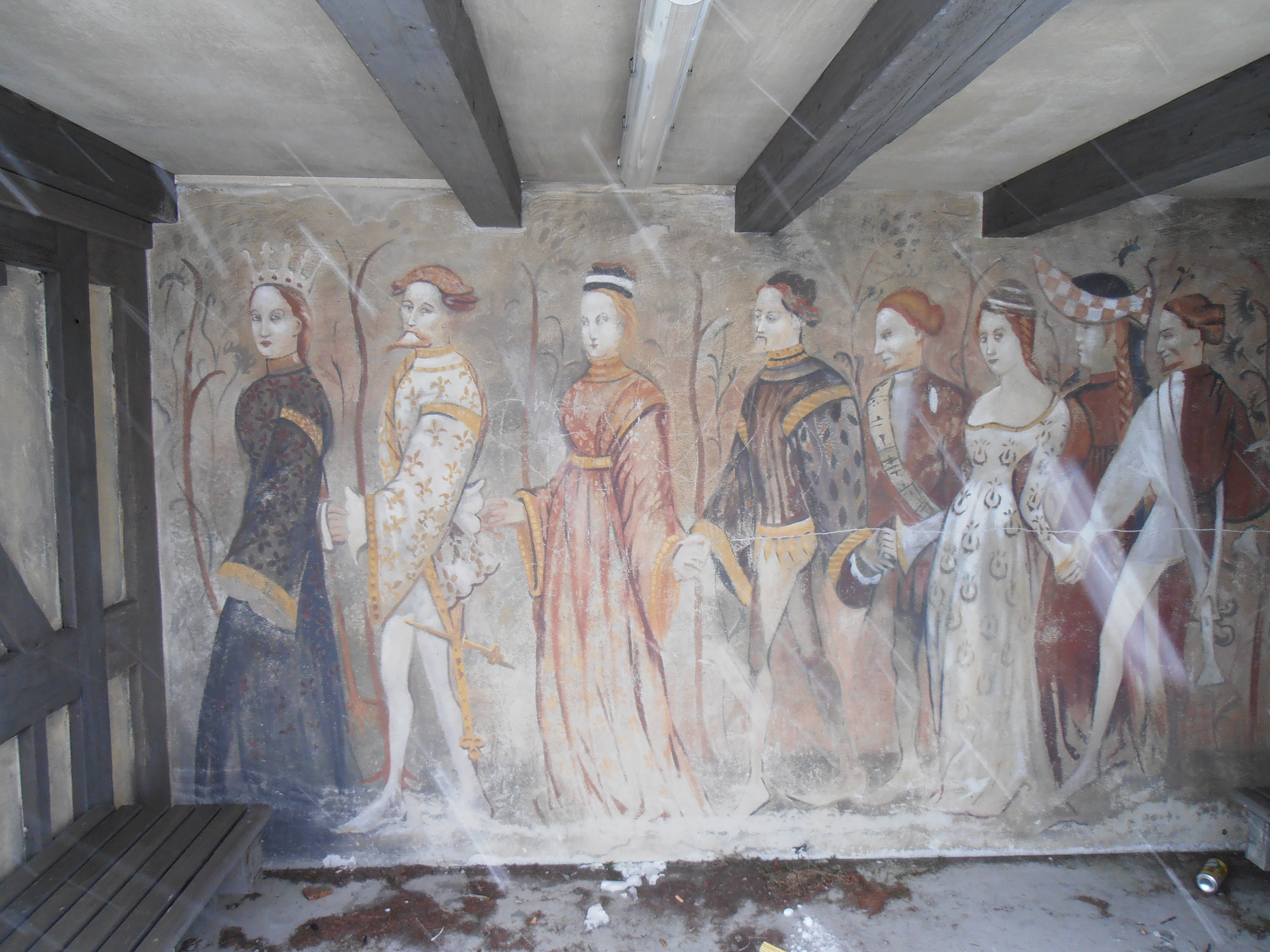
PlayCastle even has its own little fairy-tale rail station on the Mittenwald line, although in all my travels on that line I have never seen a train stop there. The ÖBB website doesn’t even recognize it as a stop, so I have to assume it’s been discontinued, even though the link directly above advertizes it as a way to get there.

OLYMPUS DIGITAL CAMERA

Inside the station, a wannabe-medieval fresco. Local kids are using the station to sit and drink, and who can blame them. At least someone is showing up.

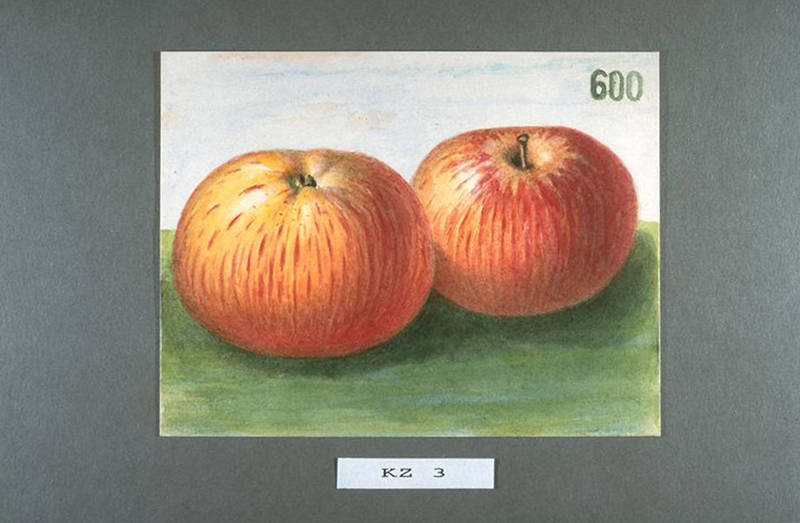
KZ 3 Apples

f016e97114

It was 80 years ago today that Hitler assumed power in Germany, and there are war documentaries all over the television airwaves. Actually one can almost always find a war documentary somewhere on tv, but they tend to cluster more thickly around the anniversaries. Anyway, I was watching an interesting one about the death marches from Dachau southward along the Starnberger See (they got as far as Seeshaupt, where they met American troops and the guards took off in a hurry). In one part of it, two sweet older women were talking about the decision to have a monument. One explained that she was looking for something other than a plaque or a stone, and remembered that there was a type of apple tree which had been bred in the Dachau Konzentrationslager (KZ), called KZ 3 (g). The man who had planted them, Korbinian Aigner, was a Bavarian priest who had been interned there, and who had been on those very forced marches and survived (the fruit is now officially named the Korbiniansapfel). A living memorial tree, the woman realized, would be a perfect kind of memorial to life.

Apparently they are very robust fruit trees. I wonder if they would take well to a large container. If so I may try to grow one myself.

Above, water color by Korbinian Aigner, around 1955. Image found here (g).

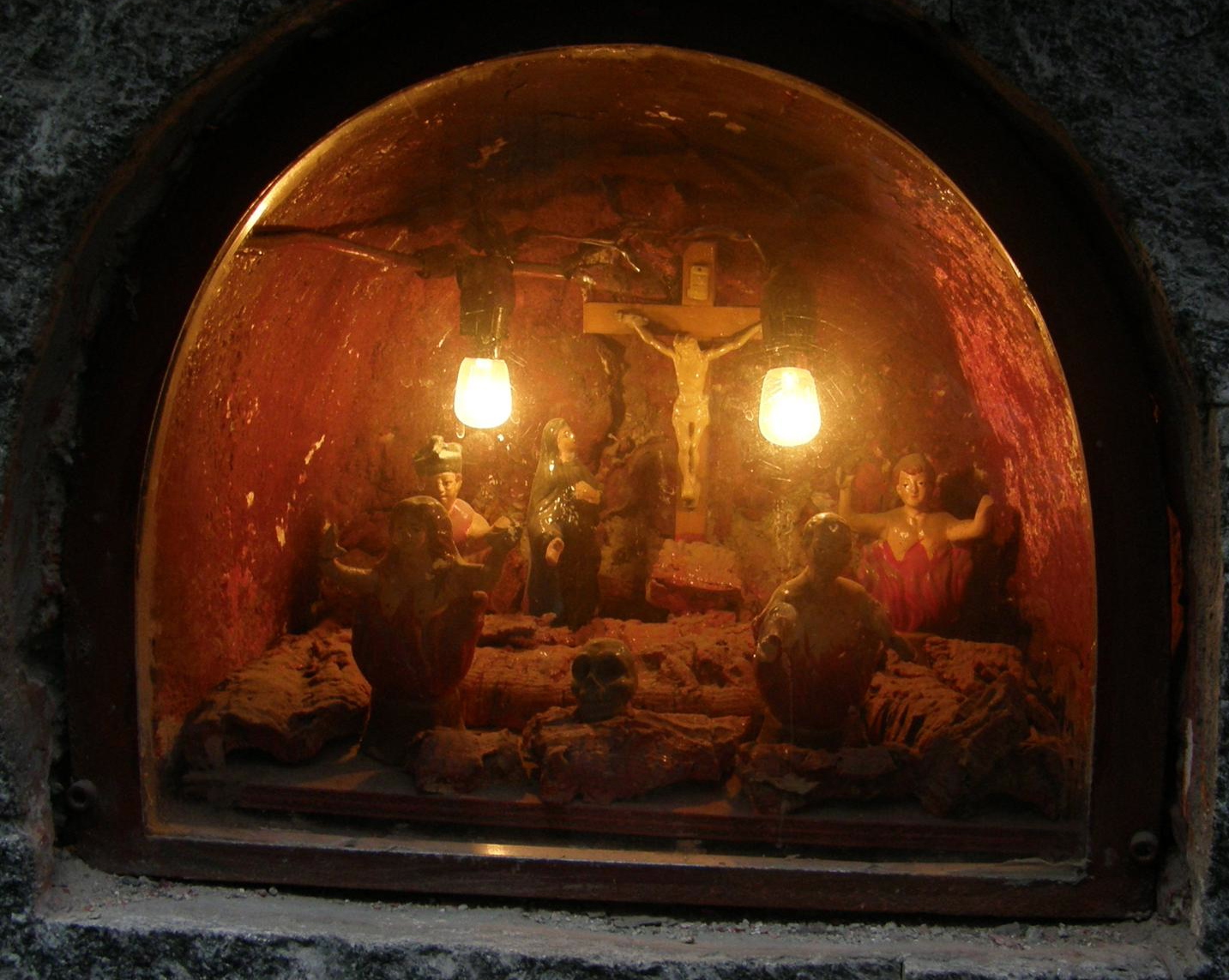
Hell Under Glass

While we are discussing concentration camps, here is a clip of Jake and Dinos Chapman discussing their work, “The End Of Fun”, which just finished showing at the Hermitage Museum in St. Petersburg, Russia. The camera zooms in quite a bit on this detailed, cast-of-thousands, miniature dystopian future, showing, well, their view of Hell. It’s not easy to describe, watch the clip. Lengthy but worthy of a look.

h/t to a commenter on a post at Club Orlov.

UPDATE: BONUS LINK. I knew there was another link I wanted to include here, but I had to wait until the fog of this Grippe cleared before I remembered what it was: here an article (with fascinating photos) of a rather unusual officers’ pow camp in Murnau, in southern Bavaria.

OLYMPUS DIGITAL CAMERA
UPDATE 2: Reader Paschberg sends this image of another representation of Hell, found embedded in a stone wall in Naples. Here the (burning) subjects seem to be aware of the glass, and press on it as if trying to escape.

KZ Reichenau Revisited

The event began with an audio recording of of a man named Klaus W., from Hippach (deep in the Ziller Valley), recounting the day the recruiters came to family’s home in the 1940s and said, “one (of you) must go” into labor service. He was chosen, to spare his parents and his sister. A simple story to give light to how these things had been done.

On a recent evening in January, the Wagnersche Bookstore (now owned by Thalia) hosted a presentation by Matthias Breit about Innsbruck’s concentration camp, in a part of the city called Reichenau. The main part of the evening included audio recordings of the recollections of Walter Winterberg, an Austrian man who had been interned there. What follows is a general summary of what we learned and heard on that evening. If I have made any egregious errors, please blame it on the bad head cold I’d brought along (and feel free to correct me.)

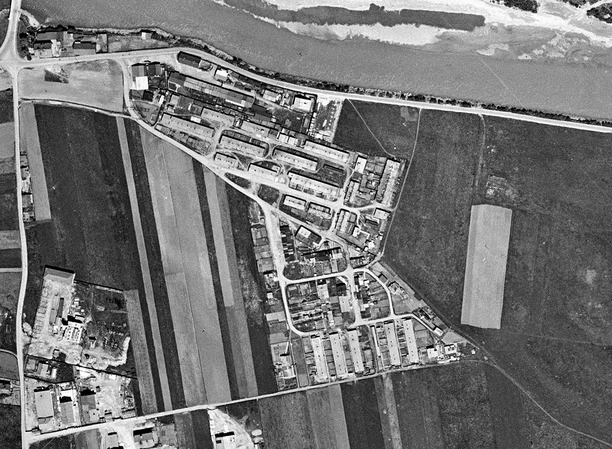
Reichenau Aerial

Reichenau was planned and built as a work camp for Italian (mostly) forced laborers who — for whatever reason — were labeled as in breach of their work duties (arbeitsvertagsbrüchig, how’s that word for you?) and in need of a little re-education. Many had probably tried to escape from the farms or factories to which they had been sent. Winterberg came from a Viennese family with some Jewish ancestry. Being a “Mischling“, he was ordered to report for a labor in the Reich’s air defence service. He went, then at some point decided to flee over the Swiss border and into France, in order to aid the French Resistance. (Little did he know that there were Swiss Nazi sympathizers at the borders then.) He was caught while still in Austria and sent to KZ Reichenau for several months before being sent on to Buchenwald.

Winterberg tells of a boy who had been brought from some eastern country, possibly Ukraine, who had suffered a bad work accident and, receiving no treatment, could no longer walk properly. He was then simply written off as unwilling to work, and sent to Reichenau. Another boy from the east, forced to work in southern Bavaria, had been accused of mishandling a child and sent off. This boy underwent the infamous punishment of being forced to strip naked in midwinter and being doused repeatedly with ice cold water until he died. These boys, and many others, were referred to within the camp as piccoli, “the little ones”, all around 12 to 16 years old. There were about 40 of them, and they mostly did maid’s duties: washing up, preparing food, etc.

He tells of Ukrainian inmates, young men, being sent out to clear debris after Innsbruck was repeatedly bombed in 1943. There were strict orders against any kind of looting, but a woman in town came up to one of the inmates and gave him a jar of marmalade. She probably thought she was helping him, and I hope for her sake that, when she died, she still believed that. In fact, when the jar was discovered by the guards, he was hanged.

Others came and went quickly enough to make acquaintance difficult. The average stay was 3 months. Many of the inmates arrived with no idea where they were, little if any idea where they would land next, and did not speak German. On the audiotape, Winterberg wonders aloud what happened to them all after the capitulation.

After the war’s end, the KZ Reichenau became a camp for displaced persons and later on some kind of public housing. It was torn down in the 1970s, to make way for the city’s recycling yard. A stone monument can be found nearby, at the side of the road.

The presentation was followed by an invitation to discussion, and this is where things got a little interesting and awkward. The first to speak, a man who looked to be in his 70s but who must have been older than that, said that he had been in the Wehrmacht and in a POW camp, and that upon returning, found no one interested in what he had gone through, since everyone believed that “all Wehrmacht were criminals”. He tried the “both sides did it” attack, an argument I have heard before, but found no sympathy among the other listeners. A second man said that one cannot look at history this way; this is an chronicle of what happened here in this place. We hear of Mauthausen and Dachau but this is a local story which needs to be heard.

A third man stood to say that he found Winterberg had “prettified” the situation in the camp by not stressing that it was in fact “ein durchgangsstation ins KZ” (“a way station to the concentration camp”, as if it were something not quite so nasty as a concentration camp itself). Breit reiterated several of the points made by Winterberg that the man seemed to have missed, that people were constantly being shipped in and out with little knowledge as to what would happen to them.

At this point my concentration skills were fading, I had a rather bad cold and my head was completely stopped up, but words were spoken to the effect that Winterberg didn’t have anything to complain about, he got through it well enough, he doesn’t mention anything terrible happening to him. Breit reminded the speaker that Winterberg states he was 49 kilos lighter by war’s end (108 pounds lighter ) This is where a woman spoke up and said: these are terrible things. When they are not dramatic enough, when this story, or this story, is not bad enough to make one find it terrible, then…

Breit wrapped things up: If too little horror appears in the reports of Reichenau, think then of the millions who passed through here, headed to their fates. This tale presented here is an historic reconstruction, not a tale of horrors. (This got me thinking of the recent need to make Holocaust stories ever more shocking. Simply being imprisoned and treated badly isn’t enough, the public wants some new godawfulness that they’d never heard of before. I thought until now that this was an American thing, but now I am not so sure.)

As we made to leave, two more listeners chimed in, not with opinions but with requests for their own projects. One man was researching another camp (I did not hear which), the other must have been Herr Muigg, who is gathering information about the Wehrmacht execution site on the Paschberg (de). I have seen his flyers posted there.

Update: thanks to information supplied by, believe it or not, a spammer , I have found that there was apparently another work camp called Reichenau, in the Czech Republic (Rychnov).
Weapons For The Gods

The Ferdinandeum (our provincial museum) is hosting an exhibit of early sacrificial offerings found in and around the Alps for military purposes (g*).

This is evidently something that people did over millennia — gave up offerings of weaponry and other war accessories for battles won, enemies routed or eliminated. The museum stresses that one not only can learn about the conquerors but also about the conquered by the qualities of their weapons.
The exhibit includes many artifacts recovered from Fliess, depots of bronze helmets, shields, swords and daggers, stone axes, Roman figurines. There are also some items on loan from the National Museum of Slovenia, recovered by this man, whose mission in the last several years has been to save the Ljubljanica River’s tens of thousands of treasure from diving treasure hunters and rich collectors. Moreover, that sword in his hand (or one very much like it) might be in the exhibit.
The time frame spans from early pre-historic stone items through the Celtic ages and into the Roman occupation, as the Romans did this as well.

* If you click on this link and then download the pdf “Rahmenprogramm” at the bottom, there is some additional information available in English and Italian.