Pagans In Tirol: The Medicine Woman from the Gurgl Valley

IMG_0632

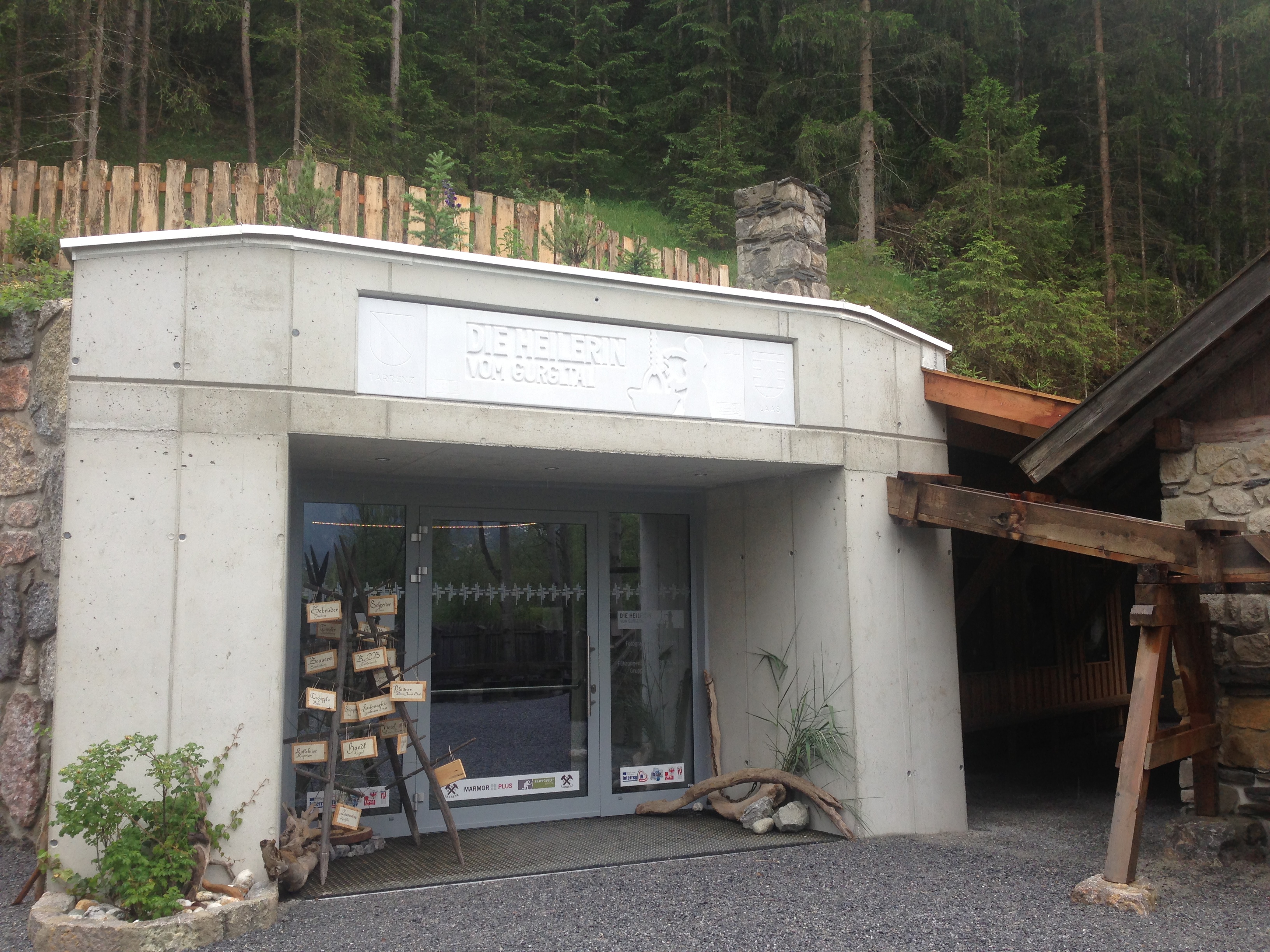
I persuaded a good friend to drive me to the village of Tarrenz (in the Gurgltal, north of Imst) to visit the brand-new museum built to house a fascinating archaeological discovery there — die Heilerin von Gurgltal, which more of less translates as the “Medicine Woman” from the Gurgl Valley. Alternately she’s referenced as being from the Strader Wald, or from the forest in nearby Strad. The story in a nutshell:

Tarrenz lies along the Via Claudia Augusta, one of the old Roman roads over the Alps. Hobby archaeologists are attracted to this area because of the artifacts that can be found along old roads. Some such treasure-hunters were combing the woods with a metal detector, and came across the first signs of something very interesting and ultimately very mysterious.

Eine Freundin fuhr mit mir neulich nach Tarrenz (im Gurgltal, bei Imst), um das nagelneue Museum der Heilerin vom Gurgltal zu besuchen. (Alternativ ist sie die Heilerin vom Strader Wald gennant.) Tarrenz liegt entlang der historische Via Claudia Augusta, ein Ziel für Hobbyarchäologen, wegen der Menge von Artifakten, die man neben alten Strasse finden kann. Ein paar solche Schatzsucher waren vor einige Jahren mit einem Metalldetektor im Strader Wald; dort stießen sie auf einen interessanten und mysteriösen Fund:
IMG_0628

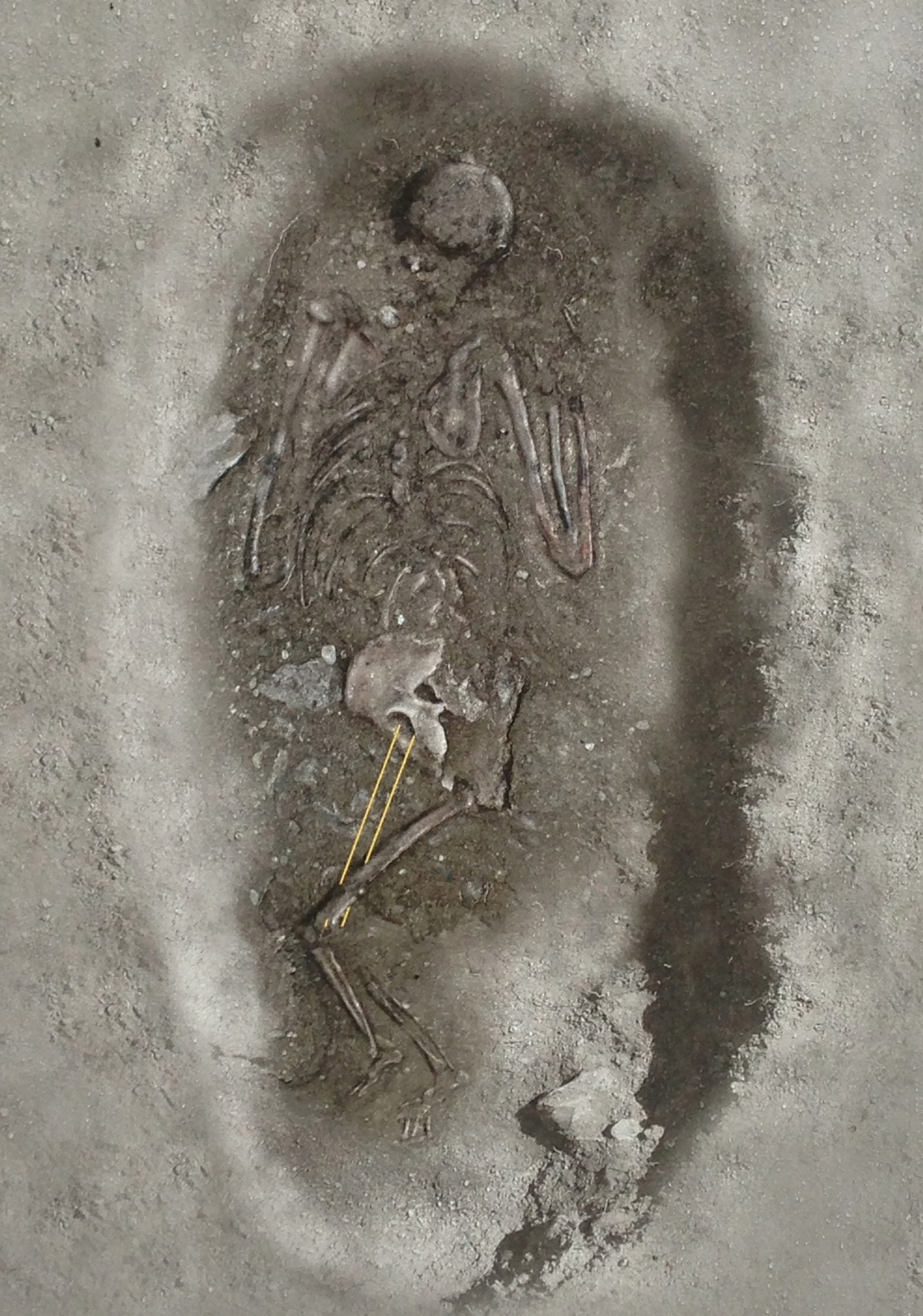
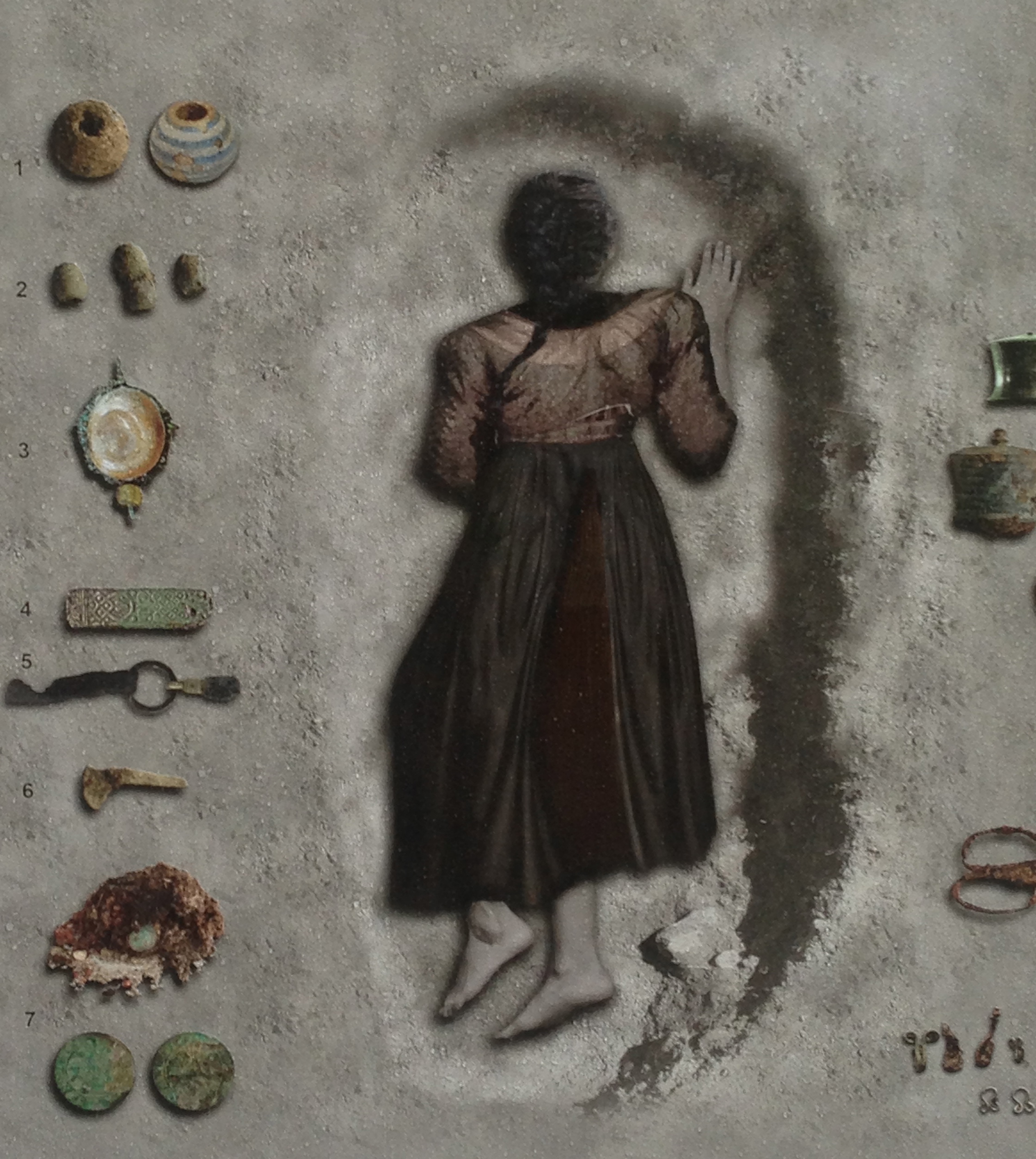
It was the grave of a woman, found lying face-down, along with a bounty of small and valuable objects — metal instruments such as scissors and keys, coins, pearls and crystals, a thimble, and — the headline-grabber —a set of metal cups used for cupping therapy. Dating places her having lived during the time of the 30 Years War, in the first half of the 17th century.

Das Grab einer Frau, in Bauchlage beerdigt, zusammen mit einer Menge kleine wertvolle Gegenstände — ihre Habseligkeiten. Eine Schere, eiserne Schlüssel, Münzen, Perlen, Kristallen, ein Fingerhut, und — meist interessant — ein Set Schröpfköpfe aus Metall. Hier der archäologische Befund. Die Frau lebte während der Zeit des Dreißigjahrigen Krieges.
IMG_0629

The circumstances don’t fit together in the usual way. She was buried quite far from the cemetery. A foreigner? A suicide? Possible Jenische*? She had, much like Ötzi did, her whole “professional kit” with her. Added to her grave as a kind of honor? Or thrown into it in a hasty burial? Then there’s the “face down” business, which normally is found to have been the custom for criminals. But she clearly hadn’t been executed as a witch, not with all those valuables in the grave with her, even though witch trials were very much in at the time.

Die Sachen passen nicht zusammen wie erwartet. Die Frau wurde ziehmlich weit weg vom nächsten Friedhof begraben. Eine Fremde? Ein Selbstmord? War sie Jenisch? Wie Ötzi, sie hatte ihre professionelle Werkzeuge dabei — wurden sie mit ihr mitbegraben, als ein Ehrenzeichen? Oder schnell hineingeworfen in Eile? Aber sie wurde gegraben mit Gesicht nach unten, wie man Kriminelle bestattete. Offensichtlich wurde sie nicht hingerichtet, sonst hätte man keine Grabbeigaben gefunden, obwohl die Hexenprozesse damals ganz in Mode war.

The museum tries to bring you in with carefully portioned experiences. First you hear  of the arts of healing as practiced in these parts, and how knowledge was handed down through generations. Then you learn about some actual cases from Tirol which involved persecutions due to superstition and fear. The antisemitic source — and consequences — of Anderl of Rinn is an example used.

Das Museum führt den Besucher vorsichtig in kleinen Etappen ein, vermutlich für die sehr junge Besucher. Man lernt von Heilkunde und wie das Wissen von Generation zu Generation übergeben wurde. Dann wird man gelehrt über wahre Öpfer von Aberglaube und Angst in Tirol, zum Beispiel die antisemitische Ursprung — und Folgen — der “Anderl von Rinn” Geschichte.

You are then ushered into to larger room to watch a short film combining the facts of the find (given by the head of the archaeology department at the University of Innsbruck, Professor Harald Stadler) with a dramatized version of what might have happened, using locals as actors. Their version involves a heathen midwife, banned from the community and the church (same thing back then) but nevertheless needed and called whenever someone got sick. A stillbirth is enough to have the villagers accuse her of witchcraft, and then tempers get hot, someone (guess who) gets killed, and a hasty, fearful burial is carried out in the forest. Entirely plausible — although often the truth is a lot more boring (she died of illness, her outsider travelling companion(s) buried her as best they could, and moved on?)
After the film ends, you finally get to see the skeleton and the artifacts, laid out under glass with plenty of information about their provenance and uses. The tour guides — a husband-and-wife team — are very much involved in the project and were able to answer questions in depth.

Man kommt dann in einer Halle und ein Kurzfilm läuft. Archäologische Details (von u.a. Universitätsprofessor Harald Stadler) alternieren mit einer Dramatisation von der Geschichte — also, was hätten passieren könnte — mit einheimische Mitwirkenden. In ihrer Fassung, ist die Frau eine Außenseiterin, eine heidnische Hebamme und Heilerin, aus der Gemeinde verbannt, dennoch in Krankenfälle immer wieder gerufen. Ein Totgeburt führt zur Vorwürfe von Hexerei, die Frau getötet und in Angst und Eile im Wald begraben. Alles schon möglich — obwohl die Wahrheit ist oft weniger interessant.
Dannach darf man den Skelett samt Artifakten (in Vitrinen) -endlich- sehen. Die Führer — ein Ehepaar — sind im Projekt involviert und konnte viele Fragen reichlich antworten.

If you go: the Museum der Heilerin von Gurgltal; is located within another, outdoor museum called Knappenwelt, which is a recreation of a small mountain mining industry from the olden days. You can buy a ticket for either, or in combination. Drive to Imst and then north on the 189 toward Fernpass. It’s trickier if you don’t have a car, but apparently this tourist shuttle will get you there from “downtown” Imst to the Knappenwelt. You’ll still have to walk from the Imst station, which is a bit removed from town.

Anfahrt: das Museum befindet sich in der “Knappenwelt”, ein Freilicht Museum. Von Imst kommt man mit dem Strasse Nr. 189 richtung Fernpass nach Tarrenz. Ohne Auto wird’s schwieriger, aber wenn man in Imst von Bahnhof ins Zentrum geht, findet man den Bummelzug “Bummelbär”, der macht einen Tour von Imst nach Strad mit Zwischenstops.

*Jenische is a name used for a certain nomadic people in Europe. They are not related to the Roma or Sinti — in fact they may not be an ethnic group at all but fall under the generic category “gypsy”.  Wikipedia likens their language to Cockney.

Kulturblogging: Hildegard Knef

When you spend more than a couple of years in another country, you may begin to realize how much the people around you, while possibly being very much like you, grew up on different pop culture. The American entertainment industry being what it is, they are sure to know many of our well-known pop singers, film actors, athletes and the like, but underneath that they have a whole trove of memories of other famous and successful figures, may of which we Americans have either never heard of, or have forgotten, or whom we did not notice because they worked on the peripheries in the international scene (such as Susanne Lothar). We may not call them minor, because they were not. They just didn’t have a large American following. (Many might leap to the conclusion that, if you’re not big in the USA, you haven’t “made it”, to which I say, open your eyes.)

Knef

So it is with Hildegard Knef. I knew that she had done some work in Hollywood (as “Hildegard Neff”) but did not know that her handprints are there in the concrete, with those of many other stars, in front of Grauman’s Chinese Theater.

She started out by being discovered at 18, while training to be an animation artist for the UFA film studio in Berlin, by the head of that studio. A year later she was having an affair with the Reich’s Chief Dramaturg, Ewald von Demandowsky (this would be 1944). She was gorgeous, extremely photogenic, highly intelligent, and one assumes that powerful men were falling over themselves to advance her career.

In a nutshell, her career was tempestuous. In 1948 she signed a 7-year contract with David O. Selznick, wherein she was paid lucratively for English lessons and screen tests, but was cast in no roles. In 1950 (now with American citizenship), she returned to Germany to appear in the film Die Sünderin. With its taboo themes of prostitution and suicide, not to mention a brief nude scene, the film scandalized the country: protests, counter-protests, banning in many cinemas. The Roman Catholic Church in Germany protested primarily that the gist of the film resembled the infamous Nazi euthanasia propaganda film Ich klage an. Twenty five years later in America, a mercy killing could be shown in a film like One Flew Over The Cuckoo’s Nest, but coming right out of the Nazi years in Germany, it was apparently  too soon.

She began a genuine singing career with the release of her first album in 1951. Her voice is clear (if unusually low, probably from all the cigarettes) and her singing style is confident and breezy, in that speaking/singing mix that was so popular in the day, but lets out a sort of dignified containment of emotion, a way of revealing pain without the least bit wallowing in it. Ella Fitzgerald later called her “the best singer without a voice”.

Here a song in English, “Too Bad” from 1969. The person who uploaded this put together an amusing collage of internet images to accompany the song.

Ostracized in Germany from the fallout from Die Sünderin, Knef returned to Hollywood and finally got to appear in a row of films, some good, some forgettable. She was the first (perhaps still the only) German to appear in a leading role on Broadway, in Cole Porter’s Silk Stockings. On the success of her international singing career, she returned to Berlin, enjoyed the spotlight on German television appearances, had a child, battled breast cancer, wrote a few memoirs, and generally made for constant headlines in the tabloids.

Here Knef singing “Aber schön war es doch”, from a television broadcast in 1963. The song lyrics tell of bittersweet memories of a last meeting, (“but it was beautiful”), and every detail — with bench, the trees in bloom, the words he’d spoken — is lovingly remembered.


“Written off” in Germany, she fled back to Hollywood where she did some film work but never really got her foot back in the door. In the 80s she played Fräulein Schneider in the musical Cabaret at the Theater des Westens in Berlin, and in 1989 moved back to German for good, heavily in debt. In her 60s, she began to be seen as one of those living legends (as so often happens to people who manage to still be around after the dust has settled), was awarded lifetime achievement prizes, appeared on talk shows, put out a (very successful) album of songs. In 2001 she got her German citizenship back. In 2003, she died of pneumonia, at the age of 76, just two weeks after her last televised interview. Working — and being in demand — until the end.

Image found here.

A Belated Memorial Day Posting

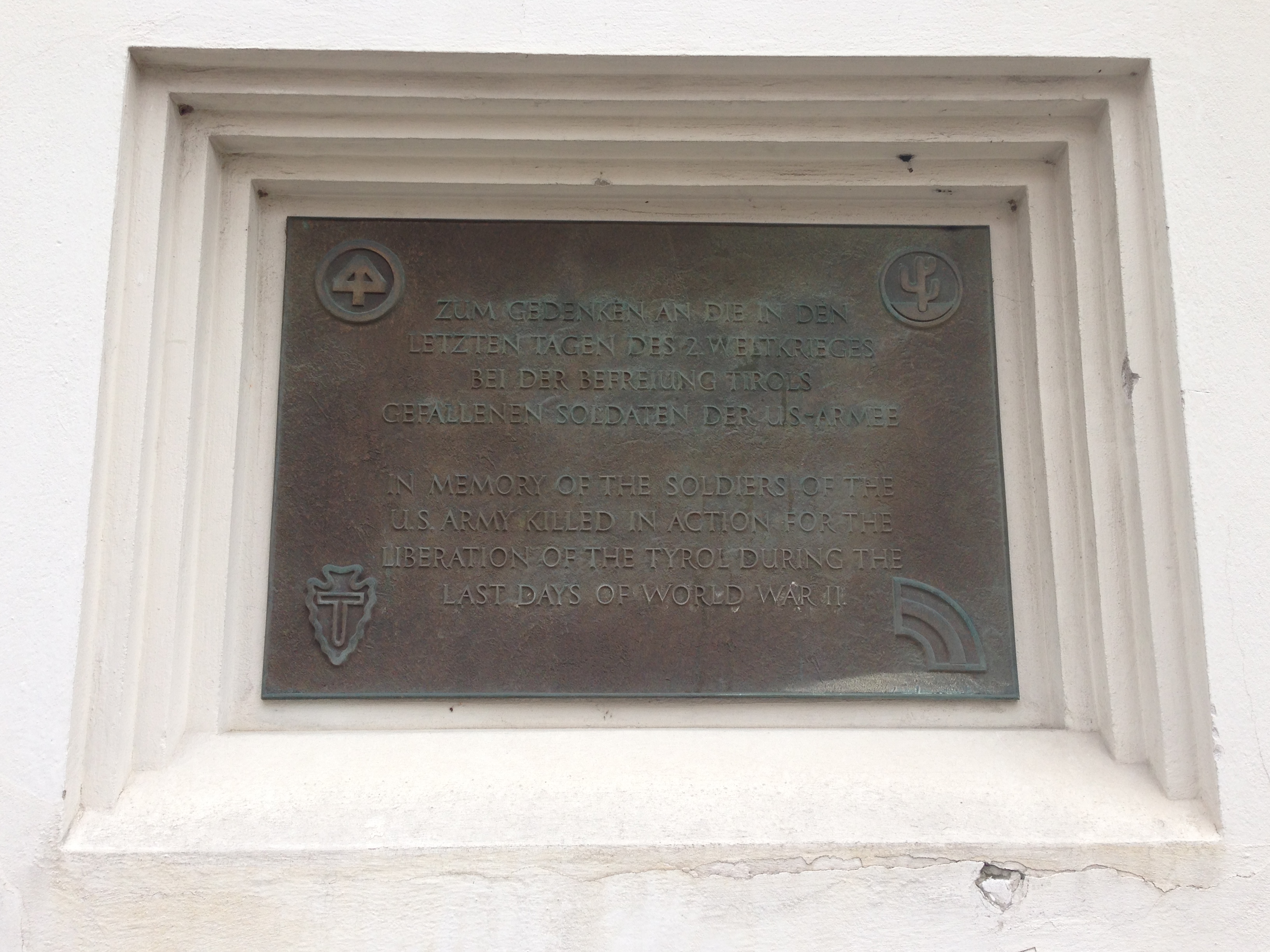
I realized too late that I had this photograph in my computer, and that it would fit nicely for Memorial Day.

IMG_0350

This plaque is recessed into the wall between Franziskanerplatz and the courtyard behind the Hofkirche. In my 13 years’ residence in Innsbruck, I had never noticed it, until one day I did. If you’re having trouble reading the text, it says:

Zum Gedenken an die in den letzten Tagen des 2. Weltkrieges bei der Befreiung Tirols gefallenen Soldaten der U.S.-Armee.

In memory of the soldiers of the U.S. Army killed in action for the liberation of the Tyrol during the last days of World War II.

(I don’t know what the symbols represent, I assume the service organizations who sponsored the plaque. The cactus is particularly charming.)

UPDATE: I found them! The symbols are division insignia of the US Army. Top left, 44th Infantry (a mirrored “four”). Bottom left, 36th Infantry “Arrowhead”. Bottom right, 42nd Infantry, “Rainbow”. Top right, 103rd Infantry, “Cactus”.

Susanne Lothar

daslebenderanderen_article

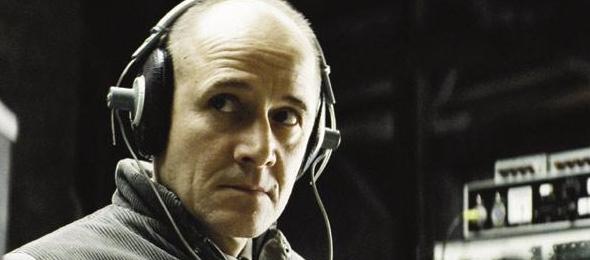
Have you seen the 2006 German film “The Lives of Others”? (Original title: Das Leben der Anderen) You may recall the wonderful actor Ulrich Mühe, who played the conflicted Stasi agent, and who died of cancer in 2007, just after the film’s release.

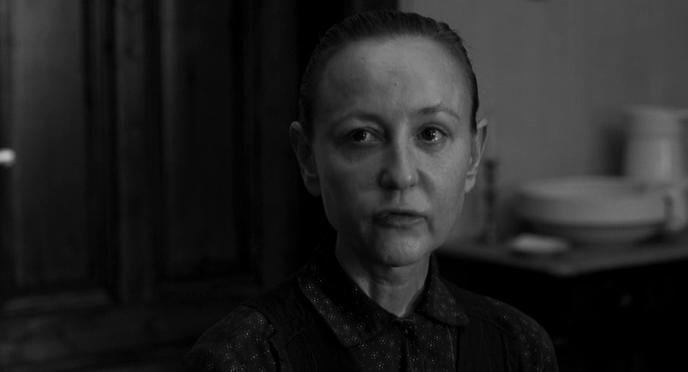
I tell you this as background to a rather sad but touching story. Last night I finally watched the whole of Michael Hanecke’s Das weisse Band (English title: “The White Ribbon”). It’s a difficult film to sit through, I found, but worth the discomfort. It’s beautifully made, and the performances are incredibly riveting.

pic_903330

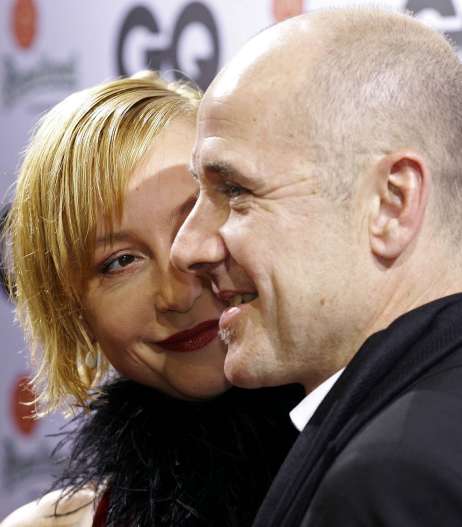
I found myself looking up the cast list the next morning, as I had recognized only two or three of the actors. One whom I hadn’t known (or at least hadn’t recognized) but who had made a considerable impression on me was Susanne Lothar, who played the midwife. A little online research brought her more clearly into focus, and brought back something I had half-heard mentioned last summer. Susanne Lothar was married to Ulrich Mühe. They had met in 1990 as Mühe’s second marriage was ending (he had just come out of East Germany, and after the Wall fell all sorts of unpleasant things started coming to light, such as the fact that Mühe’s second wife had supplied information about her husband — unwittingly, she claimed — to the Stasi. When later asked how he had prepared for his role as a Stasi agent in “The Lives of Others”, he answered, “I remembered.”)

Mühe did a lot of film and TV work, but Lothar was a stage actress, the unsettling kind which one finds in the best German theaters. She had a special talent for portraying the fragile, the damaged, the soul in pain.
When Mühe became ill, they kept it to themselves. Shortly after his appearance at the 2007 Academy Awards, he underwent surgery for stomach cancer. He died on July 22 of that year.

8555571-Leute-News_Ul_1061a

On July 21 2012, just one day short of the fifth anniversary of Mühe’s passing, Lothar died. The cause of her death, to my knowledge, has never been made public. It is assumed that she took her own life. She was 51. One can imagine that she believed that five years without him had been enough.

Images found here, here, and here.

The Viereckschanze in Utting

UttingSchanze1

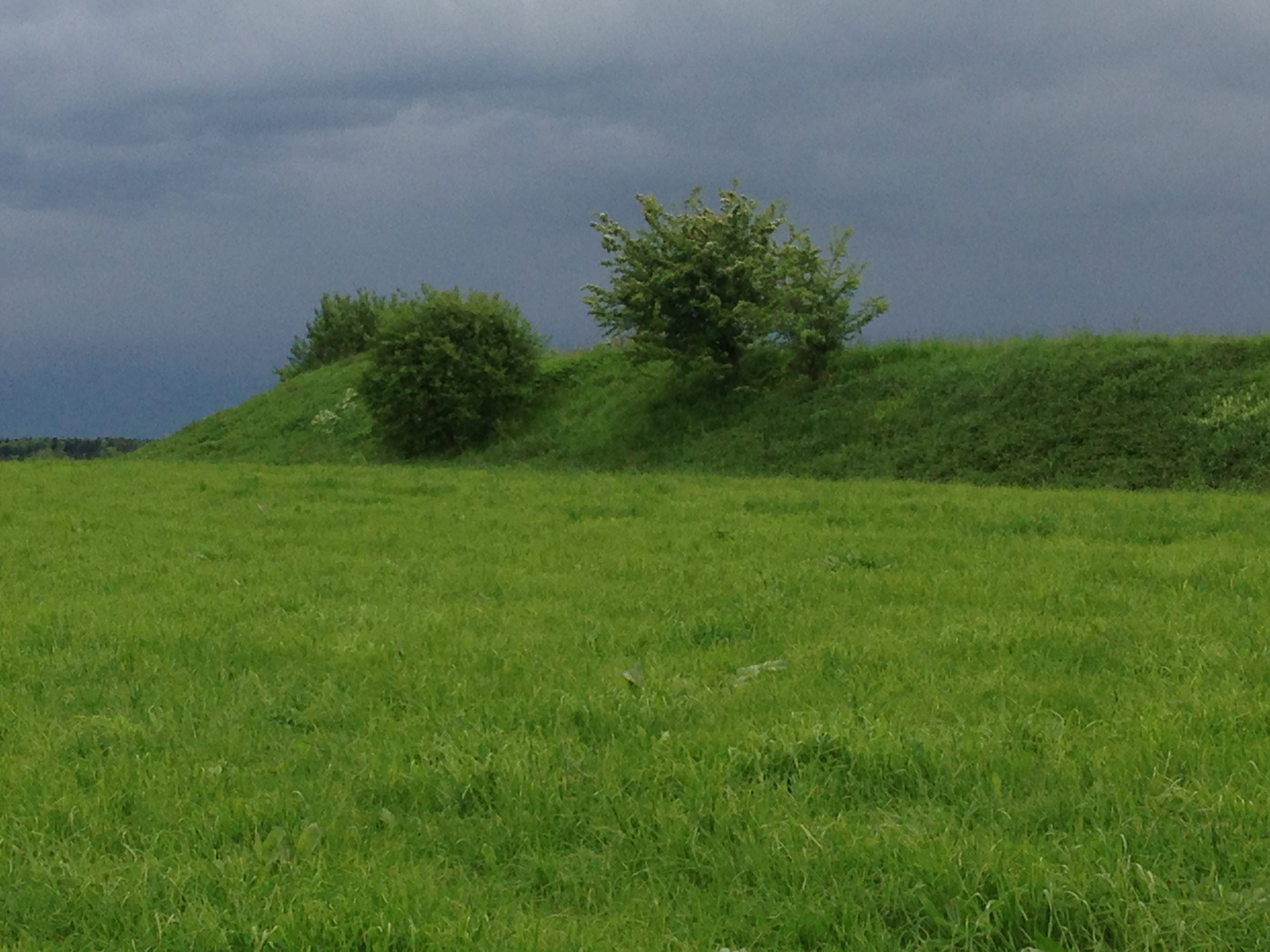
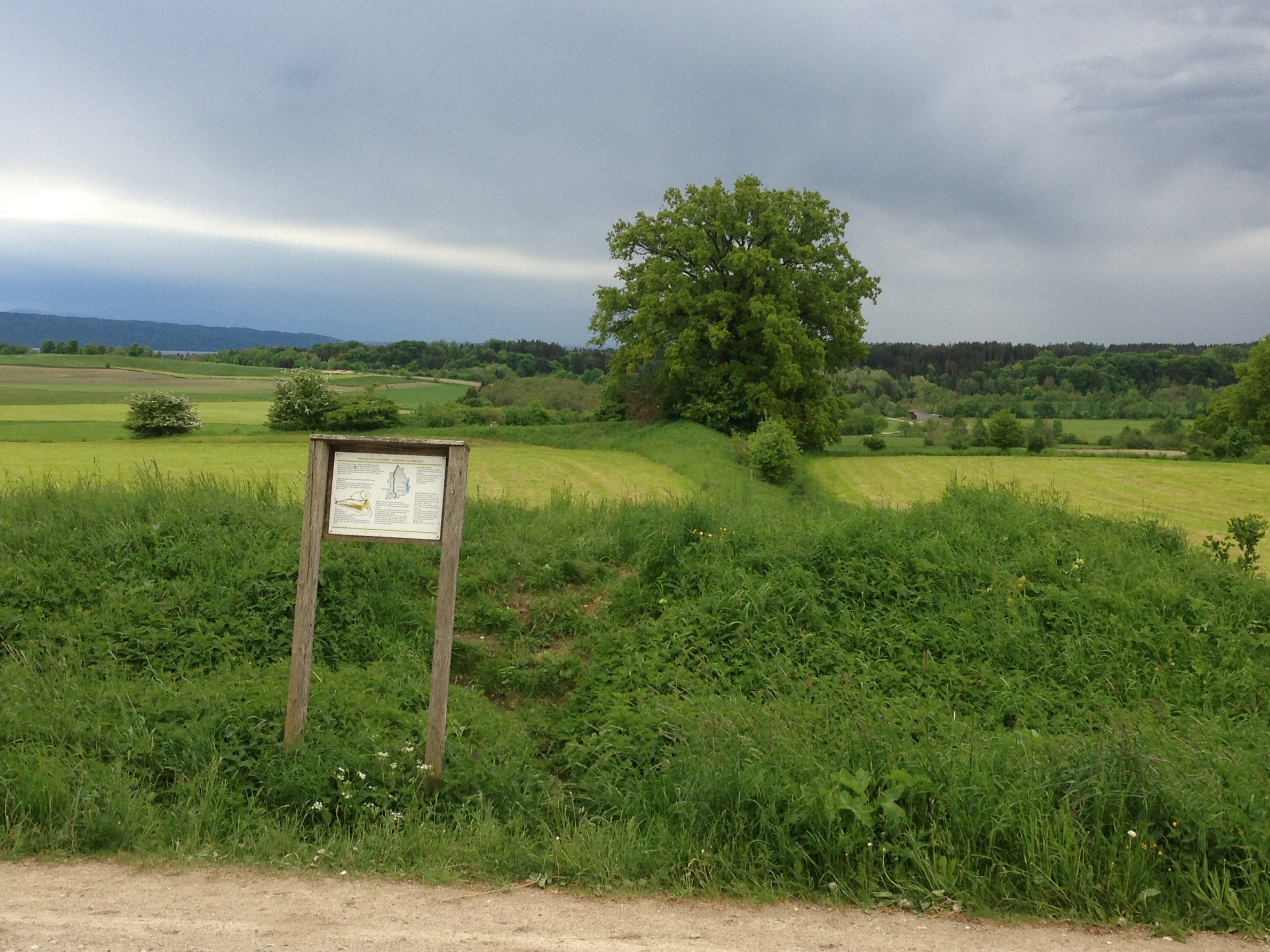
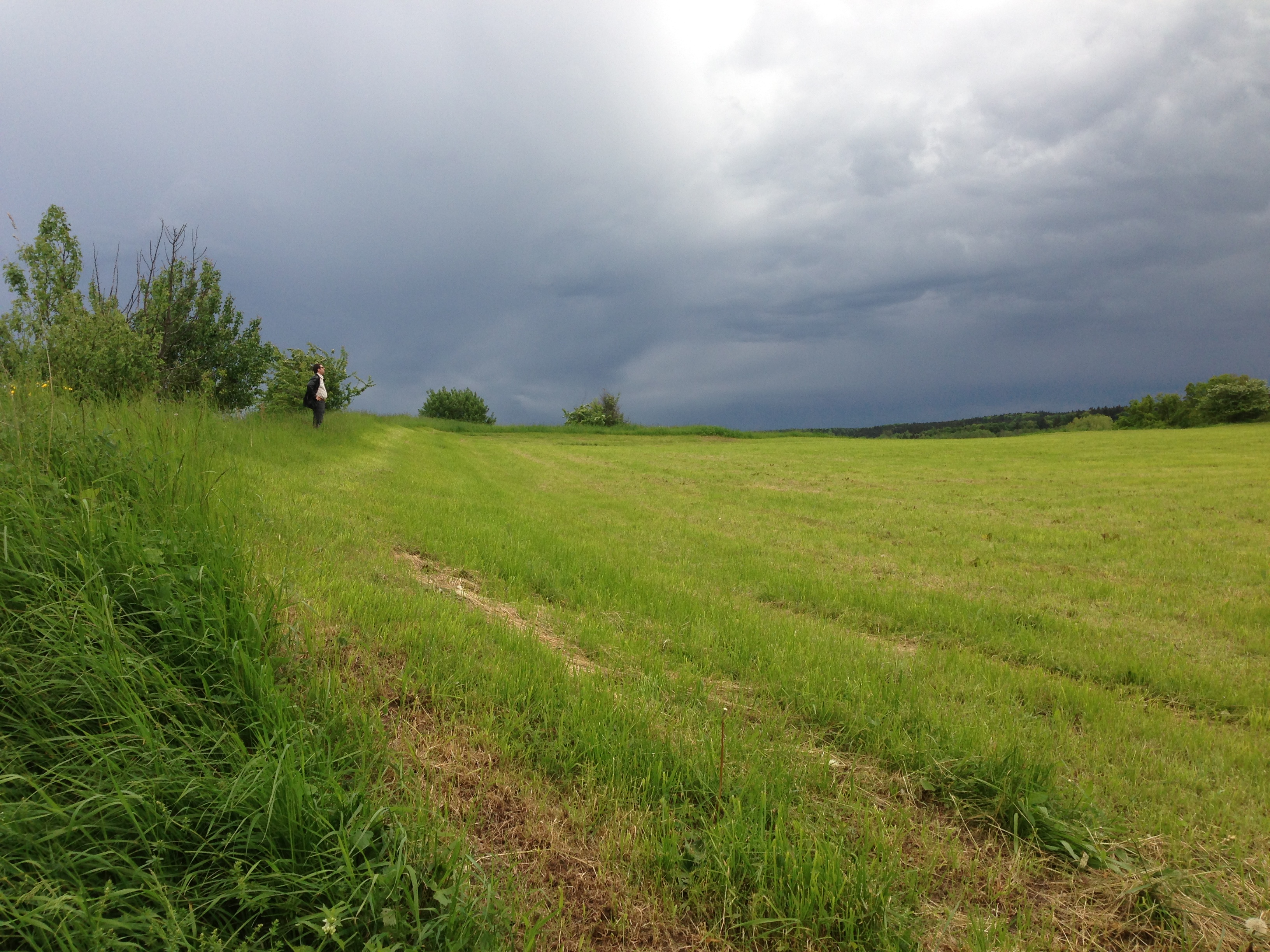
I previously blogged about the village of Utting am Ammersee in connection with the small, hidden cemetery for nearby concentration camp victims there. Today I have another unusual place to show you — the rectangular earthwork (Viereckschanze) in the fields just west of the village.

Uttingschanze3

This earthwork was built around 200-100 B.C., in the late Iron Age, by the people we call Celts. According to local sources the Roman Via Raetia (laid down after 15 A.D.) passed right by here, possibly within a few meters of the earthwork.

UttingSchanze2

There are approximately 150 such earthworks of this kind (not including grave mounds and other types) surviving in whole or in part today in Bavaria alone. The one in Utting is one of five in the county, and an unusually large one with an inside area of 12,000 square meters.

Uttingschanze4

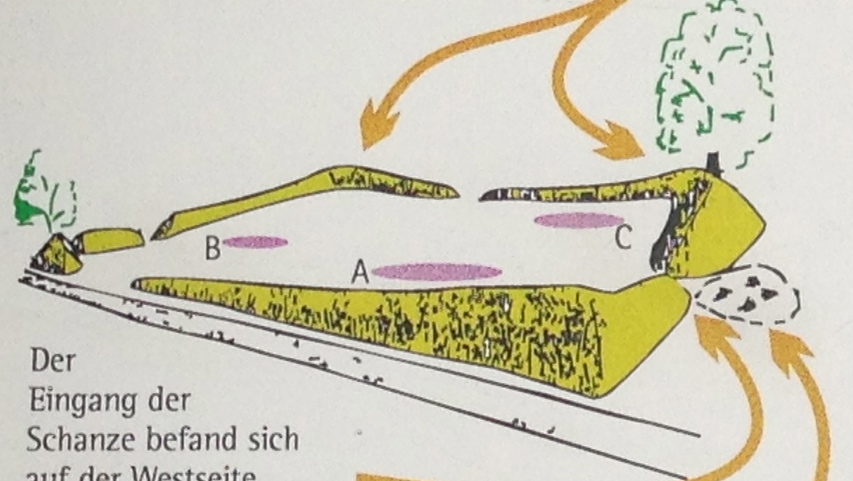
According to information given on-site, research of some kind (a divining rod is mentioned) has revealed evidence inside the enclosure of the existence of A) small buildings, B) a sacrificial site, C) a hole with wooden support walls.

I have to add here that the western side of the Ammersee, we are learning, is some kind of hotspot for the esoterically-minded, and evidently has been for quite some time, as least as early as the 1920s. The sign at this earthwork clearly reflects this, with breezy assertations that the small buildings were temples, the hole was for divining energies, that the whole thing was primarily used for “cult-religious purposes and activities, teaching and passing on of traditions, adjudication, observance of nature and the heavens.” It goes on to say that

the Celts lived in close harmony with the laws of nature. They sensed unseen active entities, forces and energies. They built their ritual sites on places with particular characteristics. These phenomena can evoke internal visions, colors, sounds or moods even today in people who are especially attuned to listening to them.

(translation mine)

Now, there may be something to the idea that people of all eras feel a certain affinity to certain places. I have come across some theories that medieval churches were built on pagan sites not just to wipe out the old gods but to capitalize on the good vibes attributed to the particular place. That’s plausible. Certainly the Celts were more in tune with the laws of nature, as were all people living at the time. But the idea that these earlier people had time to spend tuning into the universe, observing nature and digging the force fields is, to me, a bunch of hooey. Sure, this Schanze may well have included some religious purpose, in the sense that one might feel the need to pray to one’s gods while barricaded inside. These earthworks offered protection, possibly against invaders, or animals (bears, wolves, wild boars). They offered a good surveillance view of the surrounding lands. They offered safe places to keep foodstuffs and materials (leather, bone, wood) awaiting processing. Sure, the Mayans and the Egyptians built pyramids (or, better said, their kings and pharoahs made them do it.) I cannot believe  that the Celts were not too busy, just from trying to get through the winter, to expend time and energy on this sort of thing for the express purpose of being One With The Universe. Perhaps they had one Shaman who did that, and it was built for him (or her.) But then, we are back to today’s system, with a village of farmers and one parish priest. Perhaps the most powerful families maintained these enclosures, like an Iron-Age version of the Kennedy Compound. Many large farms around here have their own little chapels on their grounds (in fact you can have one built these days — we watched one go up in Eching, passing that farm regularly.) Since we are walking around today with basically the same faculties as our ancestors had 50,000 years ago, I see no reason to believe that the people who built the Schanzen were any more enlightened than today’s modern Bauer.

Still, it’s quite something to be on an earthen structure which has survived over 2000 years.

If you go: you can find the earthwork very easily on Google Maps (WNW of Utting, no coordinates needed:just  look for the word “Keltenschanze”). There is parking just off the ST2347 (Landsberger Strasse) and then it’s a few minutes walk on well-maintained gravel roads.

“It’ll Be A Hot Day Today”

IMG_0352

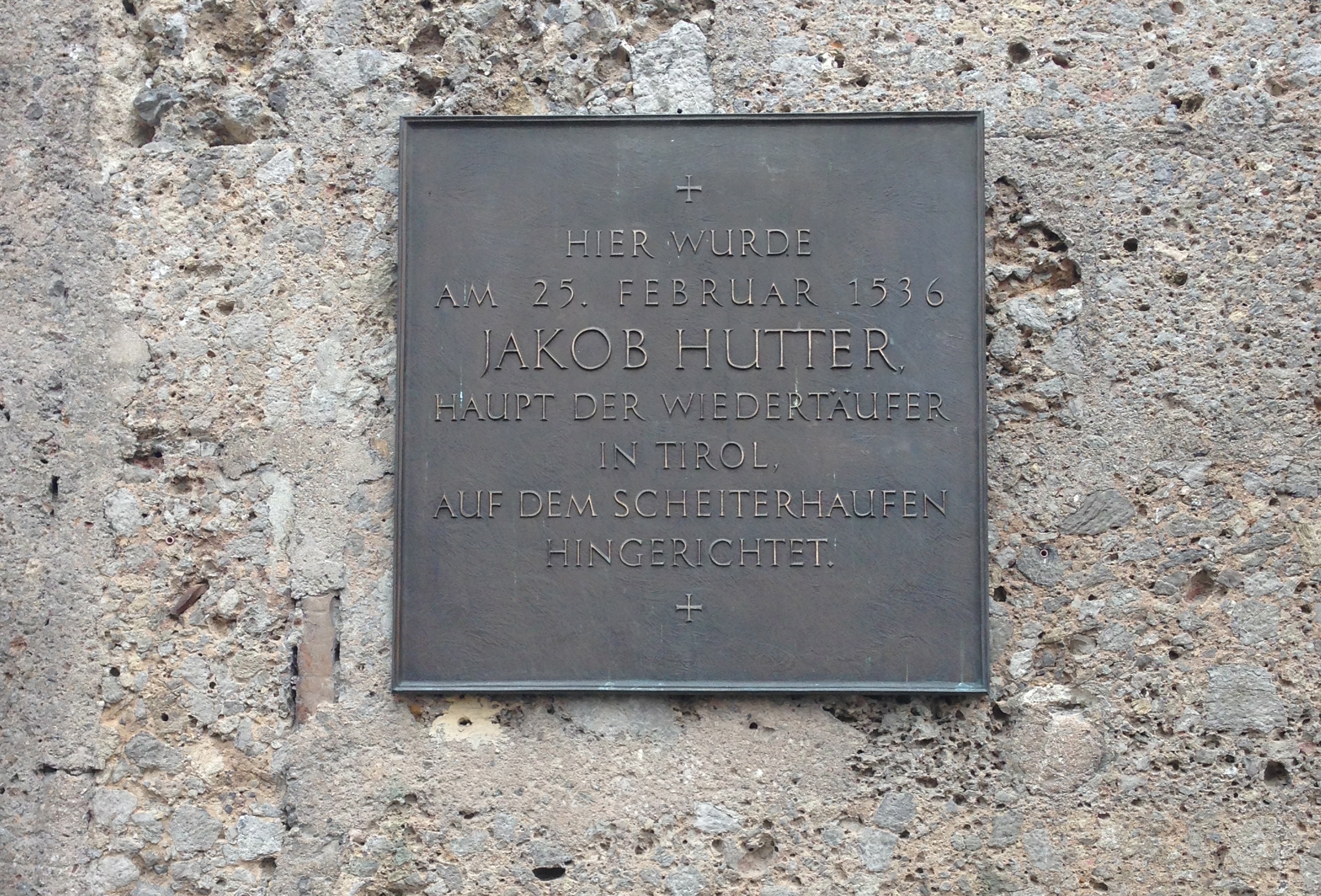
This plaque, found on the stone wall underneath the Golden Roof in Innsbruck’s old town, says: Here, on 25 February 1536, Jakob Hutter, head of the Anabaptists in Tirol, was burned at the stake.

Jakob Hutter was born in what is now South Tirol, in northern Italy. After he joined the Anabaptists, he began to preach and form small congregations in the region. Tirol was persecuting Anabaptists, so Hutter eventually followed many of his fellow believers to Moravia (part of what is now Czech Republic), where conditions were a little better for them. (The Moravian Church, not related not directly related but a possible antecedent to Hutter’s Anabaptists, got their name for this same reason — they had left Saxony for Moravia to escape religious persecution, and the name stuck when they moved elsewhere. Their founder, Jan Hus, was also burned at the stake.)

Good times in Moravia only lasted so long, however, and in 1535 the Hutterites were expelled. Jakob Hutter returned to Tirol, was soon afterward arrested, tortured, pressured to recant and inform on his fellow church members. He resisted, and was sentenced to burn. His wife was able to flee, was however later caught and executed at Schöneck Fortress in South Tirol. Online sources in German indicate that men were burned or beheaded, women drowned, and that 360 Anabaptists were executed in Tirol.

Yet another Tirolean burned at the stake was Mathias Perger, known as der Lauterfresser (g), which translates roughly to the Soup Eater. Perger was what one might call today a free spirit, occasionally working, learned in reading, writing, and astrology. In other words, someone the church considered dangerous. He was arrested on charges of witchcraft and “weather-making”, confessed under torture to such medieval horrors as “desecrating the Host”, and executed in 1645 in Mühlbach (near Brixen/Bressanone).

While Hutter was clearly pious (just the “wrong” religion), the Lauterfresser was odd enough (and perhaps heathen enough) for legends about him to crop up over time. He plays tricks on fellow inn patrons. He makes chickens fly over to the next field and lay their eggs for their owner’s neighbor. He changes at will into a bear and, for sport, chats with the hunting party trying to track it down. The legends make him a sympathetic, clever figure, a sort of alpine combination of Till Eulenspiegel and Fred and George Weasley, if you will. The quote in this title are his alleged words — “Das wird ein heißer Tag heute” — as he was fetched to be taken to the pyre.

BONUS LINK: And speaking of legends, a 1,200-year-old Coptic Egyptian text, recently translated, is found to tell the story of a shape-shifting Jesus who dined with a well-intentioned Pilate before his death. I suppose that it shows, like the stories of the Lauterfresser, that we humans want to hear these stories and be amazed.

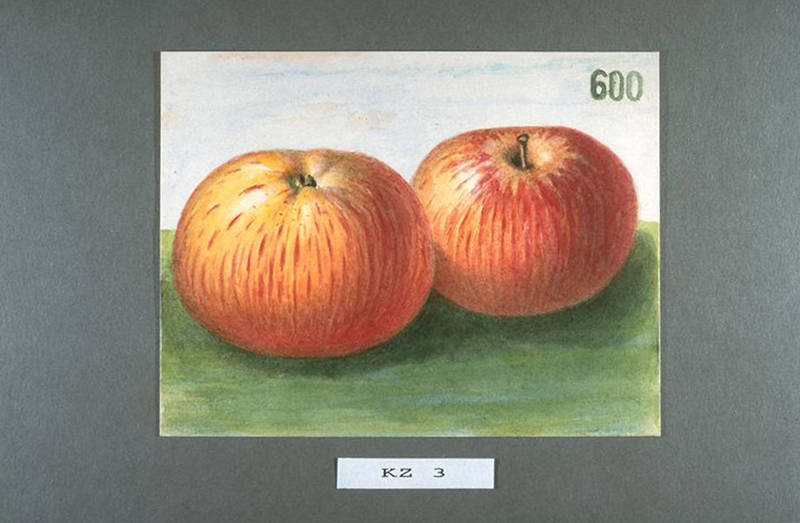
KZ 3 Apples

f016e97114

It was 80 years ago today that Hitler assumed power in Germany, and there are war documentaries all over the television airwaves. Actually one can almost always find a war documentary somewhere on tv, but they tend to cluster more thickly around the anniversaries. Anyway, I was watching an interesting one about the death marches from Dachau southward along the Starnberger See (they got as far as Seeshaupt, where they met American troops and the guards took off in a hurry). In one part of it, two sweet older women were talking about the decision to have a monument. One explained that she was looking for something other than a plaque or a stone, and remembered that there was a type of apple tree which had been bred in the Dachau Konzentrationslager (KZ), called KZ 3 (g). The man who had planted them, Korbinian Aigner, was a Bavarian priest who had been interned there, and who had been on those very forced marches and survived (the fruit is now officially named the Korbiniansapfel). A living memorial tree, the woman realized, would be a perfect kind of memorial to life.

Apparently they are very robust fruit trees. I wonder if they would take well to a large container. If so I may try to grow one myself.

Above, water color by Korbinian Aigner, around 1955. Image found here (g).

KZ Reichenau Revisited

The event began with an audio recording of of a man named Klaus W., from Hippach (deep in the Ziller Valley), recounting the day the recruiters came to family’s home in the 1940s and said, “one (of you) must go” into labor service. He was chosen, to spare his parents and his sister. A simple story to give light to how these things had been done.

On a recent evening in January, the Wagnersche Bookstore (now owned by Thalia) hosted a presentation by Matthias Breit about Innsbruck’s concentration camp, in a part of the city called Reichenau. The main part of the evening included audio recordings of the recollections of Walter Winterberg, an Austrian man who had been interned there. What follows is a general summary of what we learned and heard on that evening. If I have made any egregious errors, please blame it on the bad head cold I’d brought along (and feel free to correct me.)

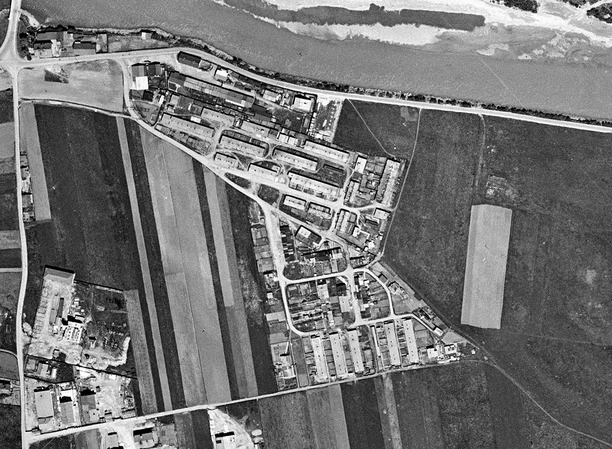
Reichenau Aerial

Reichenau was planned and built as a work camp for Italian (mostly) forced laborers who — for whatever reason — were labeled as in breach of their work duties (arbeitsvertagsbrüchig, how’s that word for you?) and in need of a little re-education. Many had probably tried to escape from the farms or factories to which they had been sent. Winterberg came from a Viennese family with some Jewish ancestry. Being a “Mischling“, he was ordered to report for a labor in the Reich’s air defence service. He went, then at some point decided to flee over the Swiss border and into France, in order to aid the French Resistance. (Little did he know that there were Swiss Nazi sympathizers at the borders then.) He was caught while still in Austria and sent to KZ Reichenau for several months before being sent on to Buchenwald.

Winterberg tells of a boy who had been brought from some eastern country, possibly Ukraine, who had suffered a bad work accident and, receiving no treatment, could no longer walk properly. He was then simply written off as unwilling to work, and sent to Reichenau. Another boy from the east, forced to work in southern Bavaria, had been accused of mishandling a child and sent off. This boy underwent the infamous punishment of being forced to strip naked in midwinter and being doused repeatedly with ice cold water until he died. These boys, and many others, were referred to within the camp as piccoli, “the little ones”, all around 12 to 16 years old. There were about 40 of them, and they mostly did maid’s duties: washing up, preparing food, etc.

He tells of Ukrainian inmates, young men, being sent out to clear debris after Innsbruck was repeatedly bombed in 1943. There were strict orders against any kind of looting, but a woman in town came up to one of the inmates and gave him a jar of marmalade. She probably thought she was helping him, and I hope for her sake that, when she died, she still believed that. In fact, when the jar was discovered by the guards, he was hanged.

Others came and went quickly enough to make acquaintance difficult. The average stay was 3 months. Many of the inmates arrived with no idea where they were, little if any idea where they would land next, and did not speak German. On the audiotape, Winterberg wonders aloud what happened to them all after the capitulation.

After the war’s end, the KZ Reichenau became a camp for displaced persons and later on some kind of public housing. It was torn down in the 1970s, to make way for the city’s recycling yard. A stone monument can be found nearby, at the side of the road.

The presentation was followed by an invitation to discussion, and this is where things got a little interesting and awkward. The first to speak, a man who looked to be in his 70s but who must have been older than that, said that he had been in the Wehrmacht and in a POW camp, and that upon returning, found no one interested in what he had gone through, since everyone believed that “all Wehrmacht were criminals”. He tried the “both sides did it” attack, an argument I have heard before, but found no sympathy among the other listeners. A second man said that one cannot look at history this way; this is an chronicle of what happened here in this place. We hear of Mauthausen and Dachau but this is a local story which needs to be heard.

A third man stood to say that he found Winterberg had “prettified” the situation in the camp by not stressing that it was in fact “ein durchgangsstation ins KZ” (“a way station to the concentration camp”, as if it were something not quite so nasty as a concentration camp itself). Breit reiterated several of the points made by Winterberg that the man seemed to have missed, that people were constantly being shipped in and out with little knowledge as to what would happen to them.

At this point my concentration skills were fading, I had a rather bad cold and my head was completely stopped up, but words were spoken to the effect that Winterberg didn’t have anything to complain about, he got through it well enough, he doesn’t mention anything terrible happening to him. Breit reminded the speaker that Winterberg states he was 49 kilos lighter by war’s end (108 pounds lighter ) This is where a woman spoke up and said: these are terrible things. When they are not dramatic enough, when this story, or this story, is not bad enough to make one find it terrible, then…

Breit wrapped things up: If too little horror appears in the reports of Reichenau, think then of the millions who passed through here, headed to their fates. This tale presented here is an historic reconstruction, not a tale of horrors. (This got me thinking of the recent need to make Holocaust stories ever more shocking. Simply being imprisoned and treated badly isn’t enough, the public wants some new godawfulness that they’d never heard of before. I thought until now that this was an American thing, but now I am not so sure.)

As we made to leave, two more listeners chimed in, not with opinions but with requests for their own projects. One man was researching another camp (I did not hear which), the other must have been Herr Muigg, who is gathering information about the Wehrmacht execution site on the Paschberg (de). I have seen his flyers posted there.

Update: thanks to information supplied by, believe it or not, a spammer , I have found that there was apparently another work camp called Reichenau, in the Czech Republic (Rychnov).

Weapons For The Gods

The Ferdinandeum (our provincial museum) is hosting an exhibit of early sacrificial offerings found in and around the Alps for military purposes (g*).

This is evidently something that people did over millennia — gave up offerings of weaponry and other war accessories for battles won, enemies routed or eliminated. The museum stresses that one not only can learn about the conquerors but also about the conquered by the qualities of their weapons.
The exhibit includes many artifacts recovered from Fliess, depots of bronze helmets, shields, swords and daggers, stone axes, Roman figurines. There are also some items on loan from the National Museum of Slovenia, recovered by this man, whose mission in the last several years has been to save the Ljubljanica River’s tens of thousands of treasure from diving treasure hunters and rich collectors. Moreover, that sword in his hand (or one very much like it) might be in the exhibit.
The time frame spans from early pre-historic stone items through the Celtic ages and into the Roman occupation, as the Romans did this as well.

* If you click on this link and then download the pdf “Rahmenprogramm” at the bottom, there is some additional information available in English and Italian.

Anna Letenská

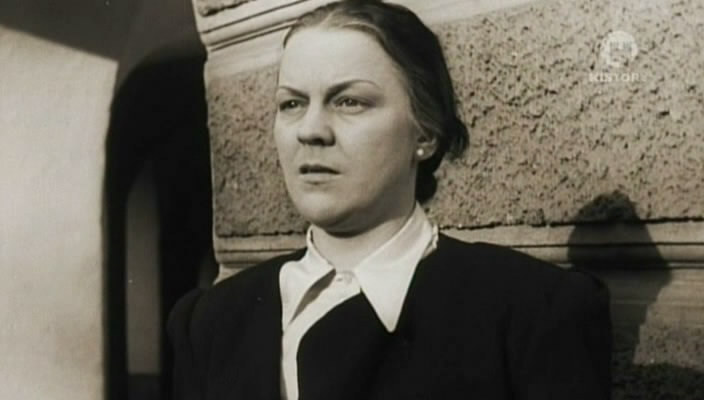
Anna Letenská was a celebrated Czech stage and film actress, best known for her comedy roles in the 1930s and 40s. Her second husband, architect Vladislav Čaloun, had ties to the Czech resistance movement. In 1942, when Nazi local boss Reinhard Heydrich’s car was grenaded in Prague, one of his assassins turned to another in the group for help. This other man was arrested for his assistance, and his wife was caught at the train station in Prague, attempting to flee. Under interrogation she confessed that she had spent the night before at the home of Letenská and Čaloun. They were then promptly arrested as well.

At the time of her arrest, Anna Letenská was in the middle of filming for a comedy film titled Přijdu hned (loosely translated, “I’ll Be Right There”). One of the producers at the film studio was Miloš Havel (uncle of the former Czech President Václav Havel), who pulled some strings with the Nazis in order to get Letenská released — at least, just long enough to allow for the film to be completed.

This clip is from the 1938 film Milování zakázáno. Appropriate to this blog, it involves singing. It’s charming.

Wikipedia: Letenská remained under Gestapo surveillance while filming continued. According to Otakar Vávra, the film’s director, “throughout this time Anna Letenská would sit with her head held between her hands although she appeared as cheerful as could be in front of the camera. We understood that she was preparing herself to die”.

There is a 2009 documentary film about her story, Anna Letenská: The Comedienne and the Nazis”, which was aired last night on the German television station RBB. There are several clips from Přijdu hned showing Letenská, and in them she looks tired. Knowing what was to come must have been absolutely draining. Meanwhile she was sending packages to her husband in prison, and caring for her son at home.

Immediately after the filming ended, Letenská was arrested and sent to Theresienstadt, then deported to Mauthausen concentration camp in Austria along with a transport of female relatives of the assassination organizers. Shortly after her arrival, she was killed by a bullet to the head, in October 1942.

Two months later, the film Přijdu hned had its premiere. It was probably not yet known to anyone there that Letenská had already been murdered. A man who had been part of the film work, interviewed for the documentary, was asked if anything had been said regarding Letenská at the premiere. Not a thing, he replied. “As if nothing had happened.

Some months after that, her son was called to Gestapo offices, and given official notification of his mother’s death.

Another post about the reprisals for Heydrich’s assassination here.