Licus Translation

German to English translation, ATA-certified

Licus Translation

The MS Utting

The Ammersee in southern Bavaria has summer passenger boat service provided by two paddle steamers, the Dießen and the Herrsching, the smaller motor-powered MS Augsburg and, until recently, the MS Utting. Because we have connections to Utting, I was always especially pleased to see it in service (which didn’t seem very often, if at all, in the last year). Then in early March we were stunned read that it was being retired, and taken off to a new life as some kind of performing space shell in Munich. Ah well, that’s that, we thought.

Until just a few weeks ago, when it was announced that the new MS Utting was on its way to the docks on the northern shore, and so we stopped by to see the new addition.

IMG_3208

By the time we arrived it had already been welded together (it had arrived in two pieces via the Autobahn during the wee morning hours) and was sitting in the water. Masts, upper deck facilities, windows and the interiors all had yet to be installed.

IMG_3211

Those are some impressive cranes.

The new MS Utting is 50.80 meters long and 9.60 meters wide, and will hold up to 500 passengers. It will be barrier-free (with an elevator to the upper deck for wheelchair users) and have a slide for children. The Free State of Bavaria is investing a cool 5.4 million euros in the new vessel.

 The first test ride is planned for the end of June. If all goes well, the MS Utting will have its maiden voyage in the second half of July. Maybe we’ll be on it!


Weekend Mountain Rail Blogging

img_3149

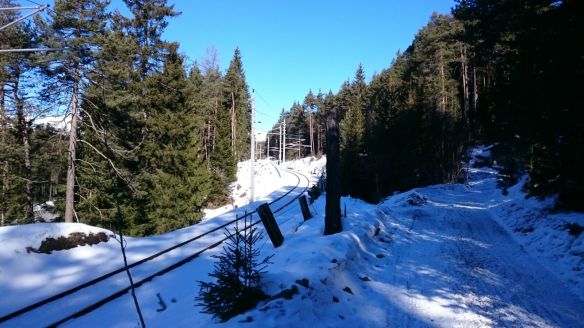
The Mittenwaldbahn meets the trail at the Seefelder Sattel. Photo shamelessly purloined from Martin Schönherr.

Tyrolean omniscient and Friend of the Blog Paschberg sends a photo of greeting from the Seefelder Sattel, a little pass over the most easily navigable part of the Karwendel Mountains, and known as a point along the alignment of the Via Raetia. What he may not remember is that I myself have a similar photo, previously posted here, from pretty much the same spot, but looking the other way — the thing is, I had indeed been looking for the Seefelder Sattel, but didn’t realize that I had been standing right on it until now.
IMG_1999

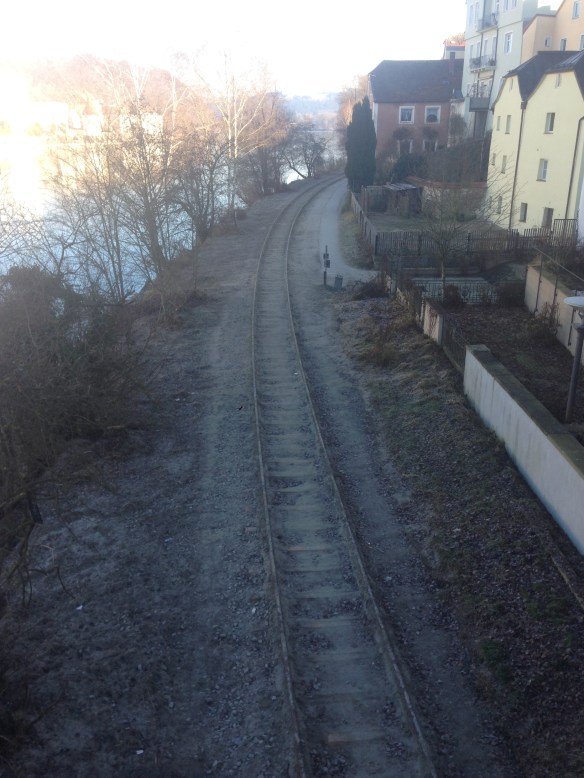
In a somewhat related vein: the closed railway line which ran past my recent overnight accommodations in Passau’s Innstadt.
img_2830
It turns out to be part of the former Passau-Hauzenberg Railway, now used primarily by dog walkers. (The Beau, charmingly sarcastic as ever, suggested that it had probably been left behind by the Romans.)

In Via: Raisting

*img_2278

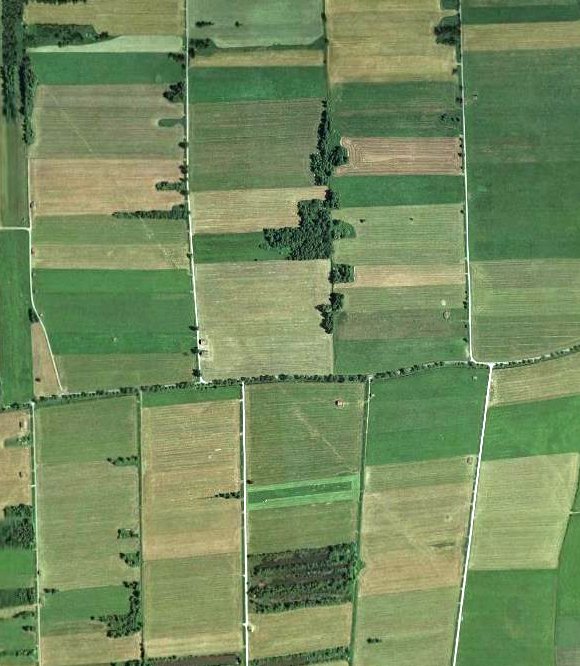
If one is interested, as I am, in the routes of the Roman roads in southern Bavaria, then one has probably heard of Raisting; the north-to-south road from the Brenner Pass to Augsburg (Via Raetia) and the southwest-to-northeast road from Bregenz to Gauting intersected here. Evidence of the latter road can be found further west, but the former has left traces in the land here which can be seen from the air. I wanted to find out what can be seen from the ground, and I wasn’t disappointed.

img_3123

First one travels south of Raisting, to the field of giant satellite dishes belonging to the German Postal Service. Our starting point will be this church.

img_2279

The old pilgrimage church St. Johann is supposedly the oldest church in the area, founded in the time of the first Christian community in Augsburg. This thesis is based on the fact that the old Roman Augsburg-Brenner road lay just 100 meters west of it.
According to legend it was built “on a holy place” by Tassilo III (748-788), the last Agilolfinger Duke. Tassilo, so the story goes, got lost on a hunt in the woods between the Lech and the Ammer rivers. He swore that when he figured out where he was, he’d build a church on the spot. Eventually he reached an open space from which he could make out the lake, and that is where Tassilo built his promised chapel. The altar was placed over a spring. (A church on a “holy place, built in the region’s earliest days of Christianity, with the alter over spring, near the Roman road? That sounds suspiciously like the former site of a roadside pagan temple.)

img_2281

It was especially cold last week; the welcoming committee was surely happy to soak up the warm sunshine today. Our instructions were to follow the road past the church until the second ditch, and then look southeast into the field. And lo…

img_3122

It’s difficult to see in this picture that the ribbon stretching before us is slightly raised, but it is easier to tell its presence by its lack of snow — underneath lies the pebble road bed. We left the marked road and trekked into the field.

img_2285

And met up with a barbed wire fence. Which didn’t stop us, we slid over /under it and followed the track to the end of the field, observed only by a small herd of camera-shy deer. Here the road alignment is even clearer to the eye. There is supposed to be the remains of a peat cutting ditch in the strip of woods straight ahead, but we saw only a small border stone marker poking out of the deeper snow before turning back.

img_2295

The satellite facility is surrounded by farmland and is easily accessible. It was impressive to see them up close. With the Via Raetia, St. Johann church and the satellite dishes, we had 2000 years of human achievement presented before us in one short walk.

img_2296

And here the route of the Via Raetia is still in use, as the main road through Raisting and Diessen, after which it veers slightly westward on its way toward Augsburg. The next place to trace its route is in Achselschwang, which we documented back in May 2014. It has since become a regular walking route for us.

Soviodurum, and a Mysterious Stone Object

img_2757

Roman knee and shin guards with intricate details

I had the chance to visit Straubing, a small town along the Danube in Lower Bavaria – basically I was there on business, but arrived a few hours earlier in order to see the Roman exhibit at the town museum. As Straubing (Soviodurum) was along the Limes and had a military station there, the museum had quite a bit to offer. Perhaps not as much as Passau or even Fliess in Tirol, but a nice exhibit nonetheless.

img_2758

Head protection for Roman horses

img_2760

Roman glassware found in Straubing, Bavaria

I had never considered whether the Romans used glass, since so often one sees only ceramics. The designs are downright modern.

img_2762

A stash of coins hidden before the collapse

This found stash of coins, like many others discovered south of the Limes, reminds one of how it ended: things looked bad, treasures were buried, things indeed got very bad, and the owners never returned to the site to reclaim their property.

The photo below was made earlier and is not from Straubing. Knowing that I was going to be spending some time in Lower Bavaria, I had done a little advance research for any mention of early, pre-Roman history of the area, and stumbled across a fleeting reference to a schalenstein in the Passau Rathaus from 1899. ( I did wander a bit through the public areas of this town hall, but did not see anyone who looked like they might know what I was talking about if I should ask.) Later, however, I took a walk up to the fortress overlooking Passau and came across this.

img_2616

What could this be?

Which is, well, technically, a schalenstein (it’s stone, and it has cup markings)
but to me looks more like something made much later. There are what appear to be charcoal markings inside. It is simply built into the wall in one of the towers, with no explanation.

The Jewish Cemetery at St. Ottilien

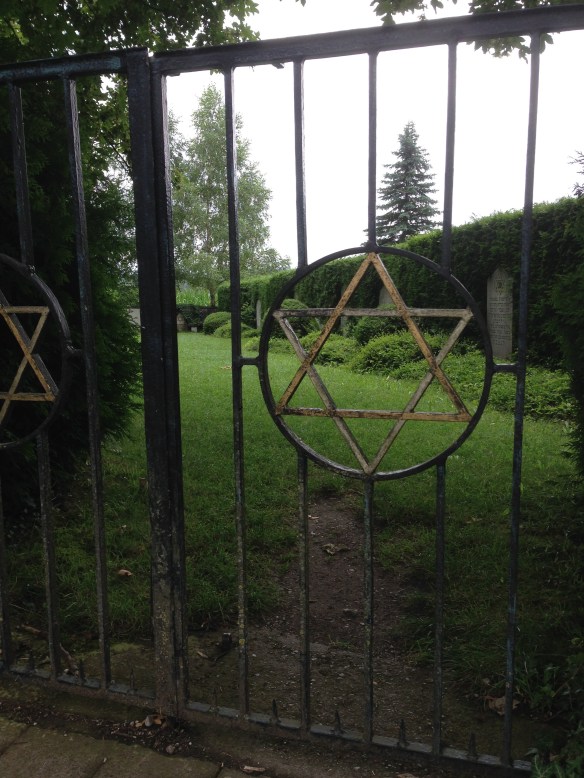
Near the Ammersee lies a Benedictine Monastery named for St. Ottilien, or St. Odile of Alsace (A recounting of St. Odile’s life on Wikipedia reads somewhat like a season wrap-up of Game of Thrones.) If you find yourself near the small St. Ottilien train station, you will see a small enclosed garden whose iron gate bears a Star of David. This is the Jewish Cemetery.
IMG_2628
In April 1941 the Gestapo confiscated the St. Ottilien Cloister and set up a reserve field hospital there. American troops liberated hospital, overfilled with almost 1,000 war injured, in 1945. Through the work of the Americans, about 450 gravely ill Jews liberated from concentration camps began to be brought to the hospital and nearby school buildings for medical care.
IMG_2626
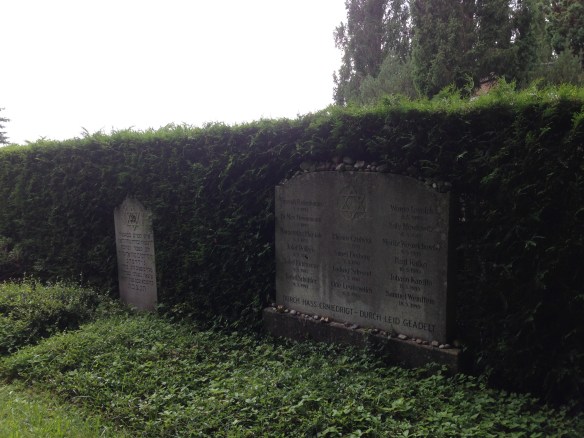
The US Army erected a Displaced Persons hospital, supervised by the United Nations Relief and Rehabilitation Administration, here in May 1945 to handle the constant stream of former camp inmates. The patients were mostly surviving camp inmates and forced laborers from the Kaufering camp complex, and ill persons from the camp at Dachau and its sub-camps in the Landsberg/Lech area. A Jewish community existed on the cloister grounds, tending to its own religious life and customs, until the hospital was dissolved in 1948. These were people who congregated here, then, for lack of the health and strength to go home, or for lack of a home to go to. Some recovered, and some died in spite of treatment from Allied medics, and those are the people who were buried here.
IMG_2627
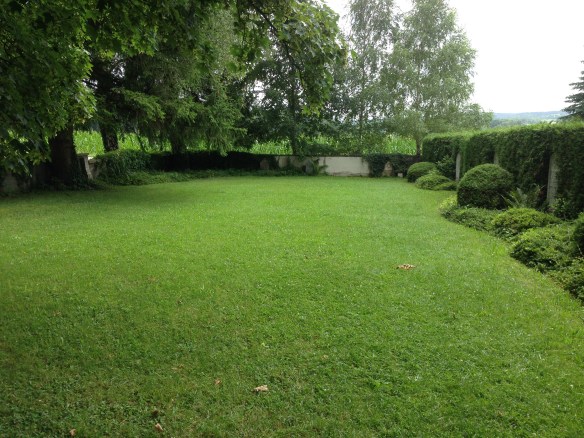
65 people were interred in the cemetery between 1945 and 1948. The first gravestone, bearing a Star of David and nine names, was erected in 1945. By 1950 there were four memorials and twelve gravestones with names and texts in Hebrew, as well as an enclosing wall with its iron gate, and a bench. The gravestones were moved to the edges of the premises in 1968 after several exhumations and transferals of remains. Since 1972 the camp cemetery has held the remains of 46 camp inmates and nine forced laborers. The people resting here came from Germany, Hungary, Poland, Italy, France and Russia; most are known by name. According to the cemetery records at St. Ottilien, 10 of them belonged to Christian confessions:  one Evangelical Lutheran, one Reformed, three Orthodox Catholics and five Roman Catholics.

The camp cemetery in St. Ottilien is a protected cultural site, and its care is overseen by the Bavarian Memorial Foundation (Stiftung Bayerische Gedenkstätten.) The monastery publishes a small and inexpensive guide to the cemetery in both German and English, which includes explanations of the Hebrew tombstone inscriptions.

Circumitus: Batavis, Boiodurum

IMG_2540

(The name actually refers to the bicycle route and is not, apparently, what the Romans called it.)

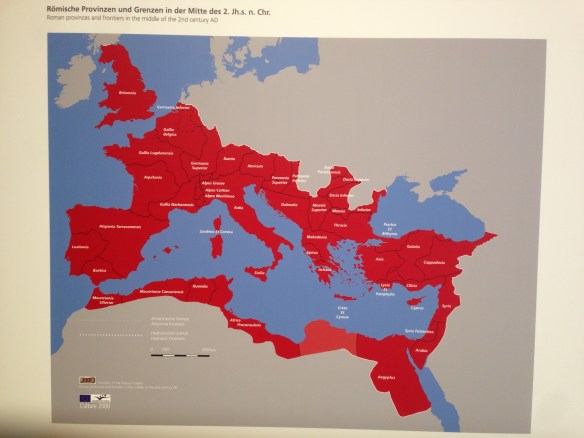
This posting hails from the other side of Bavaria, a “detour” onto the Roman road which follows the Danube and also the boundary separating the Roman Empire (in this case, the province of Raetia) from the Germanic Marcomanni to the north. This border is known as the Limes, and covered the lands on all sides of the Mediterranean Sea, in one form or another.

IMG_2542

The Roman Museum in Passau is built on the site of one of the fortified structures from the Roman period, Boiodurum. This name, like many Roman sites in Germany is apparently of Celtic origin. There were people settled on Passau’s peninsula long before even the official founding date of Rome, but according to archaeological finds they were gone, or least no longer present in sufficient numbers (discontinuity), by the time the Romans arrived; no signs of destruction or conflict have been found either. This brings me to something I have been thinking about ever since I started looking at early European history: the way some history texts tell it, the reader can get the impression that the Romans simply arrived one day –  cutting through virgin land with their swords and putting down roads to get to their provincial capitals which had also just appeared out of thin air. Just as there had been settlements here before, and some infrastructure (mule paths over the Alps), there surely must have been some Roman presence here long before as well, even if only in the form of tradesmen or scouts. Polybius made remarks about the Raetians over a century before the transalpine road plans went into effect.

IMG_2561

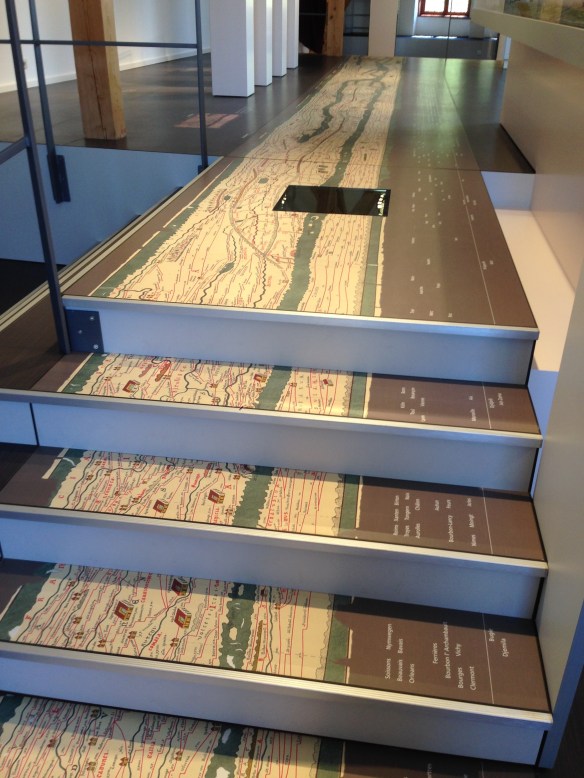
The museum found a creative way to present the Tabula Peutingeriana in a large enough size to actually read it.

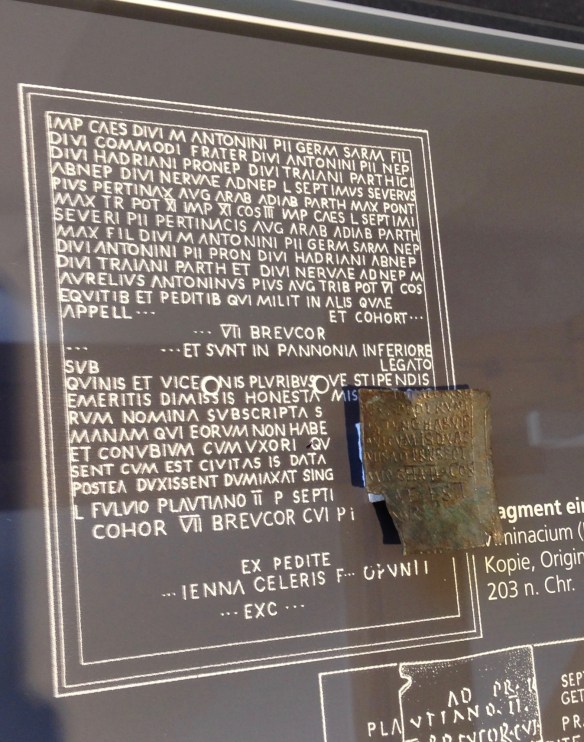
There were plenty of Roman soldiers in this “three rivers” area, but other people as well, judging from excavation finds. Below is a type of “diploma” awarded to a Roman soldier after completing his 25-year service (if he survived that long). He got some money and a little set of engraved dog tags, threaded together with wire like a spiral notebook, according him privilege wherever he went. Did Claudius Paternus Clementianus of Epfach possess one of these? Probably.

IMG_2563

IMG_2549

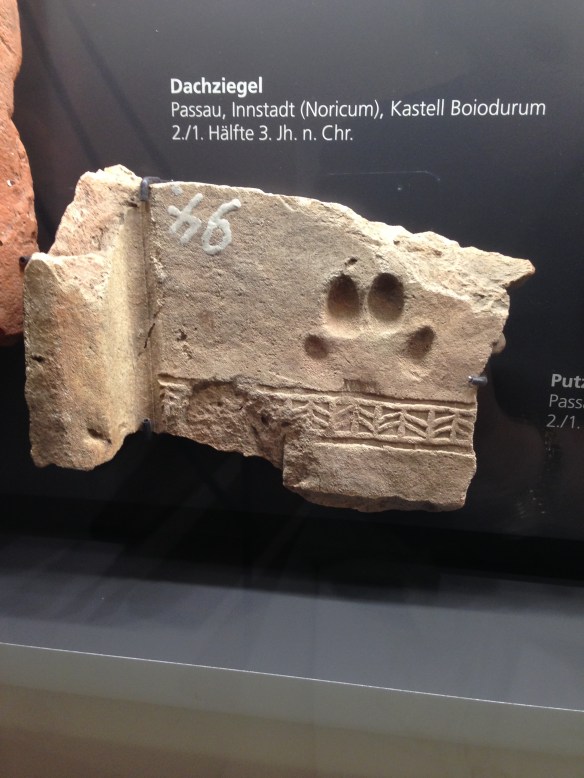
Part of a roof tile found in the ruins of the Roman Boiodurum fortress at Passau, delightfully marred by a paw print before it was dry.

In Passau one may find a little light shed on the continuity of the place after the Romans withdrew. Roman troops at Boiodurum were among the last to stick it out along the Limes, after other frontier posts had already fallen. Eugippius says that a small group set out for Rome to collect the soldiers’ last pay but were killed by Barbarians, unbeknownst to those remaining and waiting for their return. Eugippius’ biography of St. Severinus mentions “people” – probably both Romans and Romanized Raetians – holing up together in Batavis (the fortified Roman settlement in Passau, on the hill where, not coincidentally, the Cathedral now stands) and defeating the invaders before being urged to leave for safety at Lauriacum (Enns). Eugippus also mentions St. Severinus founding a small monastery at “Boiotro”, most certainly using the existing Boiodurum fortress walls.

IMG_2572

A last sign of the Roman Empire’s long march toward being the Holy Roman Empire: not St. Severinus, but the Holy Bishop Valentin of Noricum (Roman province of Salzburg), who came to Raetia as a missionary. The silver box below his image is said to hold his relics. My understanding of the “Dark Ages” seems to have been a little wrong until now – it was certainly chaotic, violent,  in flux, and certainly dark to live in — but not completely shrouded in misty Unknown. The information is there, you just have to look for it.

In via: Abodiacum

Epfach
There’s more to Epfach, an unassuming little village along the Lech, than first meets the eye. It’s a very, very old settlement, in fact. Older, even, then most German towns — Munich, for example, was first established in the 12th century. Epfach, apparently originally a Celtic settlement, was ideally situated to serve as a station along the Via Claudia Augusta in the Roman province of Raetia. It’s Roman name was Abodiacum, (or Abodiaco, as it’s found on the Tabula Peutingeriana).
TP
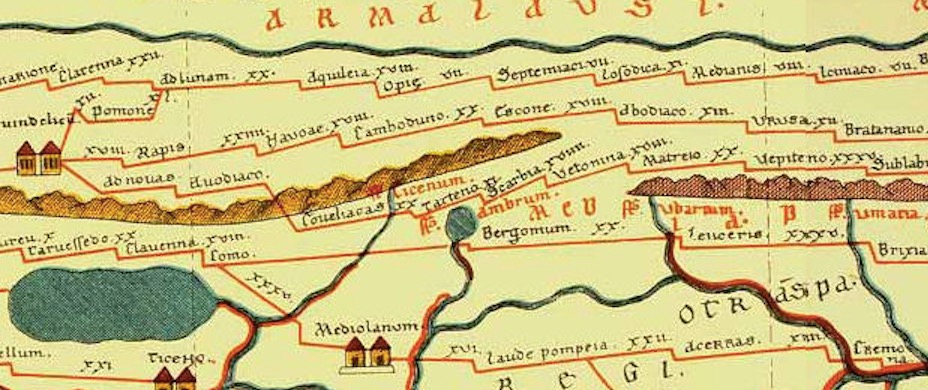
The Tabula Peutingeriana, in fact, has two Abodiacos: they are the same village. It stands at the crossroads of two Roman roads : the Via Claudia Augusta, where it’s just after the  station ‘ad novas’ on the road out of Augusta Vindelicum/Augsburg, and the salt road that partly connected Lake Constance (Brigantium) to Salzburg (Iuvavum).
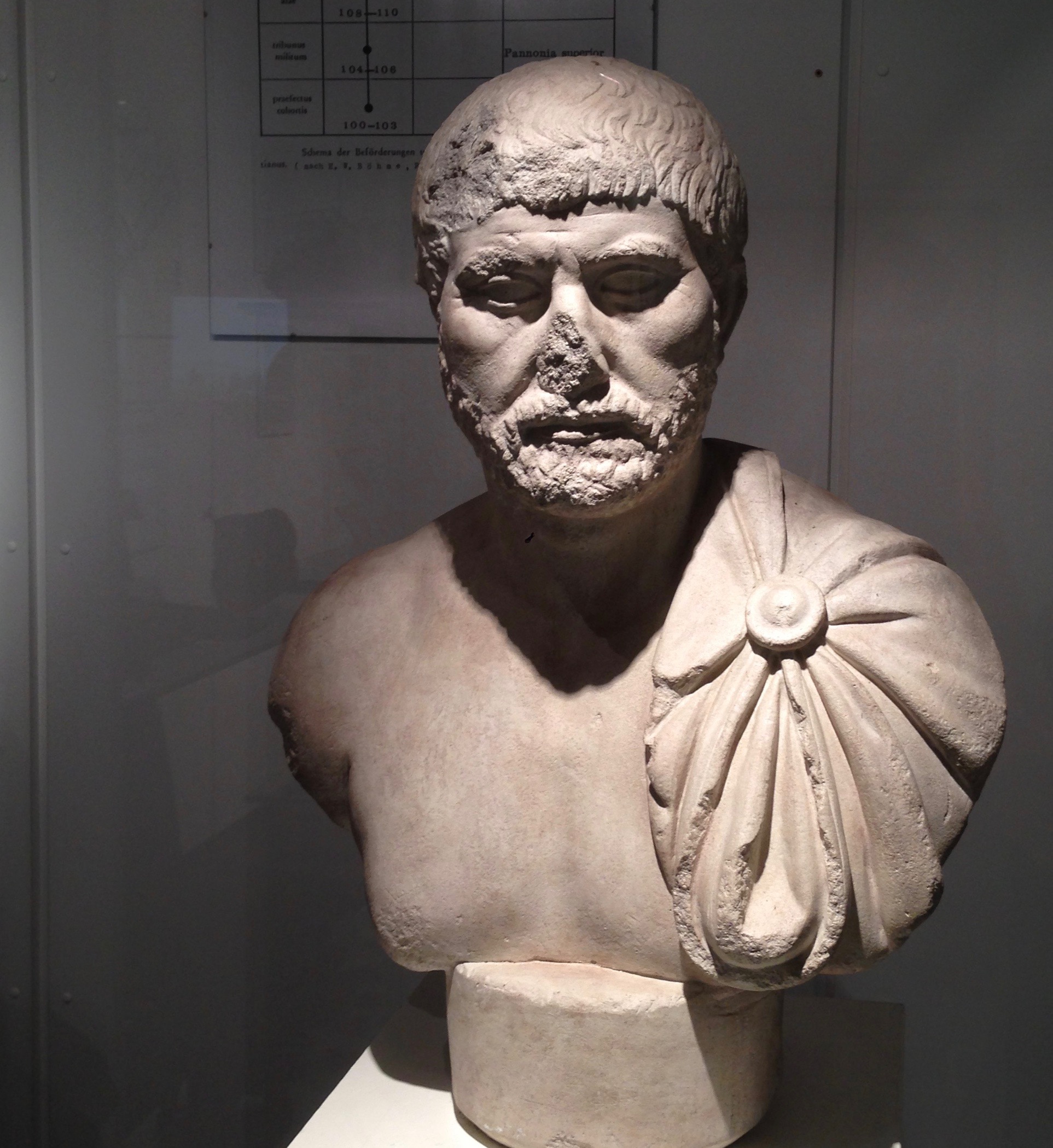
Visitors to Epfach will first see that the north-south road through town is marked as the Via Claudia. Right on this road stands the local museum, which provides information on Epfach’s Roman history, all in a space about as big as my living room. Of particular interest is an exhibit on Epfach’s first internationally renowned local homeboy, Claudius Paternus Clementianus.
IMG_2524
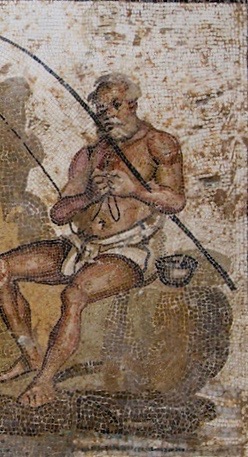
CPC was a Celt with Roman citizenship through his father, which allowed him to serve in the Roman army as an officer. His career took him to Hungary, Romania, Judea (where he served as Procurator there just 80 years after Pontius Pilate held that job, long enough afterward to have probably never heard of him), Sardinia and Northern Africa, before he came home to retire and presumably spend his golden years fishing on the Lech and downing the local wines.

Tripoli, Libya - Roman Mosaic, National Museum, Fishermen

Tripoli, Libya – Roman Mosaic, National Museum, Fishermen

He may have had the good fortune to enjoy his twilight years secure in the belief that the Empire was strong. It was another hundred years before Alemanni tribes began sacking the settlement, followed by the Romans rebuilding it, in turns. The northern frontier (Limes) remained in operation until sometime in the 5th century C.E. Then again, as a Celt, maybe he would have been happy with the eventual outcome.

While Epfach is not on the Via Raetia, there is a connection nevertheless. The Tabula Peutingeriana, a Middle-Ages copy of a late Roman roadmap of the Empire, shows neither the Via Claudia Augusta nor the Via Raetia in their entireties, but rather an amalgam of the two — the route shown follows the VCA leaving Augusta Vindelicum/Augsburg until Epfach/Abodiaco, detours east on the above-mentioned salt road and then resumes its southward way on the newer Via Raetia at Urusa/Raisting (the next stop listed is Coveliacas, near the Staffelsee). This variant may have turned out to have been shorter, the easiest to maintain (the Via Claudia Augusta, in my opinion, goes over much more precarious mountain territory than the Via Raetia), or had better stations, or better connection, or a combination of any of that.

Aside from the museum (open every day, and if it’s not you can ask for the key at the restaurant next door), you can walk to the Lorenzberg, the hill where the Roman military station was located. Epfach seems to have geared its tourism to the Via Claudia cyclists, who can take a break at the restaurant, stop into the museum, walk off lunch with a short visit to the Lorenzberg, and then continue on their way.

A Idea of Mine

I have a confession to make. Beyond all the other things I am doing right now – singing, translating, assisting in a bookselling business – I have a project in mind for the future. I want to put together a guidebook for the Via Raetia.
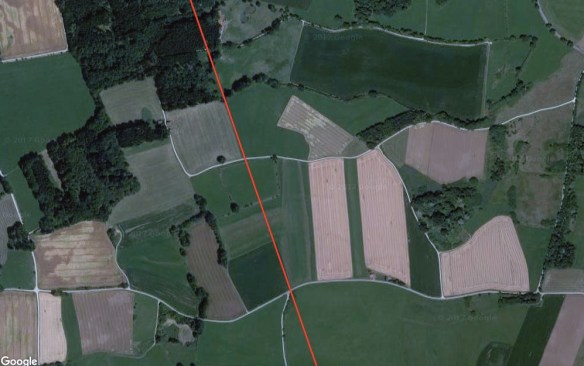
There are guides and books for following the Via Claudia Augusta, the first Roman-made road to cross the Alps in this region, but I have yet to find a modern tourist guide in English for it’s younger sister, the Via Raetia. The Via Claudia has an “official” route which one can follow ona bike, and much of it may accurately follow the old road. The Via Raetia does not, and here you can see why:
Wiel_Raisting_google

Clearly one can’t just go traipsing across private property, let alone tell others to do so.

Walking, cycling, sights along the way, history, archaeology, culture, on the route between Augsburg and… well, how comprehensive do I want this to be? I could keep it within Bavaria (Augsburg to Mittenwald) or publish installments (Part 2, North Tyrol from Mittenwald to the Brenner Pass, Part 3 Italy: Brennero to Verona). Even if I had no other work, this would take a few years of research, travel, exploration. I’m not sure I’ll ever get to do it. (Note to any publishing houses: I’m here, “boots on the ground”, if you are considering something along these lines from a distance.)

But all this will have to wait another year at least, because for professional reasons I am going to be spending a considerable amount of time at the other end of Bavaria, namely closer to the Czech border.

Image from Google maps.

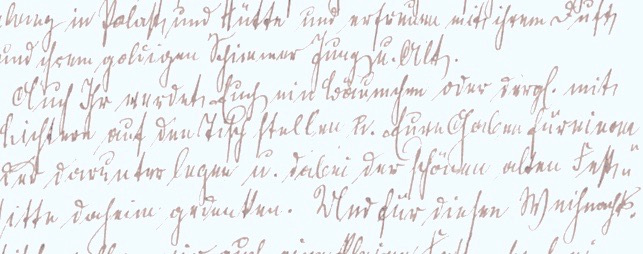
From the Translation Desk*: Sütterlin

Version 2

There are many subjects I avoid if I can. Most technical texts, for example, or medical ones. There are also certain types of formats I avoid, like excel files (they just don’t come up right on my little Mac screen). But one thing I can do, with some help from the Beau**, is old handwriting like the sample image above. This is called Sütterlin script and it’s indecipherable to most people today. When I first look at a text written with Sütterlin, it makes about much sense as Georgian, or Tolkien runes. Nothing but squiggly lines. But as one sits and studies the characters, their meanings begin to emerge.
Es gibt viele Themen, die ich wenn möglich meide. Zum Beispiel die meisten technischen oder medizinischen Texte. Es gibt auch bestimmte Arten von Formaten, denen ich aus dem Weg gehe, wie Excel-Dateien (sie werden auf meinem kleinen Mac-Bildschirm nicht richtig dargestellt). Aber eine Sache, mit der ich, mit etwas Hilfe vom Beau **, umgehen kann, ist alte Handschrift, wie im Beispielbild oben. Diese nennt sich Sütterlin-Schrift und ist für die meisten Menschen heute nicht mehr zu entziffern. Wenn ich einen Text in Sütterlin betrachte, erscheint er mir zuerst, wie Georgisch oder wie die Runen Tolkiens. Lediglich verschnörkelten Linien. Aber wenn man sich damit länger auseinandersetzt und die Zeichen analysiert, erkennt man ihre Bedeutungen.

*I actually work from the couch, as my desk and surroundings have been subsumed into service for the Antiquariat. Ich arbeite eigentlich auf der der Couch, da mein Schreibtisch das Drumherum für die Arbeit des Antiquariats verwendet wurden.
** He and a friend taught themselves this writing in school, in order to pass notes in class. Er und ein Freund haben sich diese Schrift in der Schule beigebracht, um Nachrichten in während des Unterrichts in der Klasse zu übermitteln.

Nazi Bedtime Stories

The next estate dissolution in which we took part involved the sale of a rather large piece of land in the middle of Munich. A rich textile-industry dynasty family had a villa there with a spacious guest house, and basement garage for classic autos (with a car elevator), and the entire property had been sold. The owner’s mother came from Prussian nobility. Many of the thousand-plus books were from assorted family collections, brought together and stored out of sight and forgotten. One could get a vague sense of family life from one child’s horse book collection, or the 1930s German law publications pointing to a lawyer in the family, right next to a shelf with German resistance memoirs. The art books were in the living room, the romance novels upstairs.

It was in this large, scattered accumulation that I first held in my hand an actual Nazi children’s book.

IMG_2279

Fünf Wiegen und noch eine” (Five Cradles and One More) is an odd little work. Author Henrik Herse was an SS-Obersturmführer and “Fünf Wiegen” contains perhaps autobiographical musings, although it’s hard to say (the narrator is a somewhat impoverished writer with five children and a sixth on the way. The author was a senior officer in the SS, and I don’t know how many kids he actually had). I called it an odd little work but it  was probably typical of many war-time children’s books, no matter the era or location. What it seeks to do is to “familiarize children within the SS Family of their roots and culture”* through children’s rhymes, prose and symbols of Nordic and Germanic origin. [All quoted passages translated by the blog author.]

The goal — it would be impudent to think one knows it. Much more important than what lies in the distance is the way there. We must bring it to its conclusion in a way that does not shame us.

(IOW: it’s not important for you to know where this Reich is heading but you’d better be on board.)

IMG_2280

There are sweet stories of family life in a big house in the country, interspersed with nursery rhymes. Stories of simple meals laid out on the big oaken table, of birthday rituals, of hunger and poverty born with pride, of Christmas trees. The narrator speaks of living a quiet and taciturn life, of the next child being accepted into “our circle”, into which “we don’t let everyone”. I began to wonder what kind of effect stories like this had on the children waiting restlessly in bomb shelters all over Germany. They would begin to dream of being a part of this happy family in the country, of being the “next child”. It would have planted a seed in their impressionable minds, of some rare and holy place where only the best and bravest little Nazis could go. Or was it an exclusive book, only for the children of the elite SS?

At times it reads like a journal or a personal blog. Halfway through the tone gets a bit darker and more urgent. Words like “enemy” and “battle” start appearing in the prose. And always, the idea of Keeping the Faith. His thoughts go here:

It is not so easy to live this life of ours on to its end. It is not always a song which one wants to sing. There are cares upon cares, and they are greedy and want to eat you through and through.
And some men have thrown it all away, and have fled as cowards. To their deaths, or to another side.
That is the most wretched form of desertion, and death should first come to them.
Is love then eternal? many ask. Is that happiness?
Yes!! But only if you are strong enough to win and keep it! The greatest victories are in the battles for our lives.

IMG_2281

None too obscure and none too small,
none to die senselessly and alone,
because the holy torch I was given
I will pass on as the flame of eternal life.

What can I say? Some people have reality TV shows, some people have religious movements. It has the same ring as some early Christian writings. Probably not a coincidence.

What is difficult, is to have courage. To have so much courage that the blows don’t matter in the least. To hold your head up against the blows! The head and ribs can withstand much, when the heart inside beats in resistance.

Those poor victimized fascists.

The poems are now no longer about babies and Mother, but of iron-man strength, of battle, of swords, of blood and of German soil and imminent beatings!  And then, suddenly, we’re back to cradles again, and stories of his children’s births.

IMG_2282

The NSDAP was definitely onto something when they began starting them young. Research suggests that our 14-yr-old brains are “imprinted” with the music and literature which will stay important to us throughout our lives. While the nursery rhymes in “Fünf Wiegen” are for small children, the prose passages are not. These, rather, would have been noticed by them, but understood by 12-14 year olds. What a set up. All those kids, just dying to be chosen for the special circle of fellowship and purpose. It’s almost like a “Lord of the Rings” primer from the side of the Orcs, or Hogwarts fanfic about Slytherin children (which is indeed a thing as well).

One last, important thing: this book is nothing special, there are cheap copies to be had over the Internet. It may have been everyone’s grandmother’s favorite book as a child, the one she sensibly kept hidden from her grandchildren but liked too much to throw out. These are the books that come to light after someone dies.

*I lifted that phrase from here because it is perfect. I couldn’t have said it better.