The Hidden Jewish Cemetery in Utting

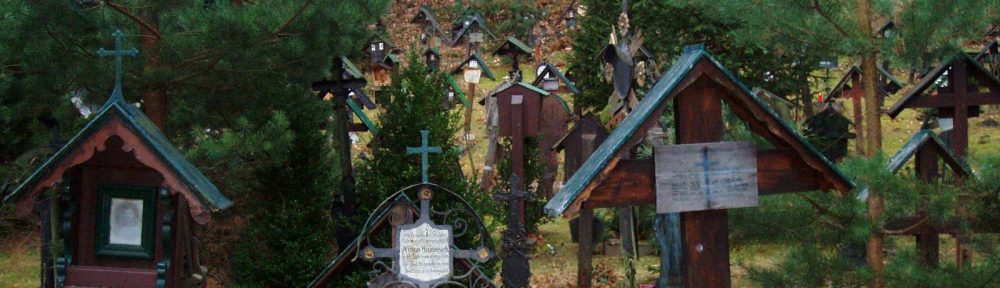
Looking for other archaeology sites on the local map, one stumbles across other, less expected things. For example, a KZ (concentration camp) cemetery outside of the small lakeside town of Utting, where there had been a tannery which made use of forced laborers from Dachau — there were satellite camps all around, this was Camp 5 (Lager V).
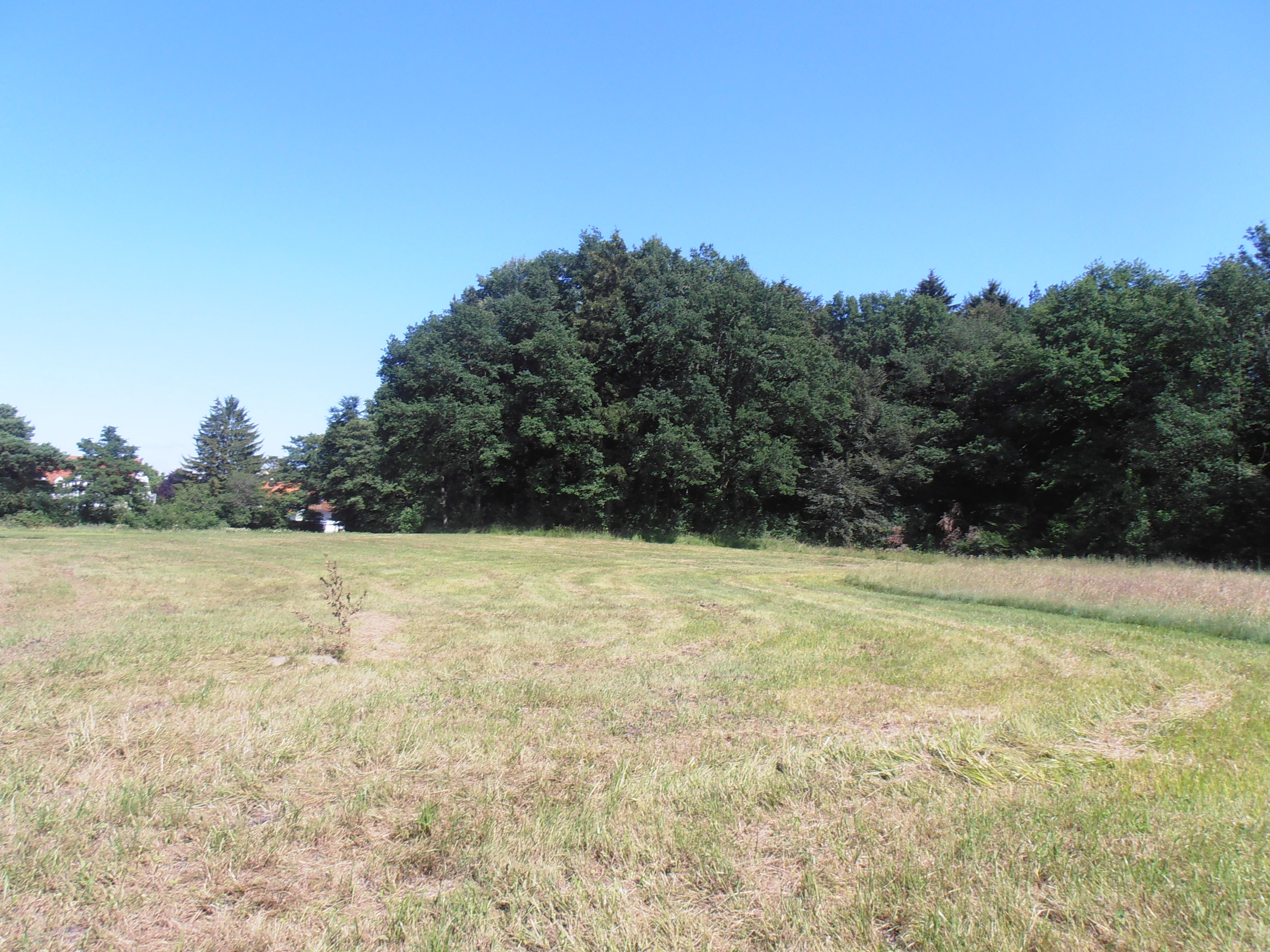
We almost didn’t find it. In fact we had come to a dead end in a field and started to turn back, when a local came by on his bicycle. When he heard what we were looking for, he generously walked us there (we never would have found it on our own, once we saw where we were headed — through a patch of forest,  someone’s back lawn and  a wooded archery range — but we had come in from the wrong road, it seemed.

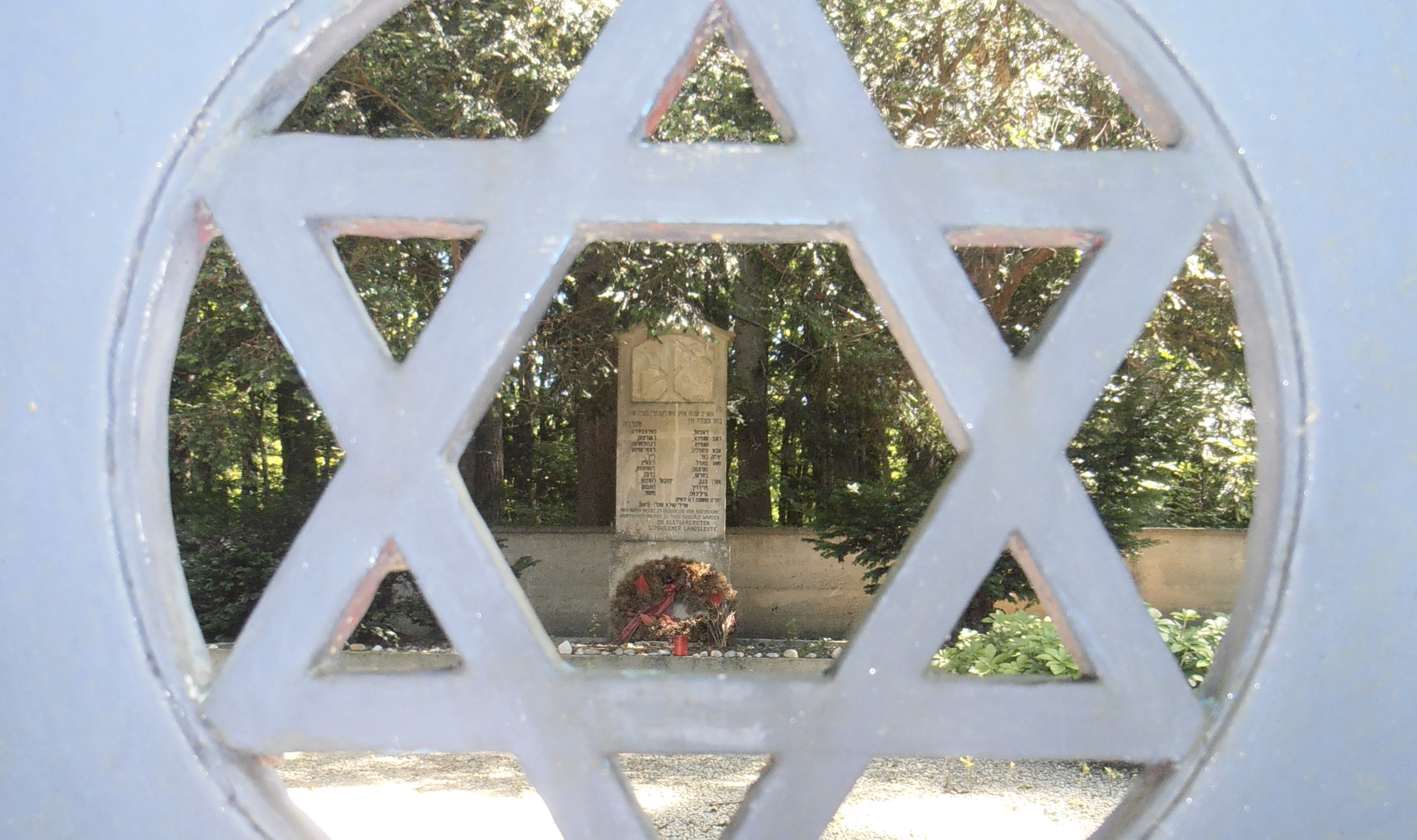
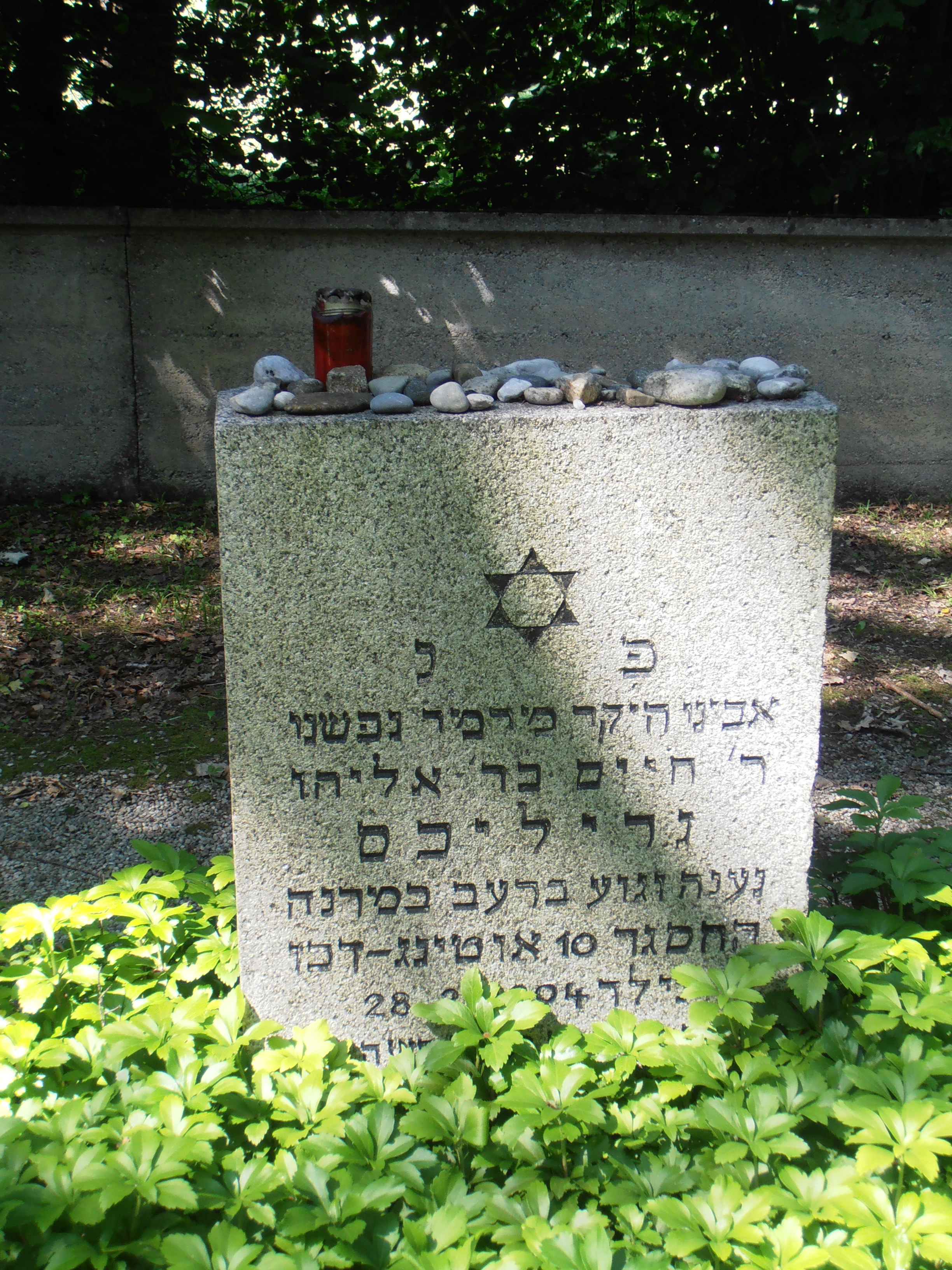
About 500 male prisoners worked here from August 1944 until April 1945. This cemetery is for the 27 who died from the brutal treatment.
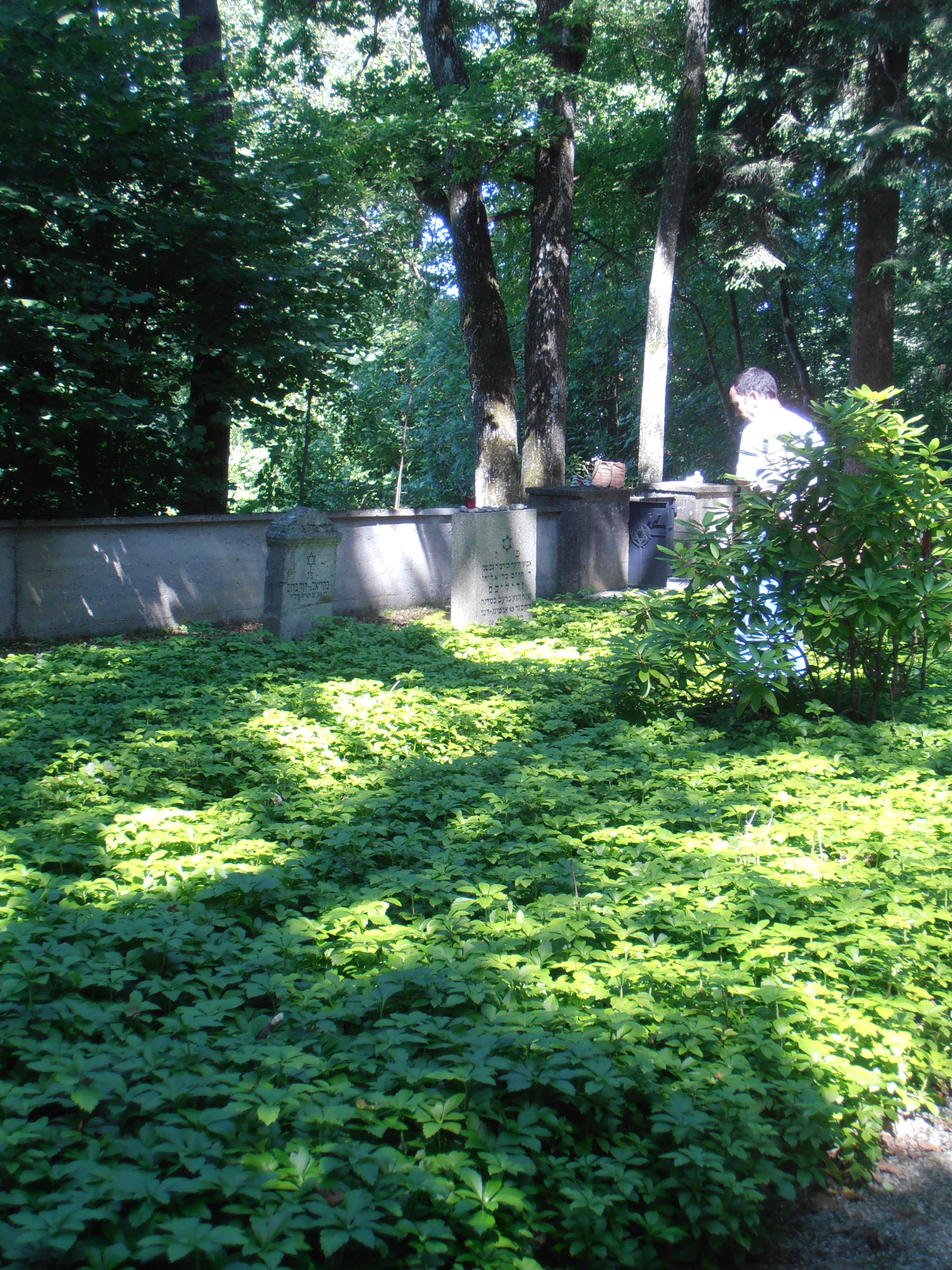
A large stone inside the cemetery wall commemorates the 27 victims, from “the rescued compatriots of Schaulen” (Šiauliai, in Northern Lithuania, was an important leatherworking town. Which explains why its sons were brought to the tannery).

In my research I came across this poem by Yehuda Amichai, translated into English by Chana Bloch and Chana Kronfeld. The description could fit just about any of these little memorial graveyards, including this one.

“A Jewish Cemetery In Germany”

On a little hill amid fertile fields lies a small cemetery,
a Jewish cemetery behind a rusty gate, hidden by shrubs,
abandoned and forgotten. Neither the sound of prayer
nor the voice of lamentation is heard there
for the dead praise not the Lord.
Only the voices of our children ring out, seeking graves
and cheering
each time they find one–like mushrooms in the forest, like
wild strawberries.
Here’s another grave! There’s the name of my mother’s
mothers, and a name from the last century. And here’s a name,
and there! And as I was about to brush the moss from the name–
Look! an open hand engraved on the tombstone, the grave
of a kohen,
his fingers splayed in a spasm of holiness and blessing,
and here’s a grave concealed by a thicket of berries
that has to be brushed aside like a shock of hair
from the face of a beautiful beloved woman.
Historical information on the cemetery found here. This is the work of one Othmar Frühauf, who has photo-documented Jewish cemeteries in Germany for Alemannia Judaica (Both links are in German). My hat goes off to him.
Poem found here

R.I.P. Patrick Leigh Fermor

I first came across the name Patrick Leigh Fermor in a biography about Bruce Chatwin; he and Robert Byron were his predecessors and influences in travel literature, and they were so neatly described that I immediately ordered old, out-of-print copies of Fermor’s “A Time Of Gifts” and Byron’s “The Road To Oxiana”. These books marked the beginning of a long and happy interest in the writings of people who have grabbed a rucksack and gone off to find adventures in a changing world.

It took me years, however, to get around to ordering the second installment in the planned trilogy, and the third book has yet to come out (although I was happy to read in Fermor’s obituary that a final draft may indeed have been completed, and may actually get published, in my lifetime I would hope…) I can’t be too saddened to hear of his death, at age 96. He lived a long, full and happy life, and cheered many, many people along the way with his delightful stories.

A Surprise In The Kaiserjägermuseum

So, I finally made good on my promise and took my young friend to the still-new Tirol Panorama Museum on Bergisel. It’s connected to the Kaiserjäger Museum, which is dedicated to the Empire’s local militia regiments from the 19th century, so we wandered through that too, just looking at the paintings and the weapons with mild interest.

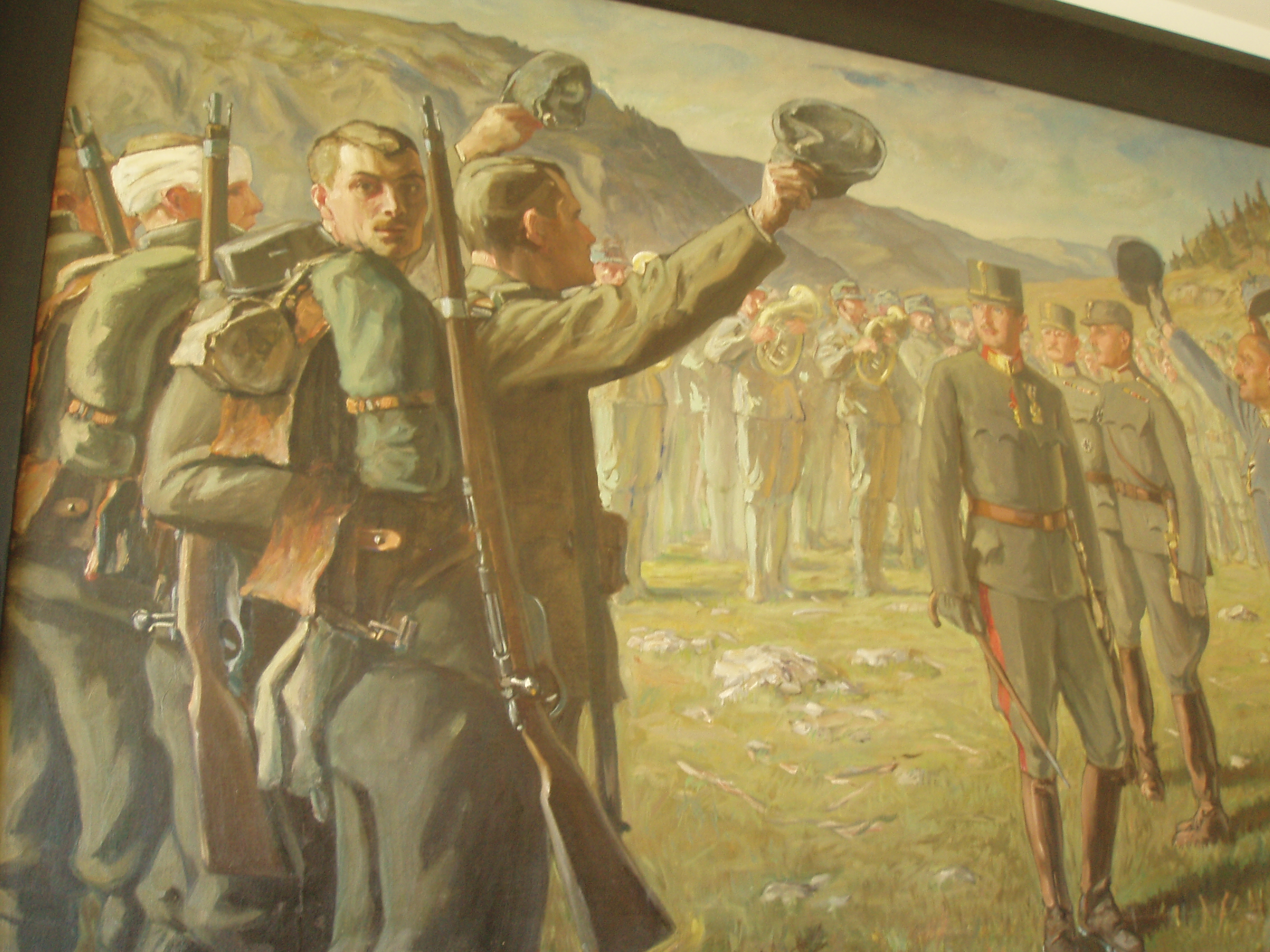
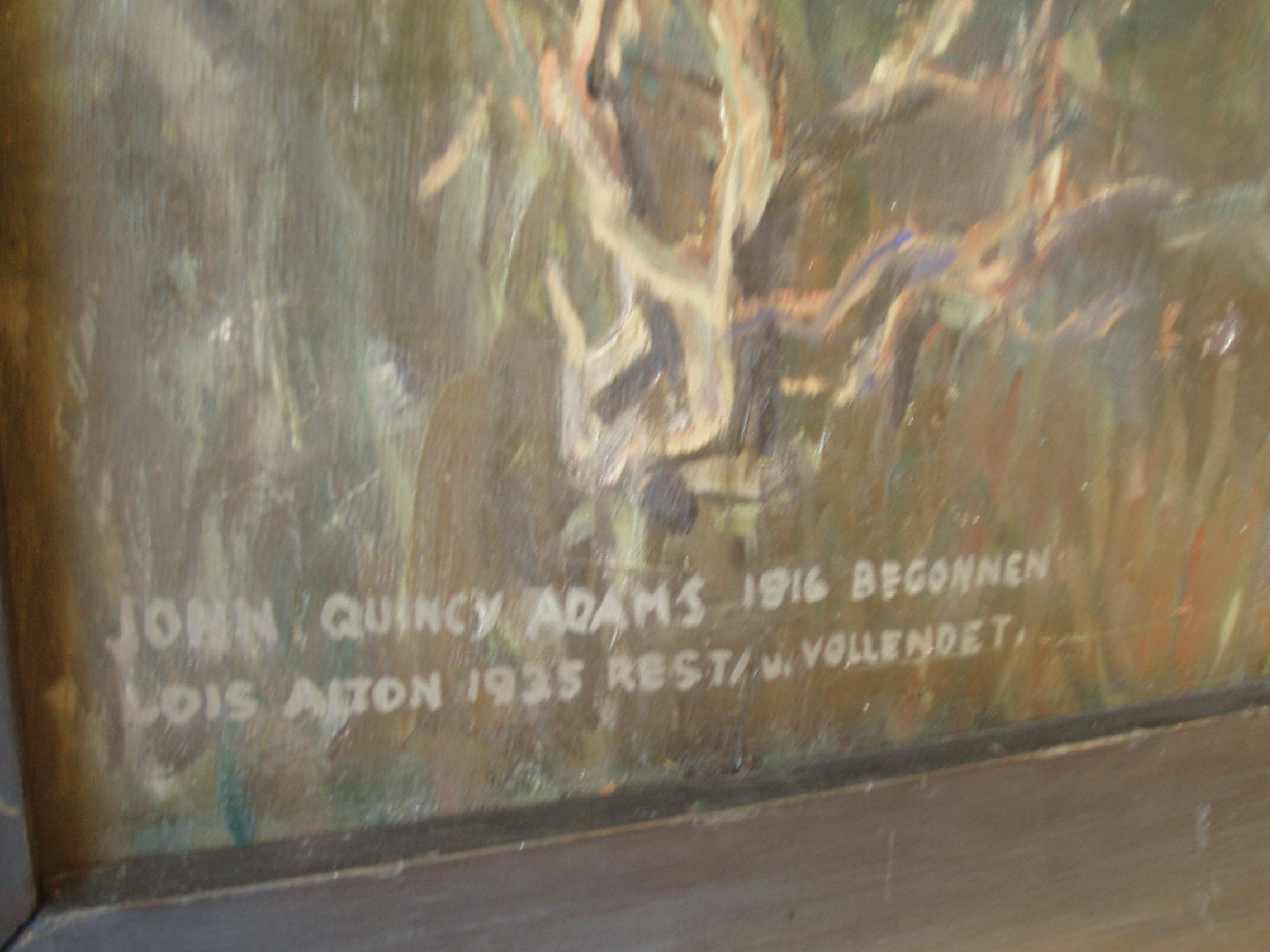
In one room my eyes rested on a large painting of soldiers greeting Kaiser Karl, the last Emperor of Austria. I found interesting the one soldier turning to look directly at the painter, and so my eyes dropped down to read the artist’s signature.

Say what? “John Quincy Adams, began in 1916. Lois Alton rest[ored?] and finished in 1935.”

Not the U.S. President, but a descendant, 1874-1933. Interesting what Wikipedia (the German site) tells me — his father, Carl Adams, was a Heldentenor at the Vienna Court Opera for ten years, then brought his family back to America when John Quincy was four years old. At age twenty-six he enrolled in the Vienna Academy of Fine Arts, and went on to have a pretty successful career on both continents. He’s even got a grave of honor in Vienna’s central cemetery.

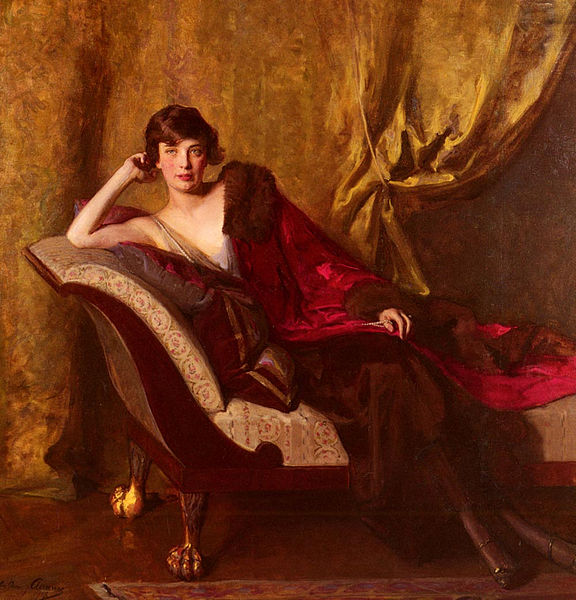
Here is another work, to show that it wasn’t all war paintings for him. Of Countess Michael Karolyi, from 1918. Very nice.

The restorer Lois, or Luis (short for Alois) Alton was a local artist of landscapes and portraits.

>Forgotten Innsbruck: “Kropferte Liesl”

>

Austrian Empress Maria Theresia gave birth to 16 children, ten of which survived into adulthood (pregnancy seems to have given her extra spurts of energy which she then used to accomplish such things like reorganizing the army or conducting wars.) Her eldest son Joseph succeeded her as monarch, and her most famous child is probably Maria Antonia (better known by the French version of her name.) These two and all the others are subject of the book which I am currently reading, “Maria Theresias Kinder: 16 Schicksale zwischen Glanz und Elend” (Maria Theresia’s Children: 16 Fates Between Glory and Misery), Hanne Egghardt, 2010.

After the unexpected death of her husband, Franz I Stephan, during a trip to Innsbruck, Maria Theresia founded a Damenstift for noble ladies there. A Damenstift (or Frauenstift) is a sort of monastery for women, but differs from a convent in that, unlike nuns, the residents were not bound by holy orders. They were required to participate in prayer and masses, but enjoyed many more personal freedoms as well as the option to leave if they so wished. The Stift founded by Maria Theresia was set up so that prayers would be said around the clock for the soul of the deceased Emperor (I assume carried out in shifts.) As most of the noblewomen were under quite young, it may well have resembled a sort of Catholic girls’ boarding school, without classes or teachers. 

When Maria Theresia died, Joseph made sweeping changes in Austrian government as well as to his own household, moving out the two “spinster” sisters still living in the palace (‘Weiberwirtschaft‘.) Maria Anna (“Marianne”) had always been in poor health and was never married off; she went by her own choice to a monastery in Klagenfurt. Maria Elisabeth had been a lovely, unserious young woman consumed with her beauty, fashion and society until a debilitating case of the pox laid her low. She survived but was literally scarred for life. All her marriage prospects dried up at once, and she stayed well out of the public eye for three years. Elisabeth, it was decided, was to go to the Damenstift in Innsbruck, and it was a turning point in her life.

After a childhood and youth in which her looks were everything, and the depressing years following her illness, Elisabeth began to find her self-confidence. She gained a high position in the community, received the Pope during his visit to Innsbruck. She never lost her sharp wit, nor her sharp tongue — she called Emperor Franz II “the boor”, Archduke Ludwig “the sneak”, the Archbishop of Oelmitz the “little nest-shitter”. Freed from all pressure to be attractive for marriage, she gained quite a bit of weight and became known for her triple chin, which she even showed off on occasion by pulling aside her veil and “letting them swing like billiard balls”.

When troops neared town (first Revolutionaries, then Napoleon’s) the ladies of the Damenstift were forced to flee, and in 1806 they ended up in Linz. Elisabeth died there in 1808 and was laid to rest in the cathedral.

>Forgotten Innsbruck: Osterfeld

>Last week the City Museum hosted a talk on a rather obscure but interesting little corner of Innsbruck, specifically a field at the edge of town called Osterfeld, in Amras. This little piece of land was farmland for a long time, and for the past few decades it’s held community garden plots. But for a couple of years it was the resting place (not so final, it turned out) for the hundreds of victims of the Allied bombing raids on Innsbruck. Plans were underway to make the Osterfeld into a new, central cemetery in Tirol, not only for the air strike victims but for the newcomers from South Tirol, who had no family plots up here. According to an article in ORF, the landowner initially refused to give over his property, so the authorities simply had him reconscripted into the war. He survived, and returned after the war’s end to demand that the bodies be exhumed from his land. They were then transferred into a memorial plot in the cemetery in Pradl.

What seems like something that everyone would remember, ended up being another part of the general amnesia concerning events from that time. Eventually the community garden plots were parceled out, and all was forgotten until 1979, when a woman came upon two small cross pendants in the earth. And then a piece of bone, which upon further inspection was determined to be human. Which means that not everyone made it in one piece into the new cemetery.

I asked Paschberg, an Amras resident, for his take on this story, and he in turn asked his mother if she could remember the field’s use as a wartime cemetery. She remembered a convoy of trucks bearing coffins as it passed her family home, and this must have been even more keenly remembered due to the fact that one of her cousins, a young woman barely 18, lay in one of the coffins. (15.04.11. This I misread; her cousin was indeed killed in that air raid but was buried later in the regular Amras cemetery, not in Osterfeld and so would not have been among the dead transported there.)
She also noted that one did not ask questions at the time, nor speak too pointedly about anything with the neighbors, lest it all be turned around somehow and used against you. It must have been somewhat frustrating for my informant, quite the train enthusiast, to find that another victim of that collective amnesia had been a railway by-pass, not 100 meters from the family home, built to circumvent the (bombed out) train station, and promptly and completely forgotten after the war. As he tells it, describing what the older generation remembered of the line, “[i]t just appeared. One didn’t ask questions, nor did one make trouble to find out when – or even if – trains ran, and afterward it was just another thing to forget as quickly as possible. All in all, a time of deliberate looking away.”

>Renft

>

A recent blogpost elswhere about “Krautrock” (classic rock music from Germany) got me thinking about a post I had wanted a certain music critic friend to write. He never got around to it so I guess I’ll have to write it myself.
Because: there was a genre of rock music coming out of German-speaking lands which was far superior to the Schlager tripe being fed to television audiences in the BRD (West Germany), and had more heart and soul than the Elektropop that groups like Kraftwerk were playing.  And that was Ostrock, the stuff being generated behind the Berlin Wall. Of special interest is the story of the band Renft, which enjoyed a few short years of real success within the country, before inevitably getting in trouble with the government. The following is from “Stasiland: Stories From Behind The Berlin Wall” by Anna Funder.

Renft may have started off with borrowed western rock songs, but there were so many lies that singing the truth guaranteed them both hero and criminal status. By the end of the mid-seventies the band embodied a lethal combination of rock, anti-establishment message and mass adoration. They were shaggy men with bellbottoms and attitude, they were hot, they were rich by GDR standards, and they were way too explosive for the regime.

Performers needed a license to work. In September 1975 Renft were called to play for the Ministry of Culture in Leipzig to have theirs renewed.

‘I had some western money,’ [ Renft said] ‘so before the licensing hearing I bought a small cassette recorder from an Intershop.’ … While they were setting up to play he turned the cassette recorder on and hid it (behind) his guitar…

But they didn’t get to play. [Ruth Oelschlägel, committee chairperson] asked them to approach the desk. She said the committee would not be listening to ‘musical version of what you have seen fit to put to us in writing because ‘the lyrics have absolutely nothing to do with our socialist reality…the working class is insulted and the state and defense organizations are defamed.”

…”And then she said to us, ‘We are here to inform you today, that you don’t exist anymore.'”
There was silence. One of the band members signaled to a roadie to stop setting up. [Lead singer Christian Kunert] asked, “Does that mean we’re banned?”
“We didn’t say you were banned”, Comrade Oelschlägel said. “We said you don’t exist.”
…[Klaus Renft:] Then I said, ‘But…we’re…still…here.” She looked at me straight in the face. “As a combo,” she said, “You no longer exist.”


Renft records disappeared from the shops overnight. The band ceased to be written about or played on the radio. The recording company AMIGA reprinted its entire catalogue so it could leave them out. “In the end it was as they had said: we simply did not exist anymore” [Renft] said, “just like in Orwell.”

Rumors were put out by the state that the band had split up, that it was in diffulties. It was: it couldn’t play. Some members wanted to stay in the GDR, others knew they had to leave. [Lyricist Gerulf] Pannach and Kunert were arrested and imprisoned until August 1977 where they were bought free by the west.

The band members managed to reconvene and enjoy a few more years of retro-success after the wall fell, although without their poet Pannach, who died in 1999. One by one the original members, their lives shortened by a lifetime of political suppression, alcohol and cigarettes (and possibly the effects of radiation used by the Stasi on political inmates at the Hohenschönhausen prison), died off until there is now only one or two left. Klaus Renft himself passed away in 2006, but the band, now with almost all new members, still plays now and then in venues throughout the “former east”.
Here is one of the last songs they wrote (lyrics by Pannach) before the hammer came down back then.

>Hilde Zach 1942-2011

>

The former mayor of Innsbruck was a special kind of politician. First, she loved Innsbruck (it was said that the city was her “only child”). In her eight years in office, I never heard a single bad word said about her.  Second — and here I speak from first-hand experience — she supported the performing arts like no other. She was in the audience, sometimes in the front row, at countless theater and concert performances. You looked out over the stage lights and saw that hairdo, and you knew the mayor was in the house.

A story I heard years ago about her commitment to the city’s cultural life, from those who were there:

The orchestra was about to perform a Bruckner symphony  for a special season-opening concert in the cathedral. The seats were all taken,  and security were either not permitted or not in the mood to let any more people in. Frau Zach arrived at the last minute, as usual, and asked a group of musicians why they were standing outside. When they explained that they were not allowed to enter, the mayor disappeared into the cathedral, and reappeared a few minutes later, saying “Da ist Platz genug drinnen, alle eini!” (There’s room enough, everybody in!) She simply went right over the security personnel’s heads and pushed us all inside!

Frau Zach battled cancer for years, and last March, when the future no longer looked manageable, she stepped down and handed the reins to her deputy mayor.
Her funeral will be held on Friday afternoon. She picked out her requiem music in advance, requesting the Haydn Mass In Time Of War, and a beautiful choral arrangement of Mahler’s Ich bin der Welt abhanden gekommen the Reinberger Abendlied which she’d heard a few years before at a chamber choir concert (in which I took part.) I will be there on Friday, deeply honored to be able to sing for her again, one last time.

h/t to Günther Hajostek, who remembers that Bruckner concert.