He found the telegram in his mailbox on the 4th.
This was it. It was now happening. The last few years might have been like a dream, but the months leading up to this moment had been like one long day right before a storm, when the clouds are gathering and the air pressure has dropped, and you welcome the thing that is coming but at the same time you are nervous. There had been massive preparation involved leading up to this moment. And here it was, the telegram, finally in his hands.
He knew in the back of his mind that, under what one in the West might call “normal circumstances,” it wouldn’t have been a sure thing that he and C would stay together. It wasn’t a sure thing as it was, but they were in love, and there was so much riding on the decision now that there really wasn’t room for second thoughts. The decision had been made and they were sticking to it. They’d met a couple of years before, back when she had come to his hometown to visit a mutual friend, and sparks had flown from the start. Of course, he was not allowed to visit her country, so they met regularly in Prague. And they spoke for hours on the phone, knowing full well that the state security services were listening, sometimes C would joke about it, like she was speaking directly to them. Only someone from the West could have that much confidence about mocking the Stasi.
Eventually they realized that the only solution was to get married, so they got all their paperwork in order: application for permission to marry a foreigner, application for a permanent exit visa due to said marriage. This last point had required some careful thought – he would have done anything to leave the GDR and emigrate to the West, but doing so could jeopardize his brother’s chances to attend university or be promoted at work. The state tended to hold things like that against your family if you demonstrated a desire to leave.
The brother decided to learn a trade, so now there was no immediate danger to anyone else’s future. They arranged a modest wedding and reception. As it had to take place there in East Germany, he did most of the planning. C’s parents came over, as did several of her friends. His friends were there. His parents did not come. In fact, his mother, in a fit of pique from some incomprehensible insult, had handed him a check, his inheritance, and told him not to come into her house again. His father had merely sat there and said, “That’s bitter” to the floor.
After the wedding night, C drove her car back over the border, packed with more of his things. And then the waiting began.
When the telegram came, granting permanent exit from the GDR, you then had to quickly collect the relevant papers at the relevant government authorities in order to receive the official exit visa – which was only valid for 24 hours. He’d already assigned to various friends everything he couldn’t take with him – furniture, housewares, prized LP collection. After the telegram arrived, he called around, and they convened that evening for one last night of drinking, smoking, and reminiscing together. It felt permanent, and sad. He wanted nothing more than to get out and experience life in a free country, but it was painful to look at his friends and wonder if he would ever see them again. He was leaving 27 years of his life behind, locked away forever behind barbed wire and a wall.
A few of his closest friends had brought sleeping bags along and crashed on his floor. The next morning, they accompanied him to the train station, where they all said their last goodbyes. There were tears. He promised he would write. What a feeling it was, the finality of it, as the train pulled away from the station. He was leaving his country and the only home he’d ever known, and even though he’d hated it and couldn’t wait to get out, it still came with a measure of unease. What would happen to him now? Would he even make it out? If they were feeling ornery, the East German border police were not above playing games with those bearing exit visas.
There were three older women in the train compartment with him. Two looked past retirement age – retirees had more freedom to travel to the West, since the GDR more than half-hoped they’d leave permanently (after which they would no longer be able to draw on their pensions). The third woman was probably from the West with a temporary travel permit, returning home. No one spoke. This train served as a normal regional train with stops along the way, people getting on and off until it reached the last town before the border.
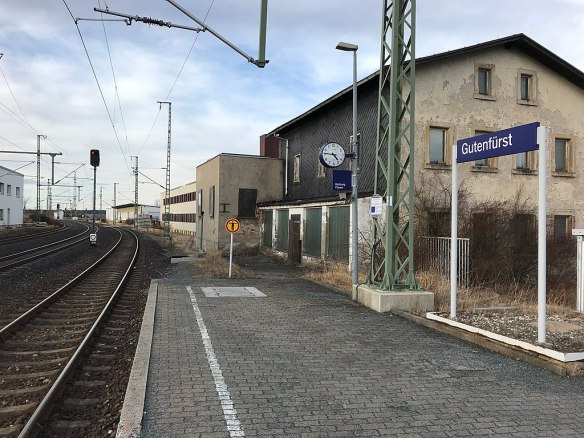
Gutenfürst, the fortified GDR border station. Image from Wikimedia Commons.
There at that last town, the East German customs officials summoned him to leave the train and join them for a little round of questions in their administrative building. They made him unpack all his baggage and identify everything while the train sat in the station. They searched through his things, examined his customs forms, asked him all sorts of questions. After an hour, they were satisfied and allowed him to board again, and then the police came through to see everyone’s travel papers. The train moved again. He stood in the aisle outside his compartment, smoking cigarette after cigarette by the window and watching the land roll by. They passed through the death strip, something he had naturally never seen before with his own eyes, and recognized it as the furthermost boundary of his entire world until that moment. Then, suddenly, the other passengers began to relax and became more talkative.
A member of the Bavarian border police appeared – Grüss Gott, where are you traveling to? Ah, Munich? You’re moving there to be with your wife? Very nice.
He had never heard someone in uniform speak to him in such a friendly manner. The atmosphere on the train lightened considerably.
He was in the West. He was out.
C was waiting on the platform when the train pulled into Munich. It happened to be her thirtieth birthday, and she’d made reservations at a nice restaurant downtown. He still remembers everything about that first day. It was a beautiful spring evening, the sun was still shining, and he was riding through his wonderful new city in the passenger seat of his new wife’s Citroen. He was indescribably happy, with a feeling that his future – their future – fanned out before him, seemingly without limit. Hinterm Horizont geht’s weiter. They would travel. They would start a family.
There was no way for him to know that within two years they would split up, that the Wall would come down, that his old country would cease to exist, that he’d start a new career – after it was clear that employers considered his East German diploma, from the best of universities, somehow suspect – and that neither the career change nor the divorce would be his last.
*From Wikipedia’s entry on crossing the inner German border: “The process of applying for an exit permit was deliberately intended to be slow, demeaning and frustrating, with a low chance of success. Applicants were pushed to the margins of society. They were demoted or sacked from their jobs, excluded from universities and subjected to ostracism. If the applicants were parents, they could face the threat of having their children taken into state custody on the grounds that they were unfit to bring up children. The heavily politicised East German law code was used to punish those who continued to apply for emigration despite repeated rejections. Those who repeatedly submitted emigration applications faced charges of “impeding … the state and social activity”. If they sought assistance from contacts in the West, such as relatives or West German state bodies, they were guilty of “illegal contact” or “traitorous information transfer or activities as an agent.” Criticising the political system was a crime of “public disparagement”. Over 10,000 applicants were arrested by the Stasi between the 1970s and 1989 on such charges.“
 It’s not an original, of course, but a replica, with historical information written in German. This milestone is placed next to the route of the Via Claudia Augusta, here an unassuming gravel road, where it crosses Bahnhofstrasse near Leeder, west of the Lech (The Bahn in question is the old rail line between Landsberg and Schongau, which is only used for special tourist trains a few times in the summer.)