>Renft

>

A recent blogpost elswhere about “Krautrock” (classic rock music from Germany) got me thinking about a post I had wanted a certain music critic friend to write. He never got around to it so I guess I’ll have to write it myself.
Because: there was a genre of rock music coming out of German-speaking lands which was far superior to the Schlager tripe being fed to television audiences in the BRD (West Germany), and had more heart and soul than the Elektropop that groups like Kraftwerk were playing.  And that was Ostrock, the stuff being generated behind the Berlin Wall. Of special interest is the story of the band Renft, which enjoyed a few short years of real success within the country, before inevitably getting in trouble with the government. The following is from “Stasiland: Stories From Behind The Berlin Wall” by Anna Funder.

Renft may have started off with borrowed western rock songs, but there were so many lies that singing the truth guaranteed them both hero and criminal status. By the end of the mid-seventies the band embodied a lethal combination of rock, anti-establishment message and mass adoration. They were shaggy men with bellbottoms and attitude, they were hot, they were rich by GDR standards, and they were way too explosive for the regime.

Performers needed a license to work. In September 1975 Renft were called to play for the Ministry of Culture in Leipzig to have theirs renewed.

‘I had some western money,’ [ Renft said] ‘so before the licensing hearing I bought a small cassette recorder from an Intershop.’ … While they were setting up to play he turned the cassette recorder on and hid it (behind) his guitar…

But they didn’t get to play. [Ruth Oelschlägel, committee chairperson] asked them to approach the desk. She said the committee would not be listening to ‘musical version of what you have seen fit to put to us in writing because ‘the lyrics have absolutely nothing to do with our socialist reality…the working class is insulted and the state and defense organizations are defamed.”

…”And then she said to us, ‘We are here to inform you today, that you don’t exist anymore.'”
There was silence. One of the band members signaled to a roadie to stop setting up. [Lead singer Christian Kunert] asked, “Does that mean we’re banned?”
“We didn’t say you were banned”, Comrade Oelschlägel said. “We said you don’t exist.”
…[Klaus Renft:] Then I said, ‘But…we’re…still…here.” She looked at me straight in the face. “As a combo,” she said, “You no longer exist.”


Renft records disappeared from the shops overnight. The band ceased to be written about or played on the radio. The recording company AMIGA reprinted its entire catalogue so it could leave them out. “In the end it was as they had said: we simply did not exist anymore” [Renft] said, “just like in Orwell.”

Rumors were put out by the state that the band had split up, that it was in diffulties. It was: it couldn’t play. Some members wanted to stay in the GDR, others knew they had to leave. [Lyricist Gerulf] Pannach and Kunert were arrested and imprisoned until August 1977 where they were bought free by the west.

The band members managed to reconvene and enjoy a few more years of retro-success after the wall fell, although without their poet Pannach, who died in 1999. One by one the original members, their lives shortened by a lifetime of political suppression, alcohol and cigarettes (and possibly the effects of radiation used by the Stasi on political inmates at the Hohenschönhausen prison), died off until there is now only one or two left. Klaus Renft himself passed away in 2006, but the band, now with almost all new members, still plays now and then in venues throughout the “former east”.
Here is one of the last songs they wrote (lyrics by Pannach) before the hammer came down back then.
>Hilde Zach 1942-2011

>

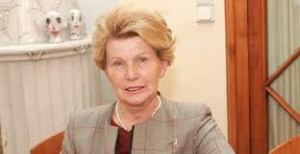
The former mayor of Innsbruck was a special kind of politician. First, she loved Innsbruck (it was said that the city was her “only child”). In her eight years in office, I never heard a single bad word said about her.  Second — and here I speak from first-hand experience — she supported the performing arts like no other. She was in the audience, sometimes in the front row, at countless theater and concert performances. You looked out over the stage lights and saw that hairdo, and you knew the mayor was in the house.

A story I heard years ago about her commitment to the city’s cultural life, from those who were there:

The orchestra was about to perform a Bruckner symphony  for a special season-opening concert in the cathedral. The seats were all taken,  and security were either not permitted or not in the mood to let any more people in. Frau Zach arrived at the last minute, as usual, and asked a group of musicians why they were standing outside. When they explained that they were not allowed to enter, the mayor disappeared into the cathedral, and reappeared a few minutes later, saying “Da ist Platz genug drinnen, alle eini!” (There’s room enough, everybody in!) She simply went right over the security personnel’s heads and pushed us all inside!

Frau Zach battled cancer for years, and last March, when the future no longer looked manageable, she stepped down and handed the reins to her deputy mayor.
Her funeral will be held on Friday afternoon. She picked out her requiem music in advance, requesting the Haydn Mass In Time Of War, and a beautiful choral arrangement of Mahler’s Ich bin der Welt abhanden gekommen the Reinberger Abendlied which she’d heard a few years before at a chamber choir concert (in which I took part.) I will be there on Friday, deeply honored to be able to sing for her again, one last time.

h/t to Günther Hajostek, who remembers that Bruckner concert.

>More Traces Of The Anschluss

>Creepy news from the region. A field of graves containing the remains of approximately 220 people was discovered in the course of a construction project at the hospital in Hall in Tirol. It is suspected that at least some of the dead were victims of the NS euthanasia policy. It has been determined that the bodies were interred between 1942 and 1945.

Construction plans were immediately halted and plans made to exhume and try to identify the bodies. According to local historian Horst Schreiber (an excellent author of many in-depth books about the region during the Nazi era), plans had been submitted for a euthanasia program involving lethal injection, but was rejected by the Nazi authorities (for whatever reason). It has been long suspected, however, that hundreds of patients were simply starved to death in Hall.

In the Anschluss years, at least 3000 people from Tirol and Vorarlberg were reported as carrying hereditary diseases — by doctors and other caregivers, who were legally bound to report them. At least 400 were forcibly sterilized; over 700 from Tirol, including children, were deported to Schloss Hartheim near Linz, a main area of euthanasia activity where thousands of people were gassed. Records were kept top-secret and death certificated were falsified, the families of the deceased given false information about the fate of their loved ones.

Exhumation of the graves will begin in March.

Wikipedia entry on “T4”
Article in Der Standard (de)

>Weekend Mountain Blogging: Sillschlucht

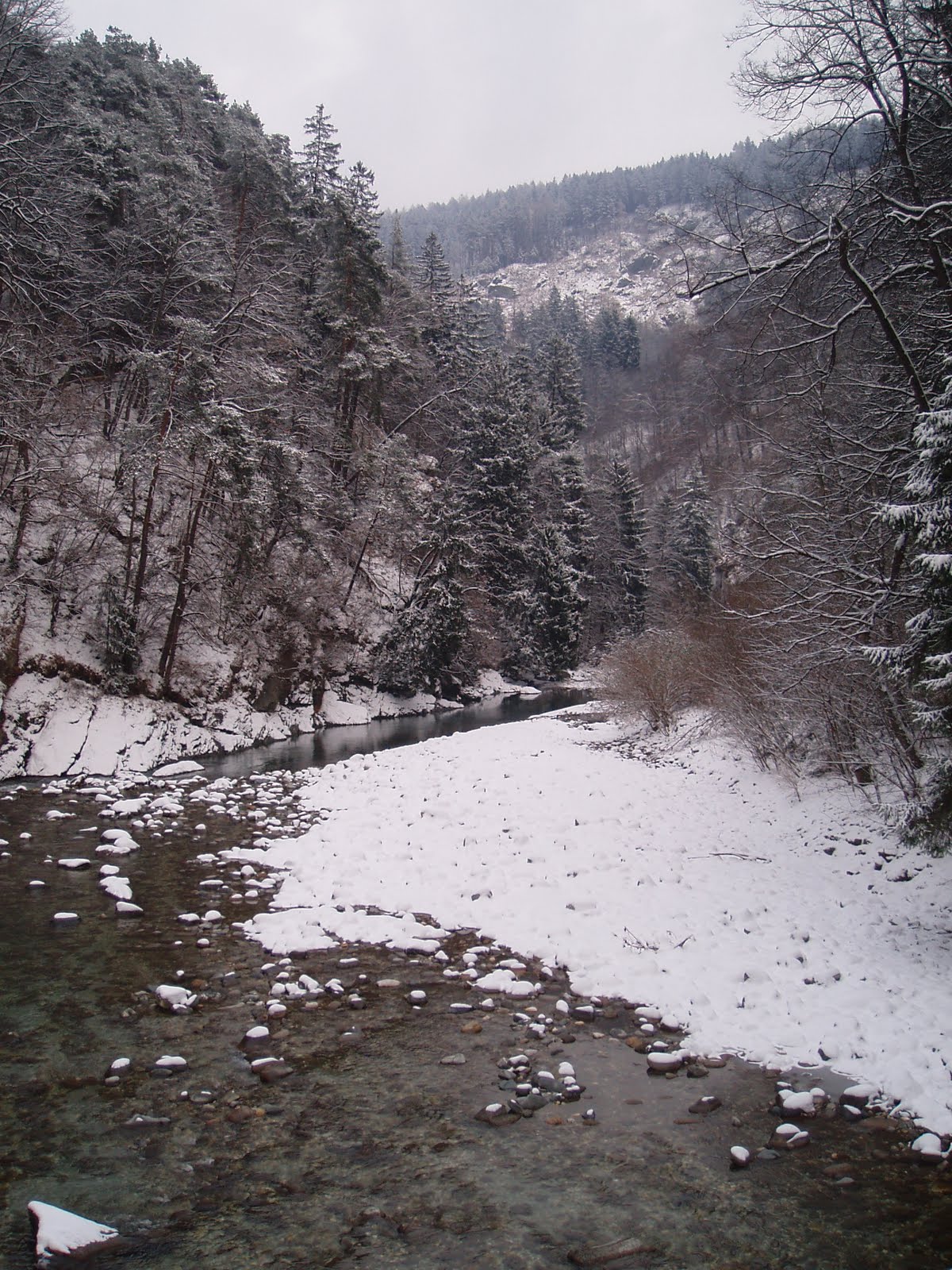
>There is another circular hiking route around Bergisel, which is close by and not long. A nice walk, especially when you have to leave the house or go mad from the noise of jackhammers.

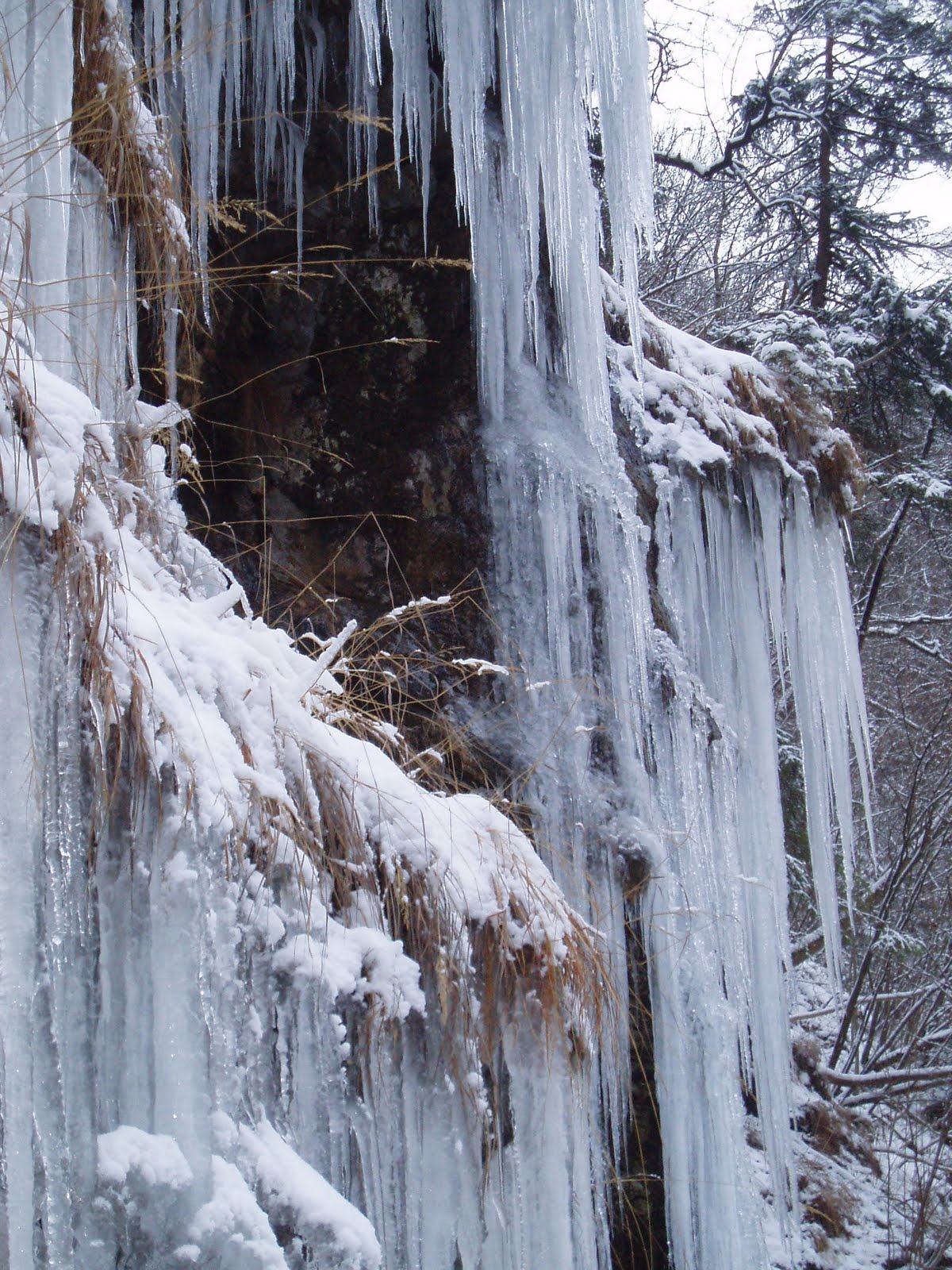
Blue-green, crystal clear, icy water. Beautiful, but the paths are narrow and slippery in the snow, and the place tried to kill me several times by nearly sending me down into the stream. My other route is more welcoming.
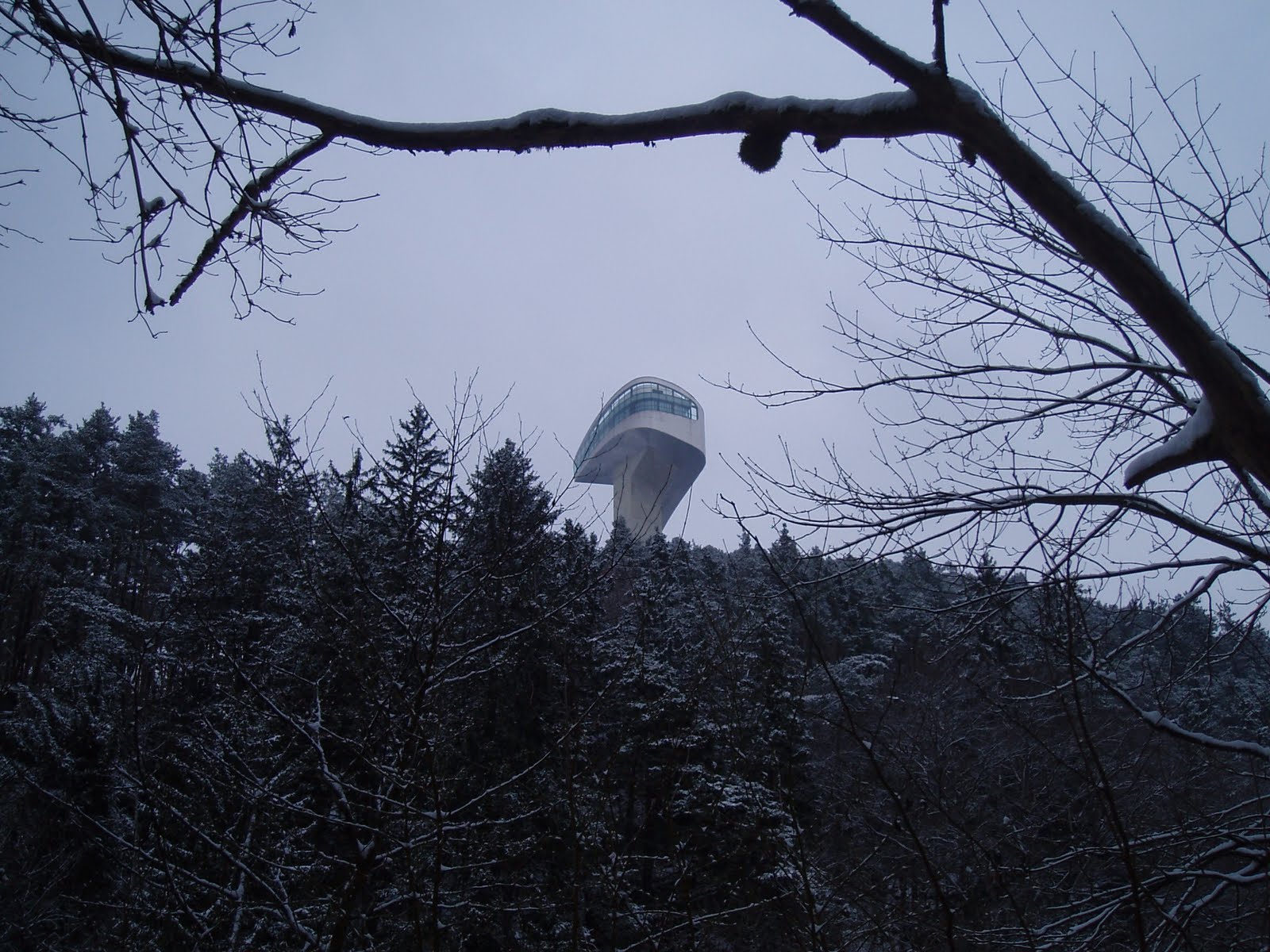
The back end of the Bergisel ski jump/cafe.
A memorial for Father Franz Reinisch, an Austrian priest who was executed by the Nazis in 1942 for refusing to join the Wehrmacht on conscientious grounds. He had spent his youth and student years in Innsbruck.

>Fun With The Language

>New York Times op-ed columnist Frank Rich writes about Sarah Palin this week, and in doing so has coined the perfect word to describe her new reality show, and in turn the perfect word to describe the image she presents to the world:

Palin fires a couple of Annie Oakley-style shots before we’re even out of the opening credits. The whole package is a calculated paean to her down-home, self-reliant frontiersiness — an extravagant high-def remake of Bush’s photo ops clearing brush at his “ranch” in Crawford, which in turn were an homage to Ronald Reagan’s old horseback photo ops in his lush cowpoke digs in Santa Barbara.

She’s not really a frontier woman, she’s “frontier-sy”, and as you can see from her political predecessors, it definitely has its appeal in America. Palin, like Bush II and Reagan, works the masses with her image as one of the “just plain folks” (which she most certainly is not) who don’t care too much for that high-fallutin’ fancy-pants higher education.

There’s been lots written over the years about the “dumbing down of America”; I haven’t read too much on the subject* but suspect it springs from a mistrust of “educated folks” that started perhaps in the beginning of the last century already. It’s something that I don’t see much here in Europe, not in this quantity, not as part of the fabric of the popular culture. There is no fitting translation of the English words “nerd” or “geek”; I hear “Eierkopf” — egghead — once in a while but there doesn’t seem to be any massive stigma in being an intellectual (not that I’d know for sure, not being able to call myself one**.) This might be because European intellectuals suffered their own actual pogroms in the past, as they never did in America. There is also the term “Fachidiot” which is, I’m guessing, someone who knows all about one subject and nothing else.

* Charles Pierce’s “Idiot America” is good, but doesn’t get down to why it’s been like this for so long in America, and not so in other countries (in my unlearned opinion.)

** And anyway I feel that for the most part I am treated well here, but any treatment, either preferential or discriminatory, that one receives would have to be viewed through several lenses — gender, age, foreignness, looks, German proficiency perhaps above all — before intellect was even considered. I think.

>Die Ahnen

>On the left is my maternal great-grandmother, who died of illness when my grandmother was still a young girl. Next to her is her own mother, and her father is in the back, sitting against the wall. The parents were both Carpatho-Russian immigrants from eastern Slovakia, who met in America. I’ve heard it said that my great-great-grandmother had “second sight”, which is intriguing, although I have no examples to relate.
My Sicilian great-grandparents with six of their seven children (the youngest hadn’t been born yet.) I am fairly certain that the boy sitting closest to my great-grandfather is my own grandfather, from his face and his expression. I can only remember meeting my great-grandparents a couple of times, even though we all lived in the same town. A family reunion or two, and then a funeral (hers.) By all accounts they were kind and lovely people. He was a professional barber with an interest in show business — he staged operas and plays in town. I never saw any of this love of the stage passed down in the family It may indeed have been there, only dormant, or there and gone before I came into the world. But somehow my great-grandfather’s operatic tendencies and the music-and-art-gene in my mother’s family combined to make an opera singer.

>More Pagans In Tirol

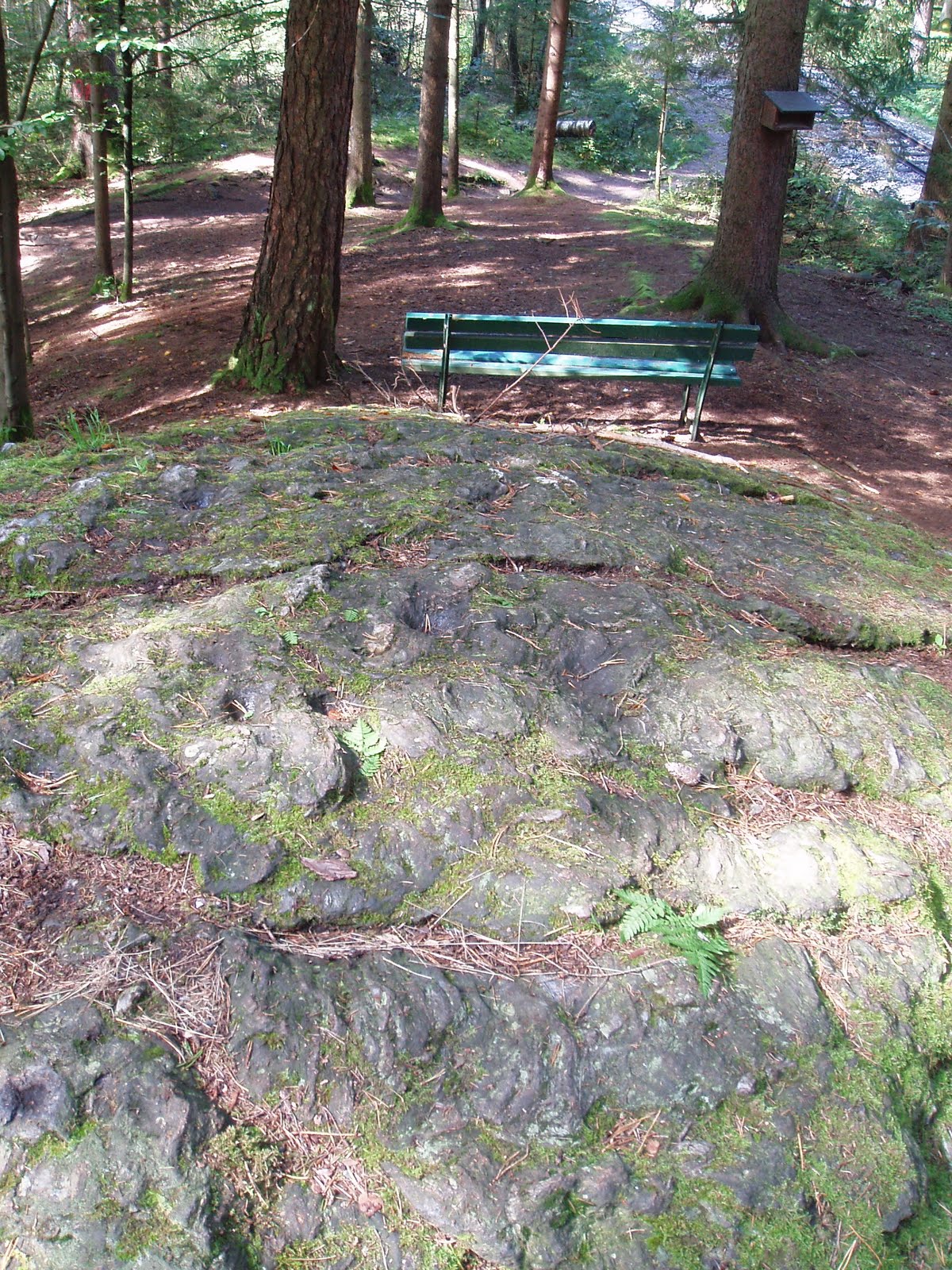
>Yes, I know it look like a face in this photo, with a mouth full of pine needles, but that’s a trick of the shadows. There are at least a dozen cup marks in this stone, and they most certainly date back to the Bronze Age. There are various theories floating around as to what purpose these cup marks had. Maybe for ritual offerings, maybe for astronomical purposes or as pre-historic sign posts. Everyone has a theory, no one really knows. There is supposedly another stone nearby, one hill over from the altar mound at Goldbichl. For me it’s fascinating to think that these markings are from modern humans, with just as much intelligence potential as we have today, who lived here in these hills 6000 years ago, probably right where villages still exist today. And that this practice had spread all over Europe, from Merano to Northumberland. What was going on?
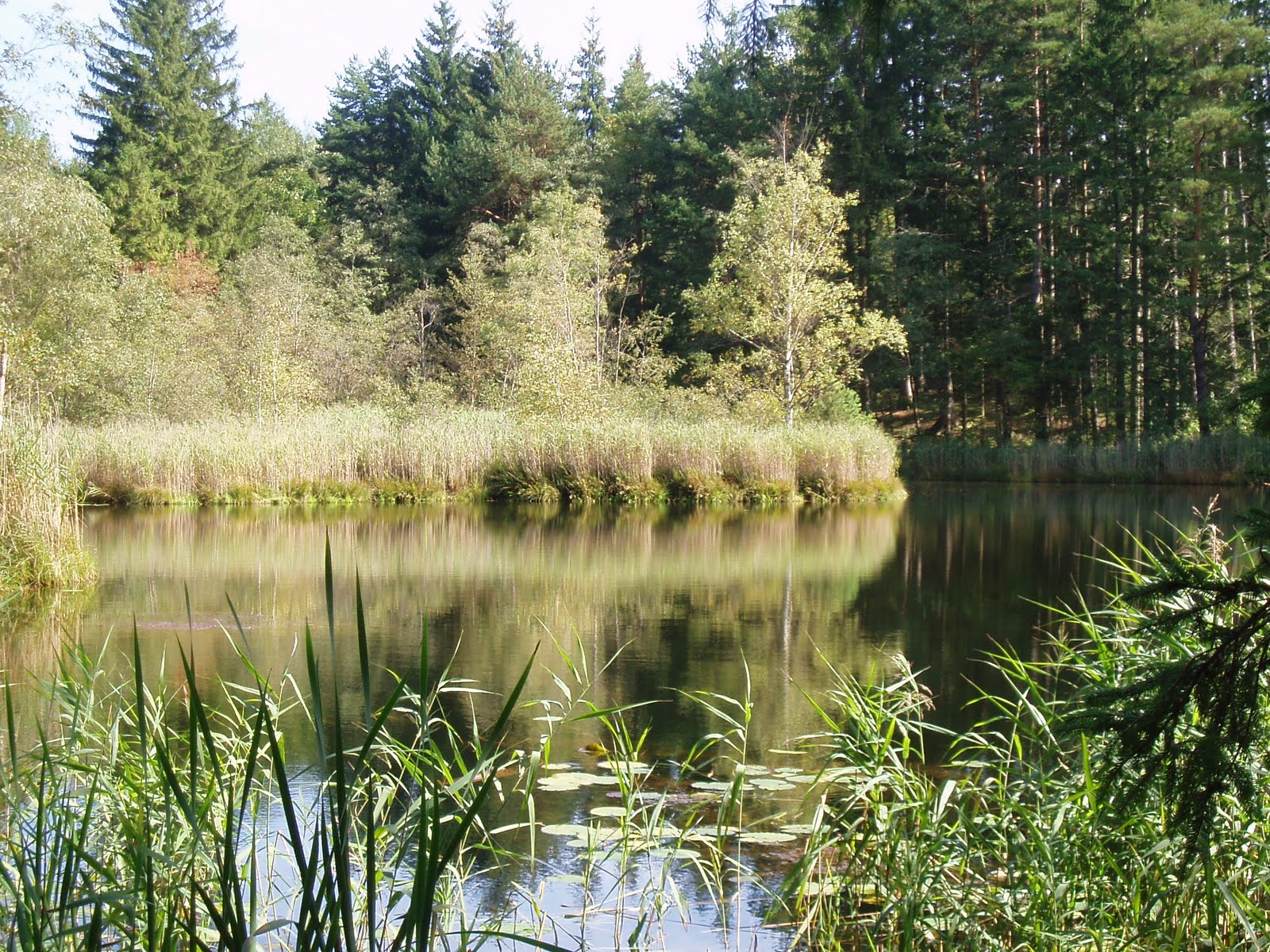
Further up the hill, the Lanser Moor, or Lans Marsh, a nature reserve.
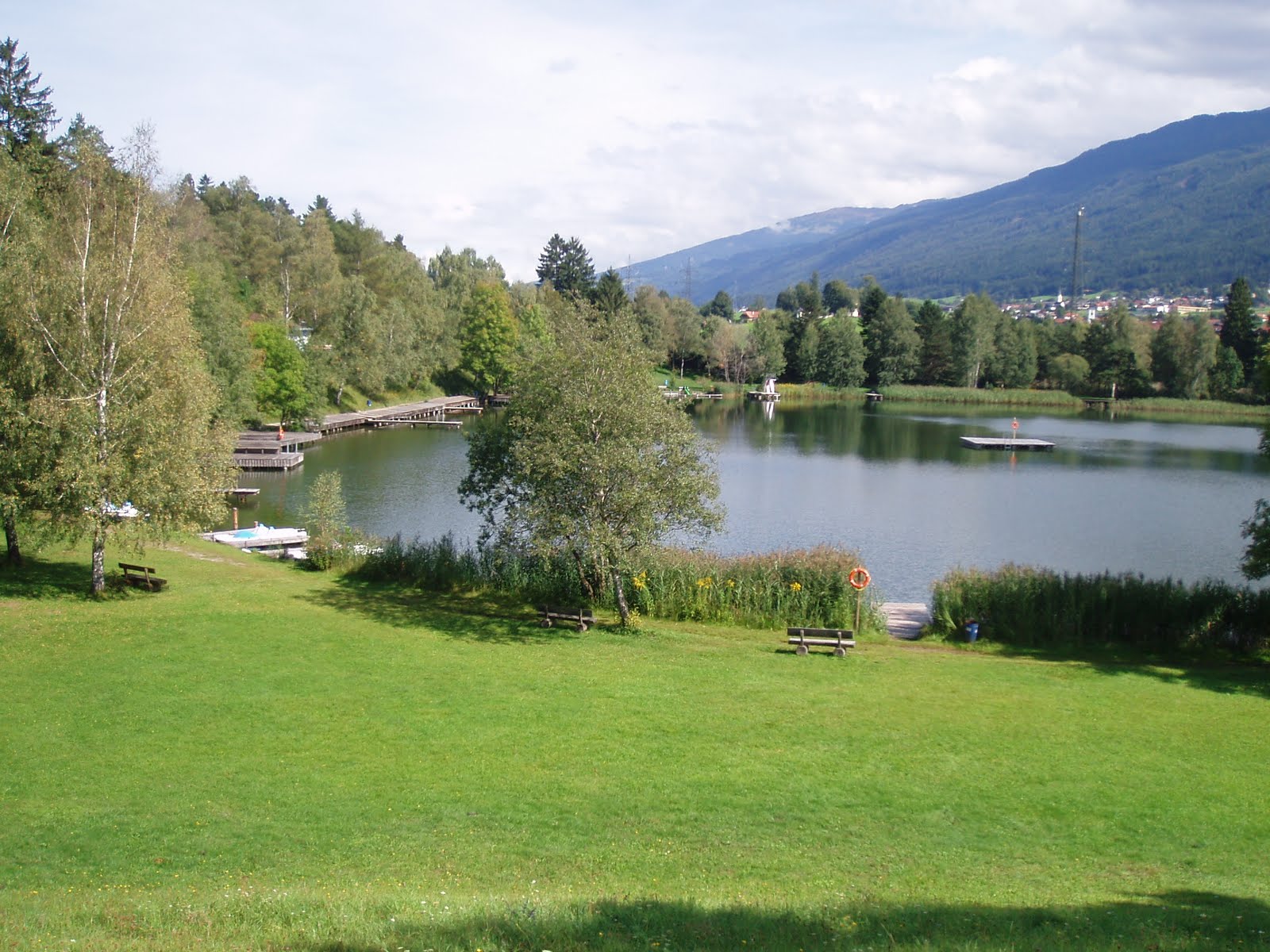
Nearby, the Lanser See, a popular swimming hole, deserted already. There’s a chill in the air now, even on sunny days, and swimming season is vorbei. A legend tells of a rich man who envied a farmer’s grove of trees, and took him to court to obtain it. The judge was unfair and the farmer lost his land, but not before he cursed it to sink under water. Which it did, and now we have the Lanser See to swim in.

Pagans In Tirol: Goldbichl

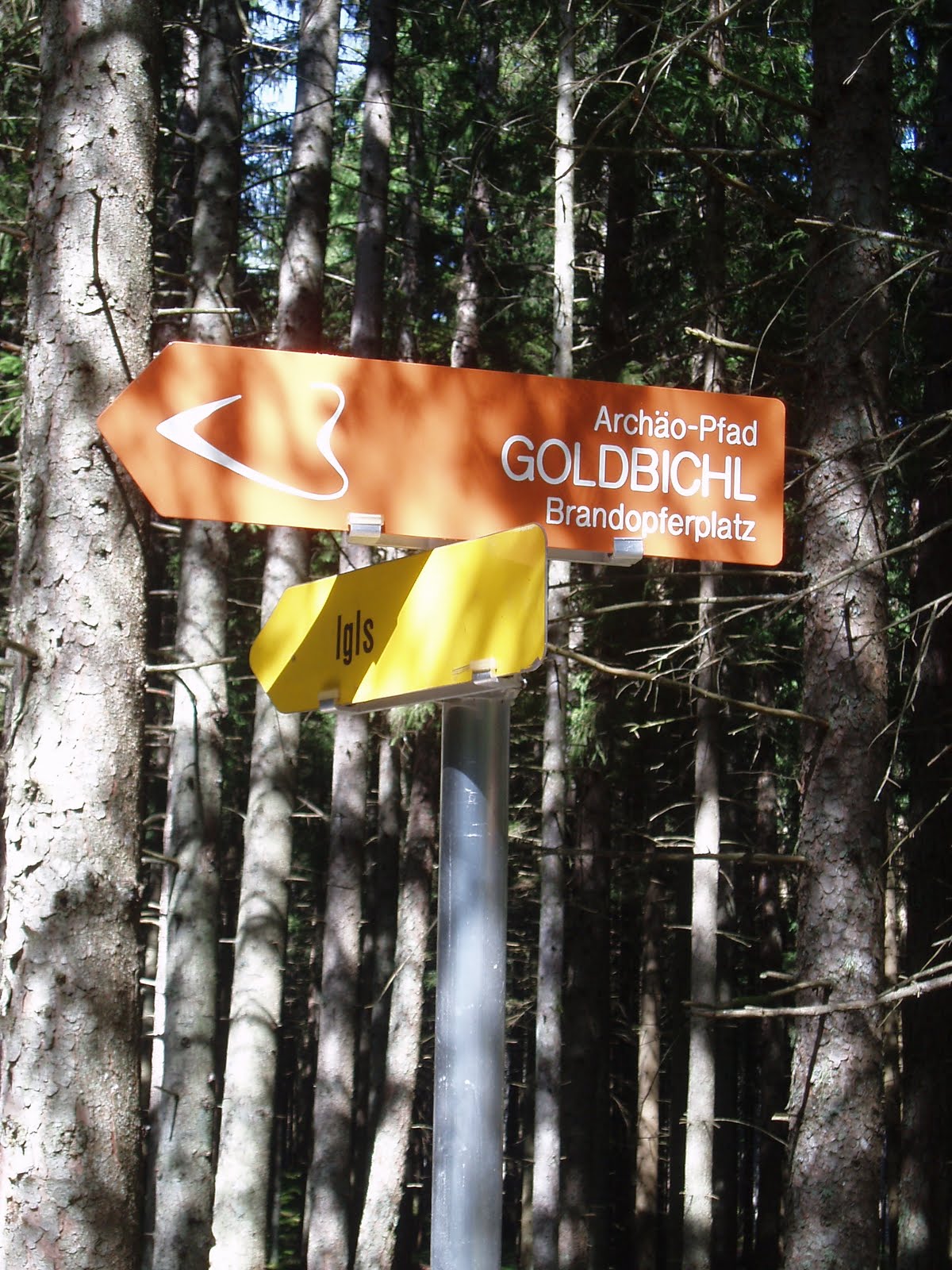
>Thanks to a recent post by a fellow local blogger, I was diverted from my studies by a desire to see a nearby ancient sacrificial burning site, just minutes up the road from town.

Sacrificial burning was, in the Bronze and Iron Ages and into antiquity, a fairly common pratice. The ancient Hebrews did it, and the Greeks, and so did the people of Tirol. Just as the funeral pyre allowed the deceased to leave his or her earthly shell and head off for the great beyond, the ritual sacrifice operated on the same premise; that the sacrificed animal — or object — would lose its material composition and rise as smoke for the gods to receive.
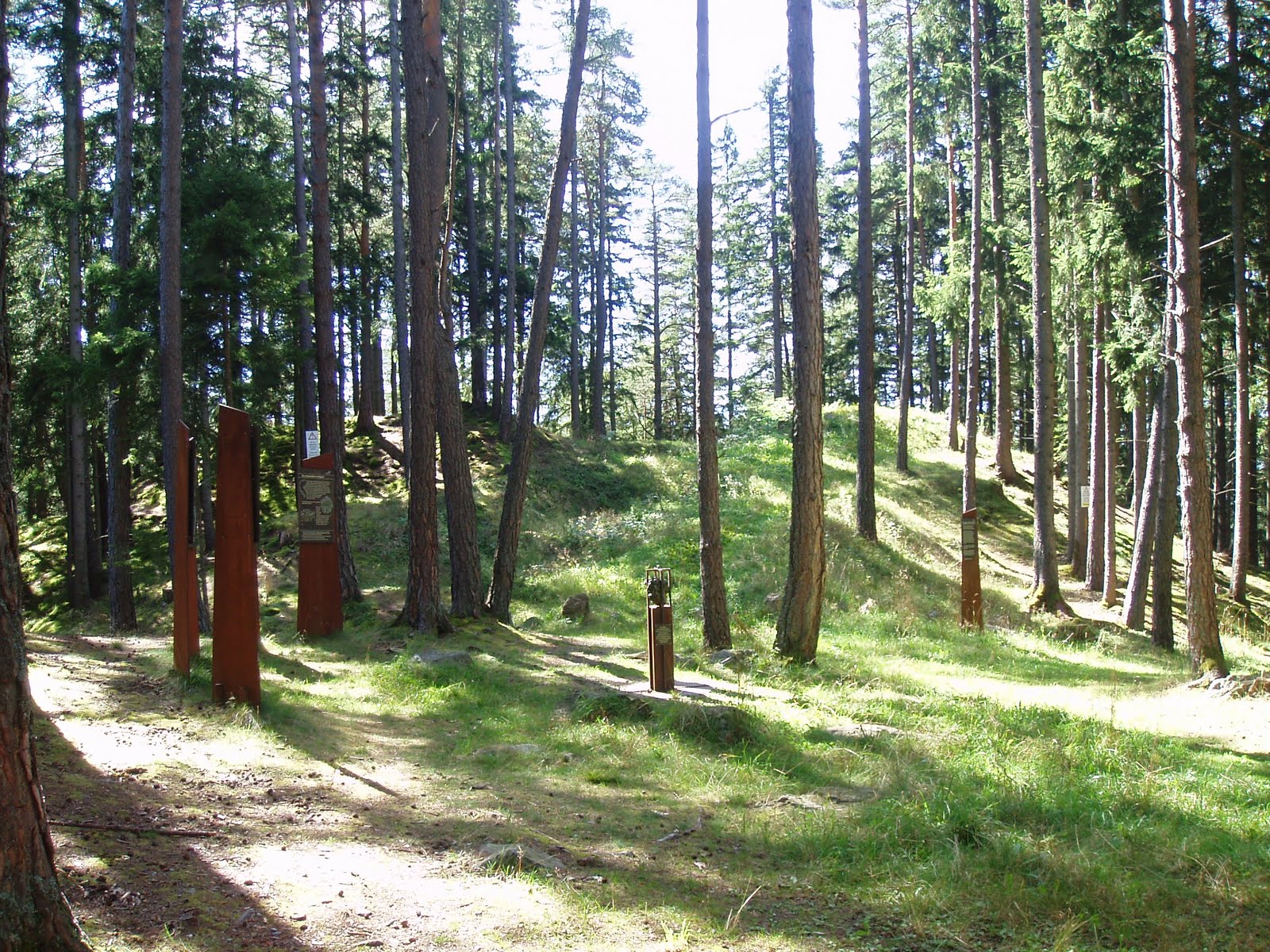
The oldest ritual sacrificial burnings found on the Goldbichl (Bichl is an old alpine word for hill) date back to 2000-1500 B.C. The first altars were clay/mud platforms ringed by stone blocks. Later, a high stone altar was built over the platforms. As clay was necessary to ritual cleansing of the fires, more was applied each time. In this way, the altar grew in height over time.
In the photo above, the level at which the metal signs are found is the natural height of the hill. The mound beyond it is the altar site.


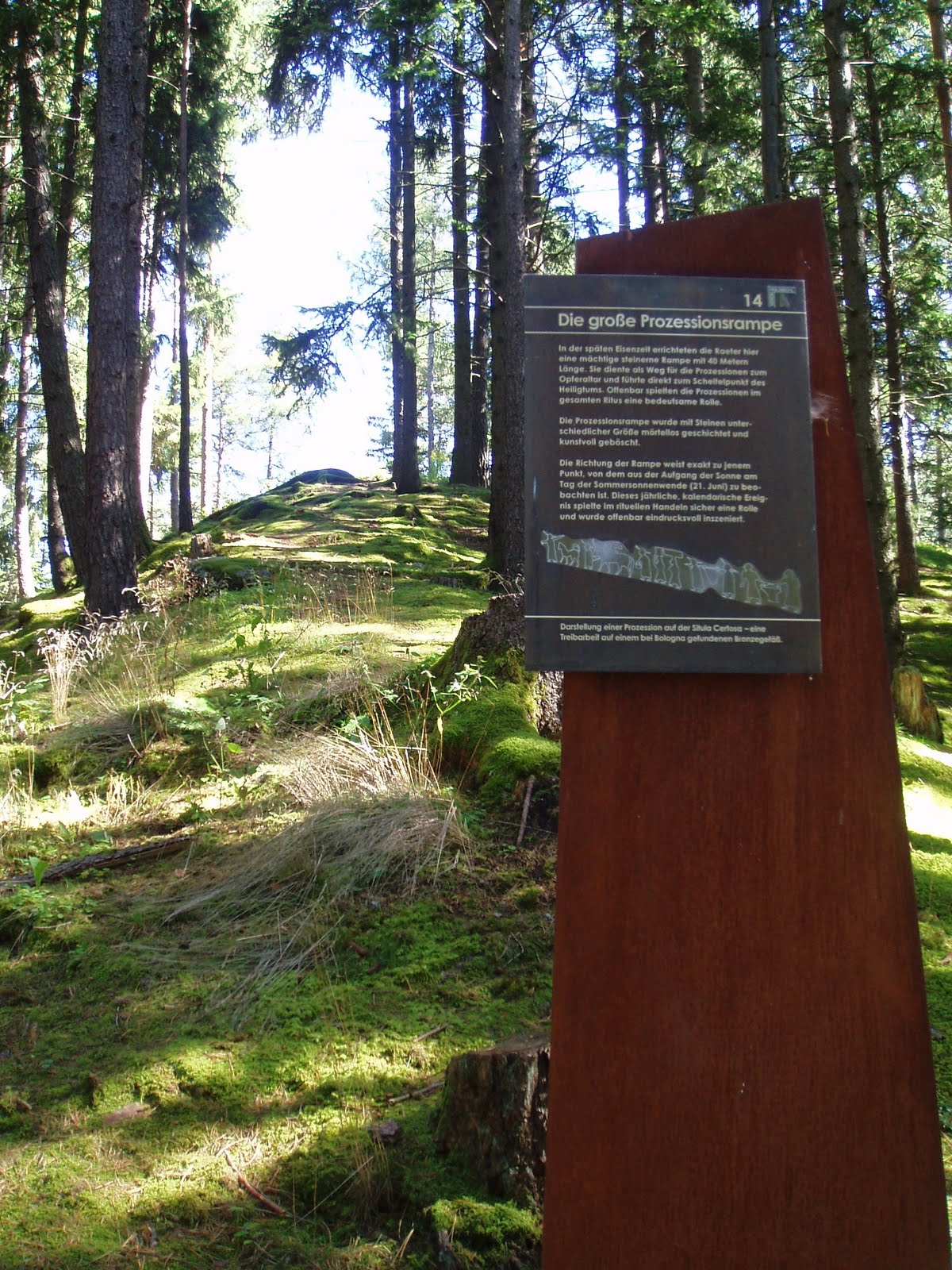
At some point the site fell out of use — possibly its people moved on or were forced away. After a few centuries of disuse, the Raeti crossed the Brenner Pass and settled in. They revived the ritual fires on the Goldbichl, and did some work on the place — they added ramparts, and rose the altar site to a 7-meter-high pyramid. To this height they added a 40-meter-long ramp up the side, which was used as a processional path to the top and led directly to the altar. The ramp lines up exactly with the point at which the sun rises on the summer solstice. Cool, no? I imagine a dawn procession, where the sun rose right up over the fire. Very theatrical.

Archaeologists discovered one Bronze-Age grave within the walls of the site. It contained the burnt remains of a young woman, along with broken pot shards and an intentionally smashed stone loom weight. Beyond its use in looms, which was to keep the vertical threads taut, the loom weight had symbolic value. In Greek mythology, spinning and weaving were analogous to the unfolding of destiny. Zeus’ daughter spun the thread of each human’s life. With this in mind, it is possible to imagine that the woman here was perhaps a priestess.

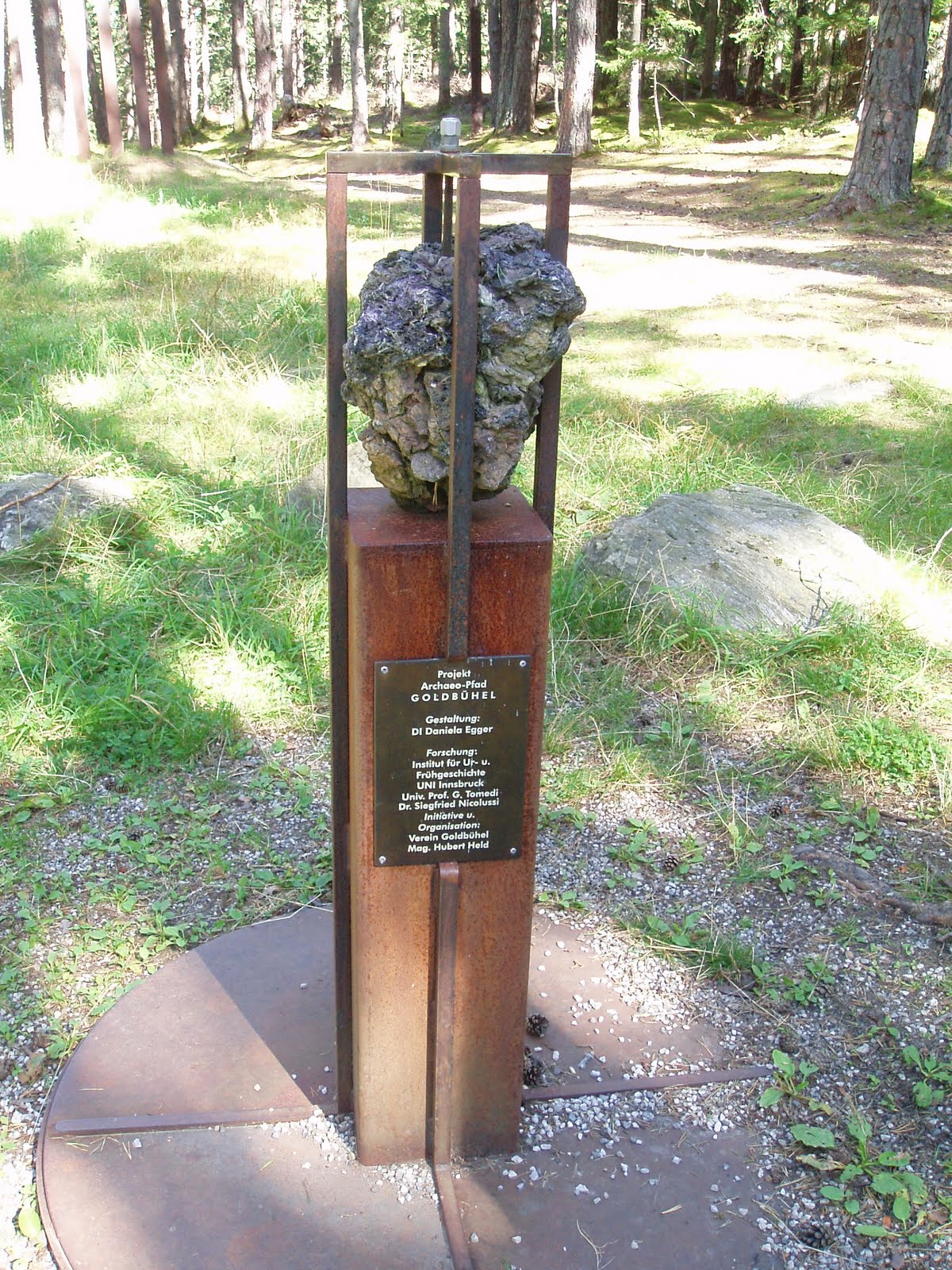
This is a rock which was covered with molten slag. The fire on the Goldbichl reached 1200°C (over 2000°F) which melted nearby rocks. It really must have been quite a show.

The site was destroyed around the time when the Romans pulled in. Drusus and Tiberius, stepsons of Caesar Augustus, led their legions through here on their way to the upper Danube in 15 B.C. It seems that the Raeti, like their Celtic neighbors just to the north, lived on as a subjects, and sent men to fight as soldiers in the Roman army. What happened to them after that, I don’t know. They mingled with everyone else in the Dark Ages and came out as Swiss, and probably there’s some Raeti in modern day Tiroleans as well.
Just up the road toward Patsch we lunched at the oh-so-nice Hotel Grünwalderhof, which has a pretty impressive view. I’m pretty sure we’re looking at the Stubaier Glacier, right above the sails.

More information about the Goldbichl, as well as archaeological finds on display, can be found at the tourist office in Igls.

>The Other September 11th.

>I caught this poem in a film clip at the end of Patrizio Guzman’s documentary “Salvador Allende”, read aloud by its author, Gonzalo Millán. I couldn’t find an English translation of it online, so you’ll just have to accept mine. As this poem deals with another September 11 anniversary, it would be interesting to me if someone wrote about 9/11 like this.

The City

The river flows against the current.
The water cascades upwards.
People begin to move in reverse.
The horses run backwards. The soldiers unmarch the parade.
The bullets leave the flesh.
The bullets enter the gun barrels.
The officers put their pistols in their sheaths.
The electricity flows back into the cable.
The electricity flows back into the plug.
The tortured stop writhing.
The tortured close their mouths.
The concentration camps empty.
The disappeared reappear.
The dead leave their graves.
The airplanes fly backwards.
The missiles rise into the airplanes.
Allende fires.
The flames go out.
He takes off his helmet.
The Moneda is rebuilt like new.
His skull reassembles itself.
He walks back out onto the balcony.
Allende backs up to Tomás Moro.
The arrested leave the stadium, backs first.
September 11th.
Airplanes return with refugees.
Chile is a democratic country.
The armed forces respect the constitution.
The soldiers return to their barracks.
Neruda is reborn.
He returns to Negra Island in an ambulance.
His prostate hurts, He writes.
Victor Jara plays guitar. He sings.
The speeches go back into the speakers’ mouths.
The tyrant embraces Prat.
He disappears. Prat returns to life.
The suspended parts are put back into the treaty.
The workers march by, singing.
We shall overcome!