>May Day

>In villages across Austria, May Day is the day when the Maibaum (a tall smoothed tree trunk with the branches left on only at the very top) is, um, erected (think big phallic symbol being planted into Mother Earth), marking the unofficial beginning of summer and cause for traditional folk music and grillparties with beer.

But that’s in the villages.

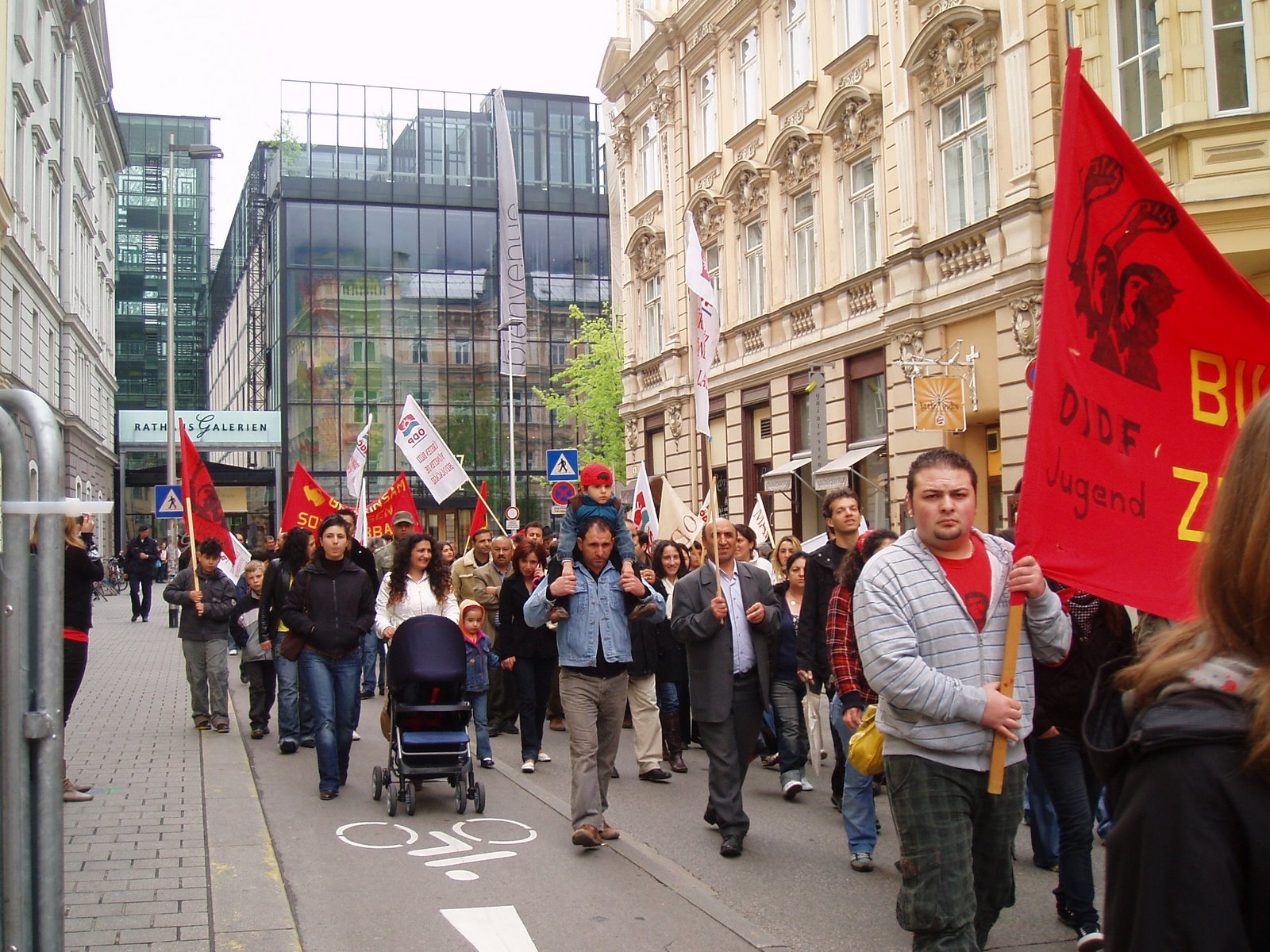
In Innsbruck, however, it’s THE RED SCARE!! RUN FOR YOUR LIVES!!!! No, not really, but the assorted left-leaning parties celebrate International Workers’ Day with small parades and outdoor events.
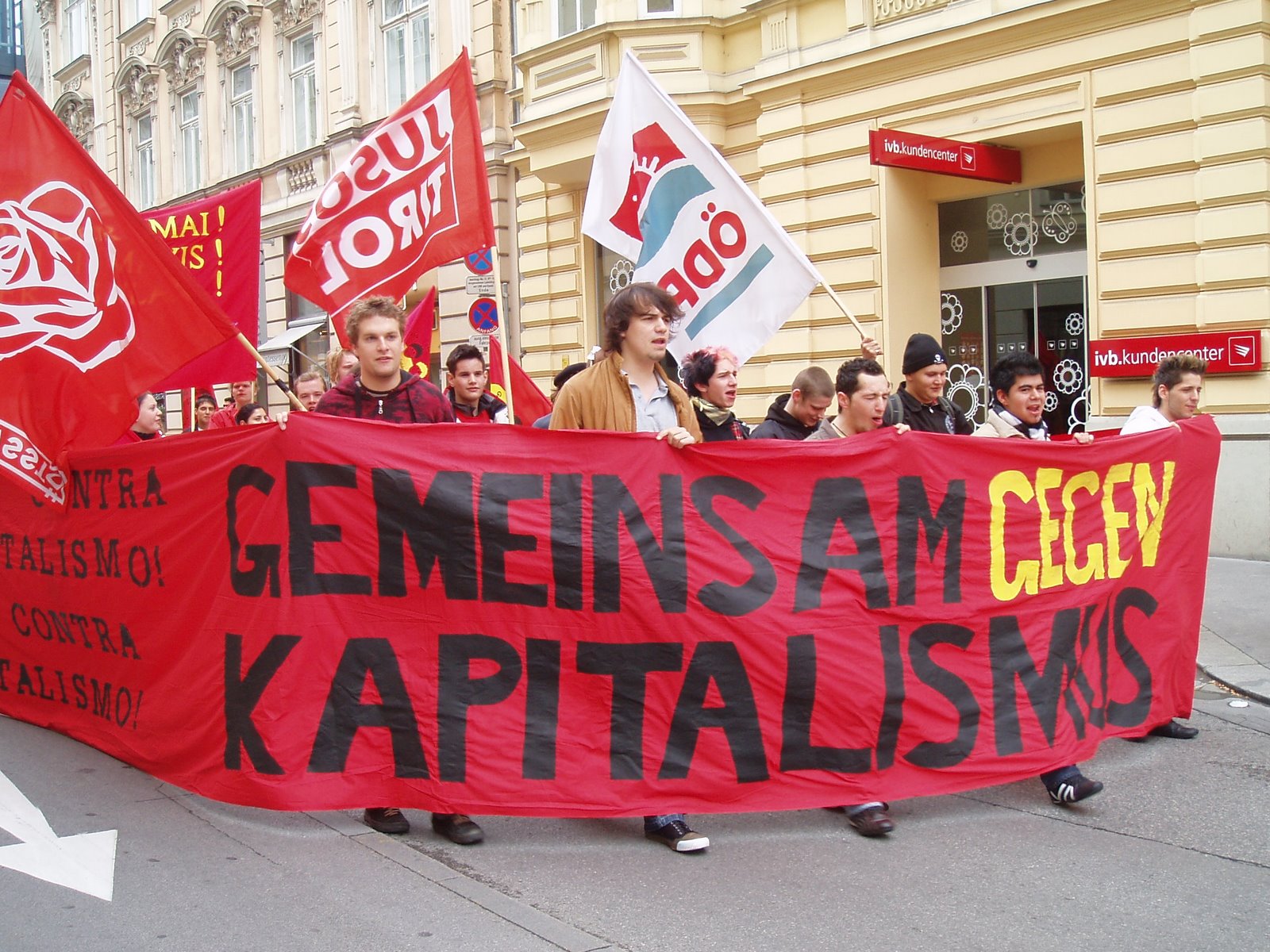
This is the Democratic Ecology Party (Ökologisch-Demokratische Partei), which was founded, I recently learned, by a former member of Germany’s CDU (Christian Democrats, the party of Helmut Kohl et al) who had broken away to help found the Greens, and then broke away from them as well.
Marching with them are members of the Federation of Democratic Workers (DIDF), which is made up mainly of workers with Turkish and Kurdish backgrounds.
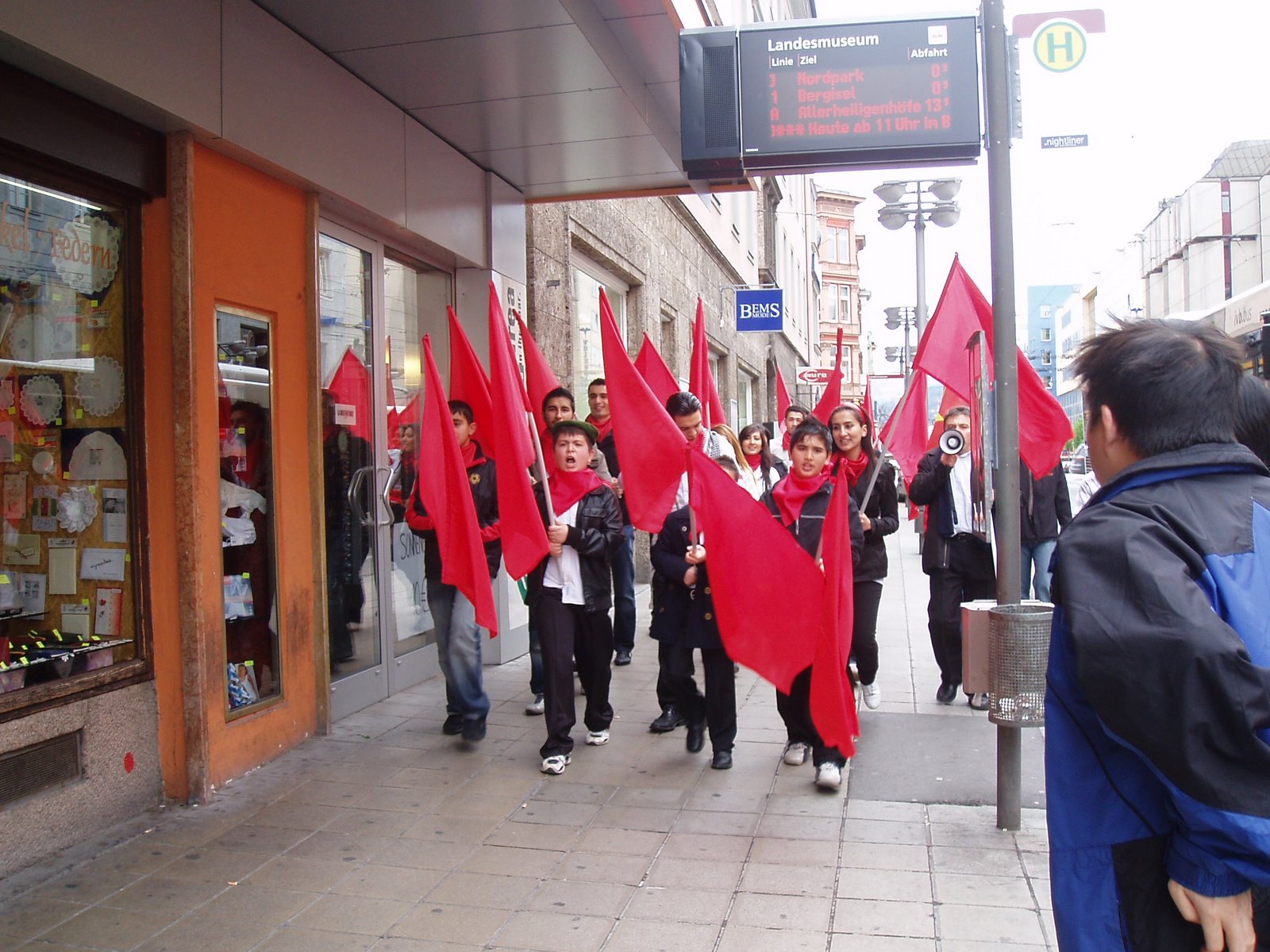
Above: a brigade of young marchers about to join up with the Kommunisten, who had gathered in front of the museum before their own parade.
And yes, they had The Banner, which never ceases to amaze me.(I’ll give them a pass for Marx and Engels. Lenin, not so much, and Stalin and Mao, jeesh, what can one say? There’s really no excuse for it.) But everyone was friendly, no one objected to my photographing them, and even the police, lounging nearby around their van, were laid-back and cool with the whole thing — no alpha-cop tension or aggression anywhere.
I can’t imagine anything like this in the States. Even if the marchers were Grandmothers For Peace, the mere presence of police would, I feel, add a level of unneeded tension to the event. Not that Austrian police are angels, far from it (as we learned from the Marcus Omafuma case) but perhaps the lack of rampant violent crime keeps their stress levels lower. Aggression and fear, which seem to reflect and feed on each other, were not visibly present today.
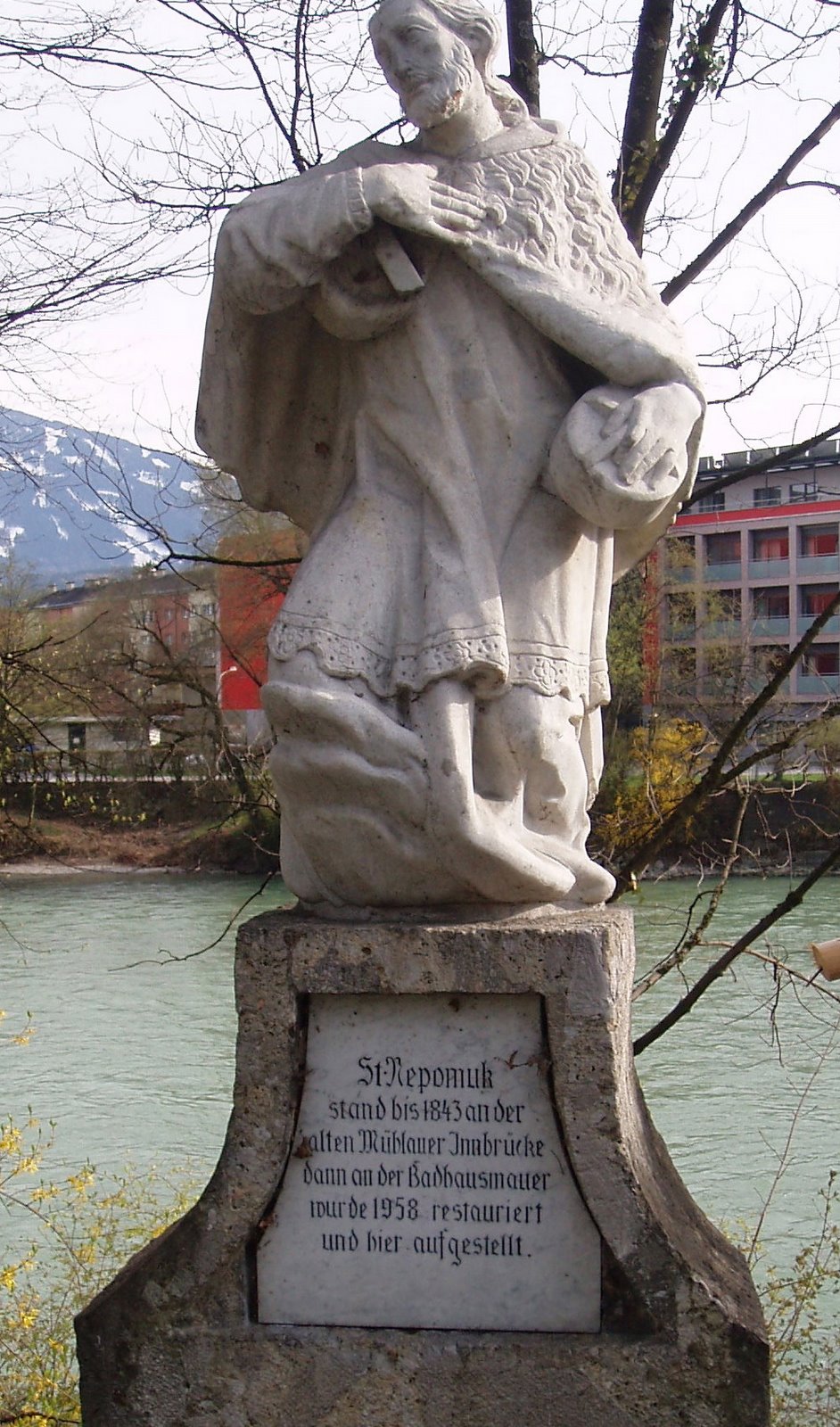
>St. Johann Nepomuk

>There are thousands, if not tens of thousands of St. John Nepomuk statues on or near bridges throughout central and eastern Europe. He was the vicar-general to the Archbishop of Prague, and legend has it that he was martyred for refusing to divulge details of the Queen’s confession* to the King, Wenceslaus**, who had him thrown from the Charles Bridge into the River Vltava. He is the patron saint of rivers and protector from floods.

* There were of course more complicated reasons, involving the King’s support for the Avignon Papacy, and the growing Hussite reform movement in Bohemia.
**This is Wenceslaus IV. The “good” one mentioned in the Christmas carol is Wenceslaus I, IV’s great-great-great grandfather.

>Künstlergespräch; Christa Ludwig

>This morning I had the opportunity to hear two living legends talk about their careers — Brigitte Fassbaender interviewing Christa Ludwig, who turned 80 recently. She’s in fine form, and was a joy to hear as she reminisced about her early career (which began with standards like “Stormy Weather” for American G.I.s in bombed-out Germany); a crisis period which included a divorce, menopause and a burst capillary on the vocal chords all at the same time, and how she felt about ending her career while still in top form (just fine, apparently. She went outside, opened her collar and thought, “At last, I can just catch a cold and not fret about it!”)
Between topics, we got to see and hear a few of her greatest moments on film, including a clip of a concert performance of Bernstein’s “Candide”, with Bernstein himself at the podium and Ludwig singing the Old Lady’s “I Am Easily Assimilated.” It was wonderful, and especially meaningful to me because I had sung that very role on that very stage where she was now sitting, a few years back.
She was wittily honest about what her future plans are (“Nothing!”) and why she doesn’t give many voice lessons (“I’m too lazy”) brutally self-critical at times but not in a self-flogging way, but rather in the way one sees her own “flaws” objectively and strives for improvement. There was a special moment right after a film clip was played of her singing Leonore in “Fidelio”; beforehand she had mentioned that there was a certain note she was never quite happy with. As the clip ended, Fassbaender turned to Ludwig with a silent hand gesture of “Na? What was wrong with that?“, and Ludwig returned with a hand gesture of “Eh, it was so-so!
I was particularly attentive to her discussion of getting through menopause, at it requires a great deal of re-figuring things out for singers, and every women experiences it sooner or later, although it’s not something that everyone talks about openly. Back in my student days, someone told me that Christa Ludwig is a “real mensch”, and this morning confirmed that for me — a warm, funny, feet-on-the-ground kind of artist, and a very special musician. A real living legend.

>Banana trees on the ski slopes

>Achim Steiner, executive director of the United Nations Environment Program, said today that the world’s glaciers are melting “at an alarming rate”, based on data collected by the World Glacier Monitoring Service in Zurich.

Juliette Jowit from the Observer writes:

Glaciers act like gigantic water towers: snow falls on the top in wet seasons, where it freezes and compacts over years, while melting water at the bottom is released gradually, keeping rivers flowing even in the hottest weather. ‘Glaciers are like a bank,’ says Professor Wilfried Haeberli, director of the World Glacier Monitoring Service. ‘You have income – mainly snow – and you have expenditure – mainly melting: the difference between snowfall and melting is the yearly balance.’

Since at least 1980 the service has kept a constant record of this net gain or loss in mass balance of 30 ‘reference’ glaciers in nine mountain ranges around the world. It has also used travellers’ diaries, photographs, and the clues left on landscapes scarred by the moving mass of ice and debris to map historic growth and the gradual decline of glaciers since the mid-19th century.

From 1850 to 1970, the team estimates net losses averaged about 30cm a year; between 1970 to 2000 they rose to 60-90cm a year; and since 2000 the average has been more than one metre a year. Last year the total net loss was the biggest ever, 1.3m, and only one glacier became larger. Worldwide, the vast majority of the planet’s 160,000 glaciers are receding, ‘at least’ as much as this, says Haeberli, probably more – a claim supported by evidence from around the world.

In North America, Dr Bruce Molina of the US Geological Survey says that in Alaska ’99-plus per cent of glaciers are retreating or stagnating’.

In the European Alps, a report last year by UNEP said glaciers declined, from a peak in the 1850s, by 35 per cent by 1970 and by 50 per cent by 2000, and lost 5-10 per cent in the mega-hot year of 2003 alone.

UNEP has also reported declines in the last 50-150 years of 1.3 per cent in the Arctic islands to 50 per cent in the North Caucasus in Russia, 25-50 per cent in central Asia, a 2km retreat of the massive Gangotri glacier which feeds the Ganges, 49 to 61 per cent in New Zealand, and 80 per cent in the high mountains of southern Africa. There is also ‘considerable’ shrinking of medium and small glaciers in central Chile and Argentina accompanied by ‘drastic retreat’ of glaciers in Patagonia to the south.

Steiner also mentioned that the Climate Conference to be held in 2009 in Copenhagen “will provide the true litmus test of governments’ commitment to reducing greenhouse gas emissions, the carbon pollution from fossil fuels damaging Earth’s climate system.

Otherwise, and like the glaciers, our room for manoeuvre and the opportunity to act may simply melt away.”

>Militärgebäude

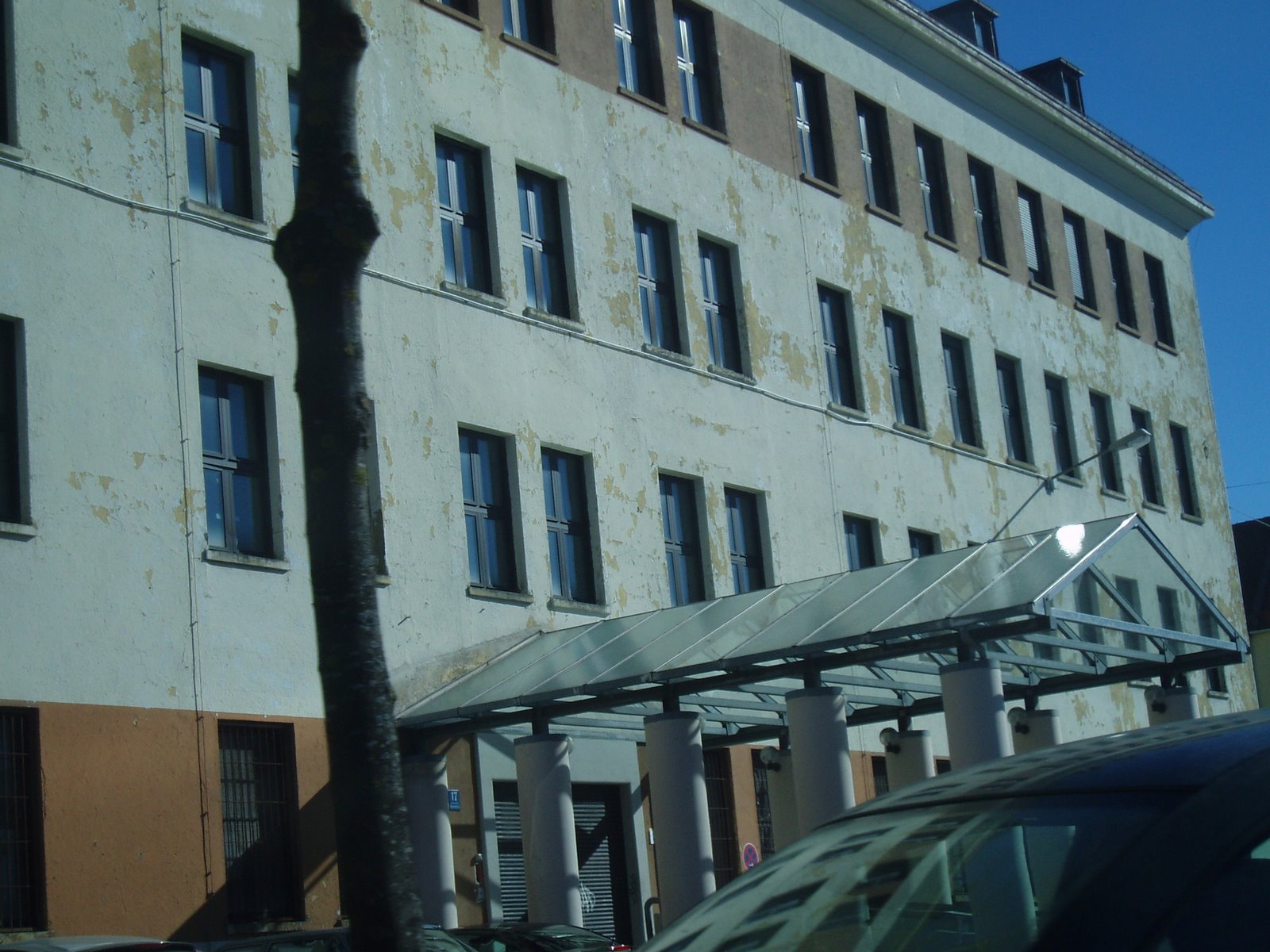
>Occasionally people will say that some neglected eyesore of a building looks like something “aus der DDR”, when it has that look of faded, socialist-architecture glory about it. My boyfriend says this too, and he should know, having grown up there.

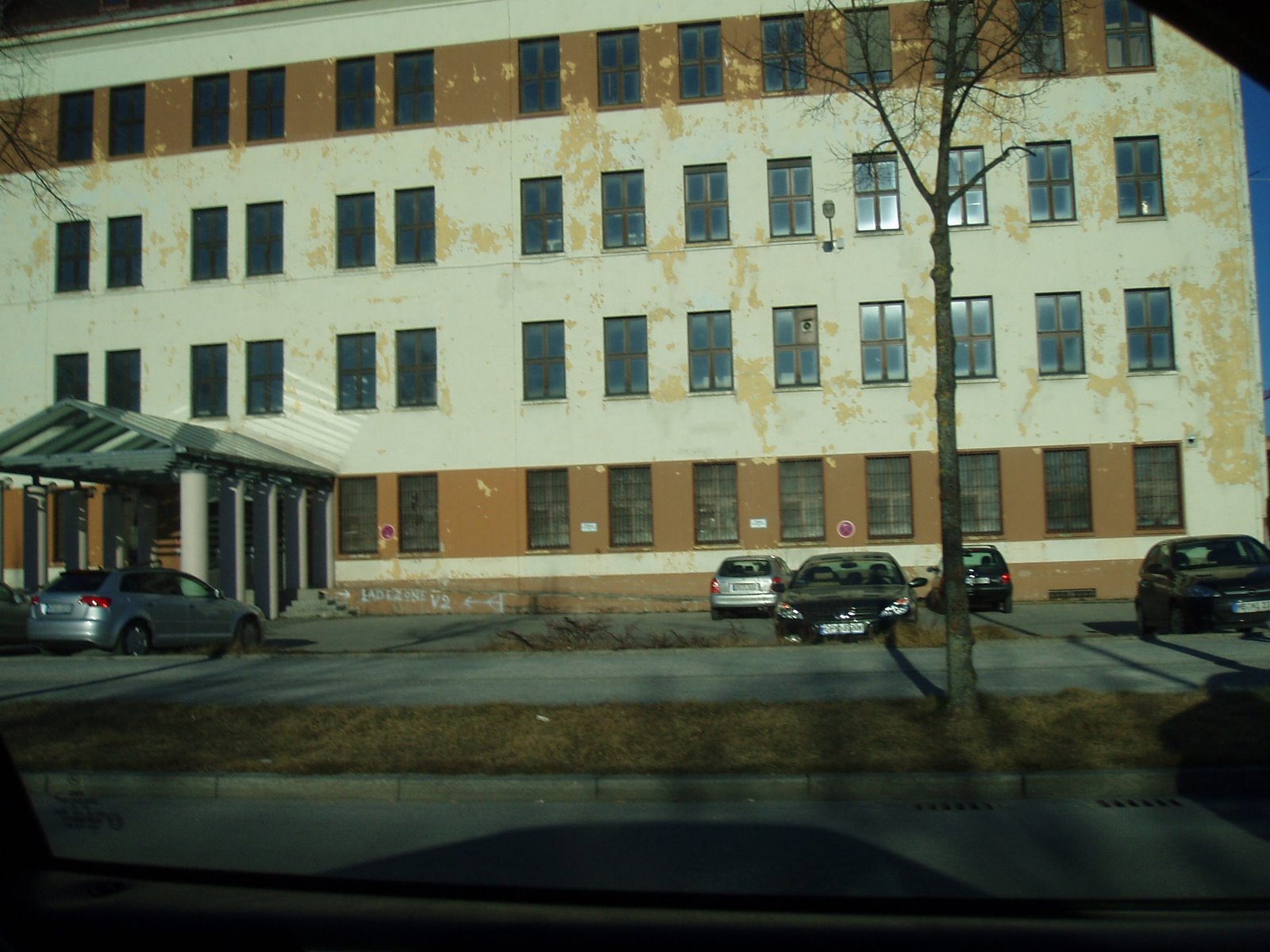
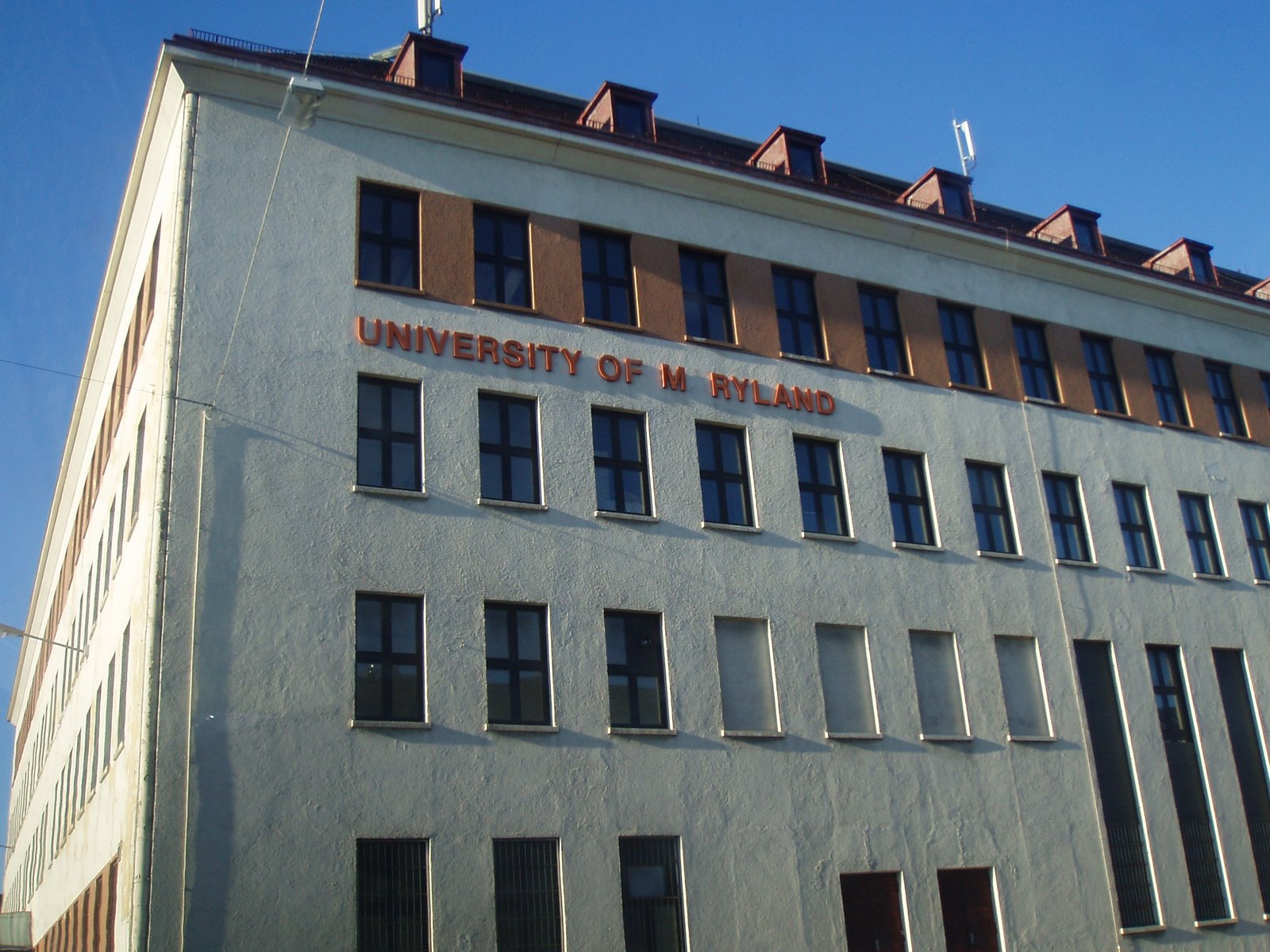
In Munich there is a particular building, attached to a complex of similar buildings, which has this look; massive, with small windows (for more fortress-like protection in case of attack), peeling paint, grass growing in the parking lot. Former Soviet Embassy? Gestapo building? Nope.

It’s OURS. Or was. This branch of the University of Maryland served mainly the children of soldiers stationed here at the neighboring McGraw base (now closed) and other bases in southern Germany. In 1992 the university moved its facilities to Augsburg, and then to Mannheim, where it is set to close any day (in May, I think.) A cursory internet search tell me that the Munich police now use the building, but for some reason they’ve left those letters hanging up there (and falling down) and haven’t bothered to repaint. I am not quite sure who actually owns these buildings now, and that might be the problem.
Like the war bunkers and monuments, these military-related buildings are reminders of a time past, when the cold war was in full swing.

>Spuren des Anschlusses 6: Um das Landhaus

>Innsbruck is Tirol’s capital, and the Landhaus is the seat of the state government. It has a beautiful 18th century facade but the back of it was rebuilt in 1938-40 in what we’ve all come to think of as Ugly Socialist Style. On the rear side of the building over the entrance (not shown) one finds three stone squares; the one on the left is a stone cut of the Tirolean coat-of-arms, on the right that of Vorarlberg (which had been merged with Tirol into one Gau at the time.) The square in the middle is empty, and I was told by a local historian that that is where the swastika was.
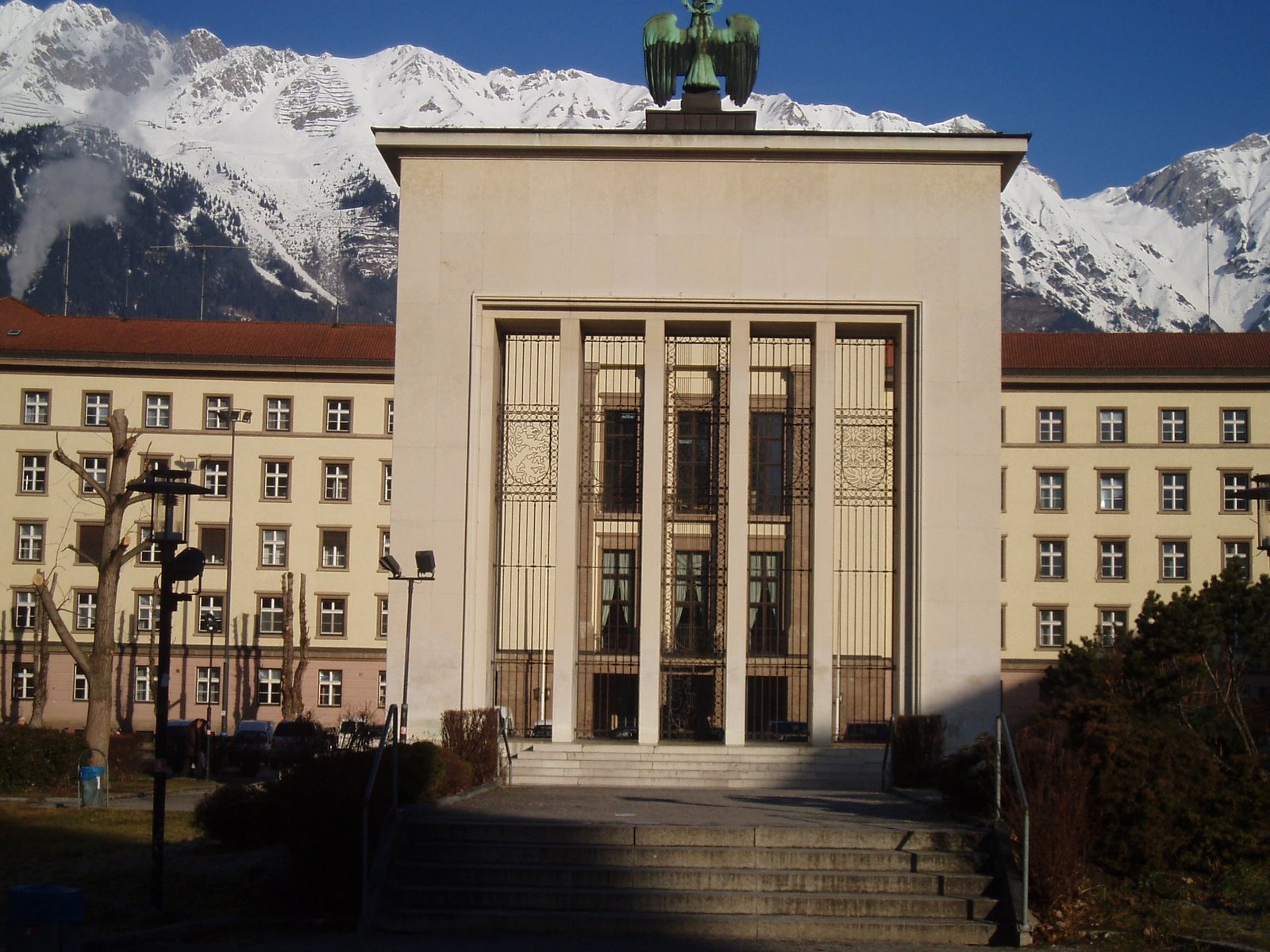
On the south side is the Landhausplatz, and looming in the middle of it is a rather imposing and Socialist-looking monument in the form of a gate. Actually, this monument was built just after the war by the French, as a memorial to her fallen soldiers. Eventually it acquired the words “Pro Libertate Austriae Mortuis”, which made it to honor all war dead. This photo shows the back of the memorial aligned with the Landhaus.
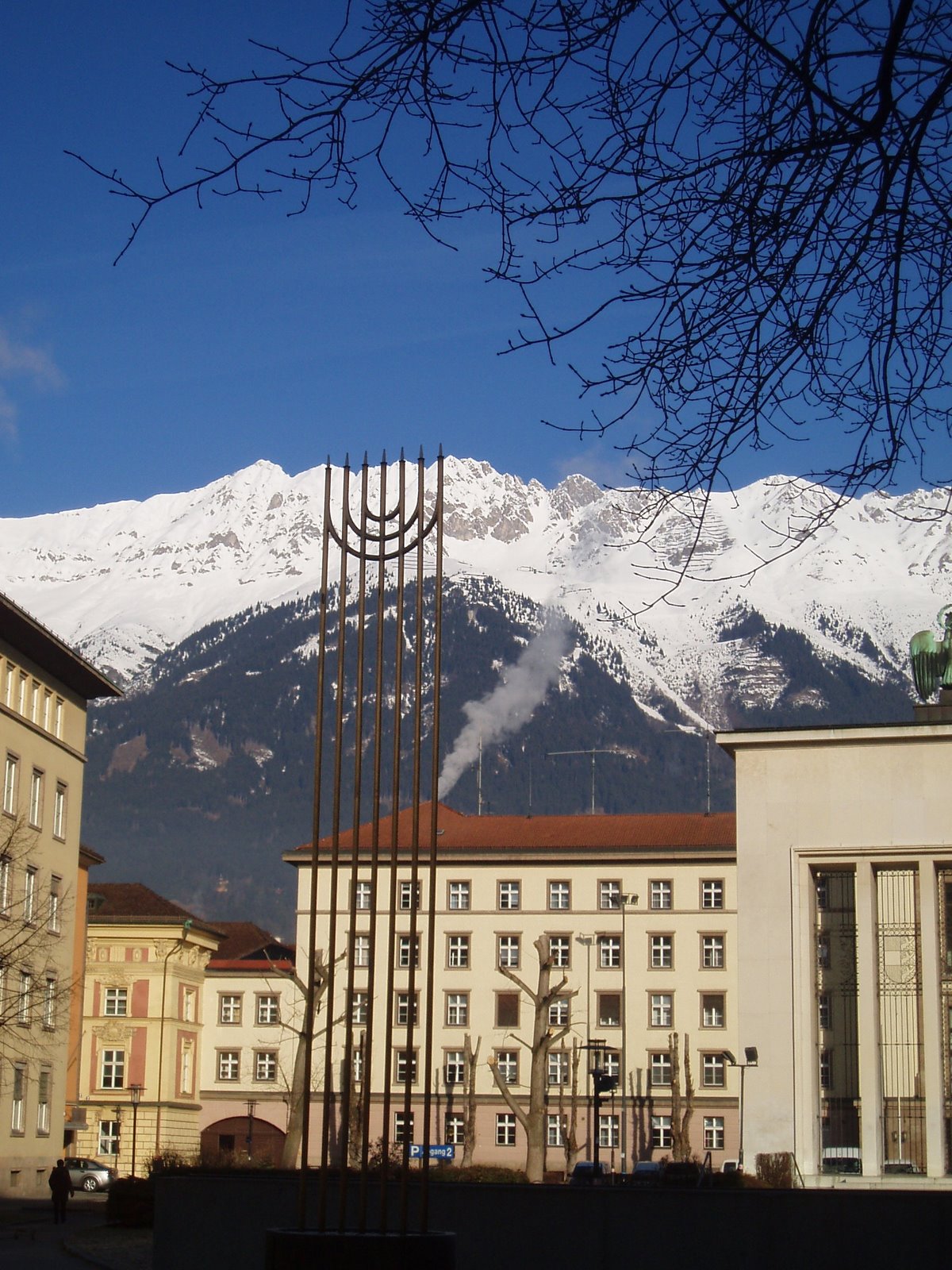
A few dozen meters from the French monument stands a much smaller memorial for the victims of Kristallnacht, November 9 1938. This was the result of a project initiated by the state government in 1997 and awarded to the winner of a local student design competition, the costs taken care of by the state. (The right-leaning Kronenzeitung came out with a complaint, predictably prefacing it’s gripes about money and questions about ulterior motives with “Nothing against memorials, but —.”) The memorial features a menorah design, and a separate sign nearby with the details of the pogrom in Innsbruck.
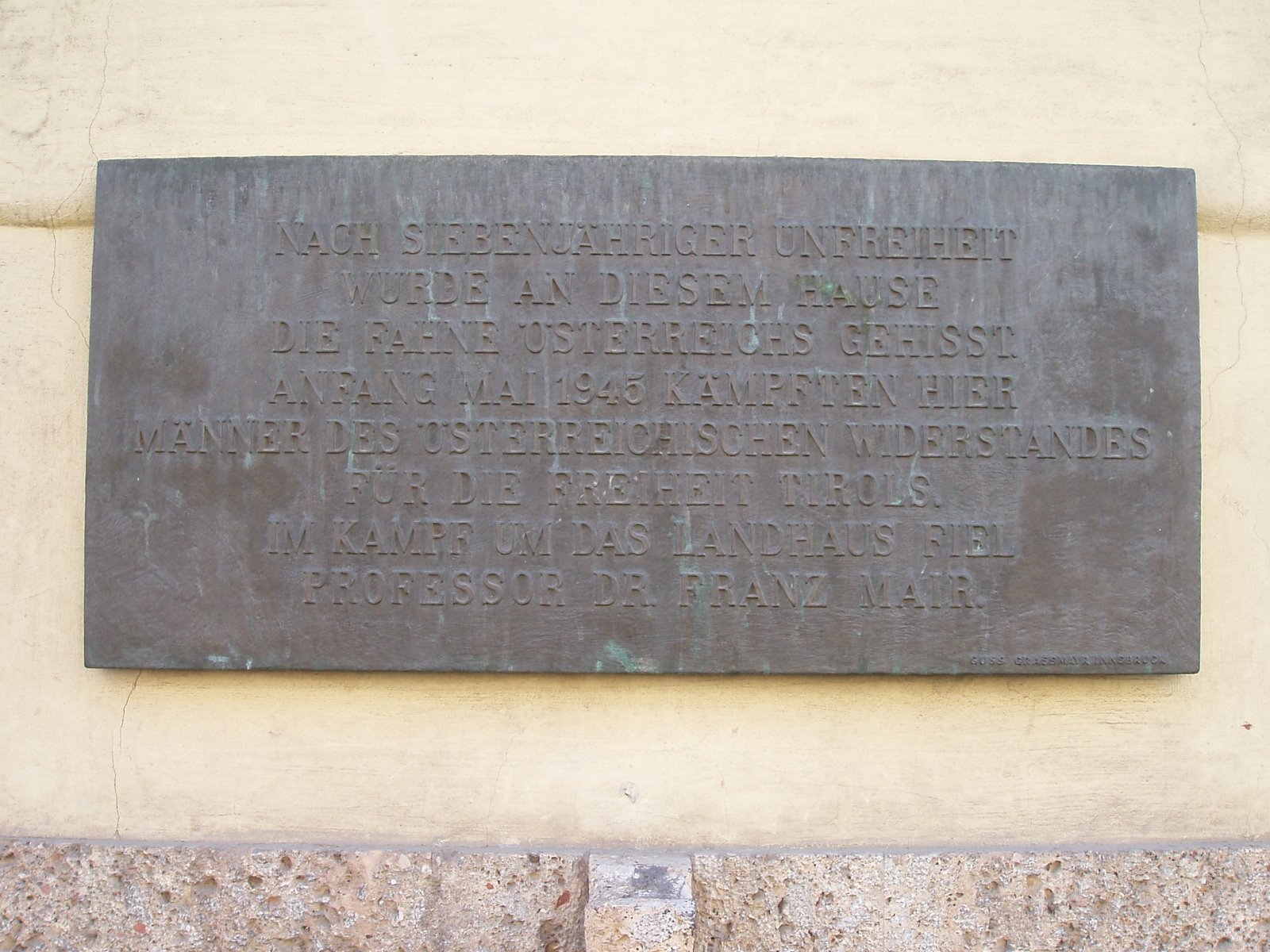
At the front of the Landhaus, just to the left of the main entrance on Maria-Theresien-Strasse, one finds a bronze plaque which reads thus:
After seven years of subjugation, the Austrian flag was raised again before this building. In early May, 1945, men from Austria’s Resistance Movement fought for Tirol’s freedom. At this place, Professor Franz Mair fell in battle.

Franz Mair was a popular high school teacher who led a secret resistance group among the brave and like-minded, including many of his students. When the war was all but over and the Americans had not yet reached the city, there were skirmishes between the still-loyal Wehrmacht and the resistance fighters, who took over the Landhaus in May. This was the first World War II plaque that I came across in Innsbruck, and I learned later that there’s an interesting story attached to it.
This plaque is actually the third incarnation to grace this wall. The first, erected in 1946, was just like it except that it began with the words “Nach sieben Jahre Unterdrückung“, “After seven years of oppression.” In 1955 it was taken down and a new, barely decipherable plaque was put up in its place, which read “In this place, Professor Franz Mair fell in the fight for Tirol’s freedom.” The reason given was that German tourists, taking their vacations in the merry Alps, had complained, although there was also plenty of speculation at the time that more than a few of the local ex-Nazis wanted it changed too.
There were protests, specifically from Catholic groups, and a new “old” version of the plaque then went up, true to the original in all but one word — in place of Unterdrückung, or oppression, this one used the more vague, less aggressive Unfreiheit. There’s not even a decent way to translate this word in the way that it’s meant — “nonfreedom.”
The choice of wording goes a long way to explain the internal conflict Austria had, and is still having, in finding its place during those frightful years. Victim, perpetrator, willing accomplice, resistance fighter, bearer of guilt, denier. All of the above. Unfreiheit.

For now, this is the last installment in my Anschluss history blogging. Thanks for reading it.

Heidemarie Uhl, “Das Gefallenengedenken als Antithese zum Geschichtsbild der Opferthese: von Opfermythos zur Mitverantwortungsthese,” in “Erinnerung-Absenz”, XING Magazine, available in PDF online (in German.)

>Spuren des Anschlusses 5 : Bombenkrieg

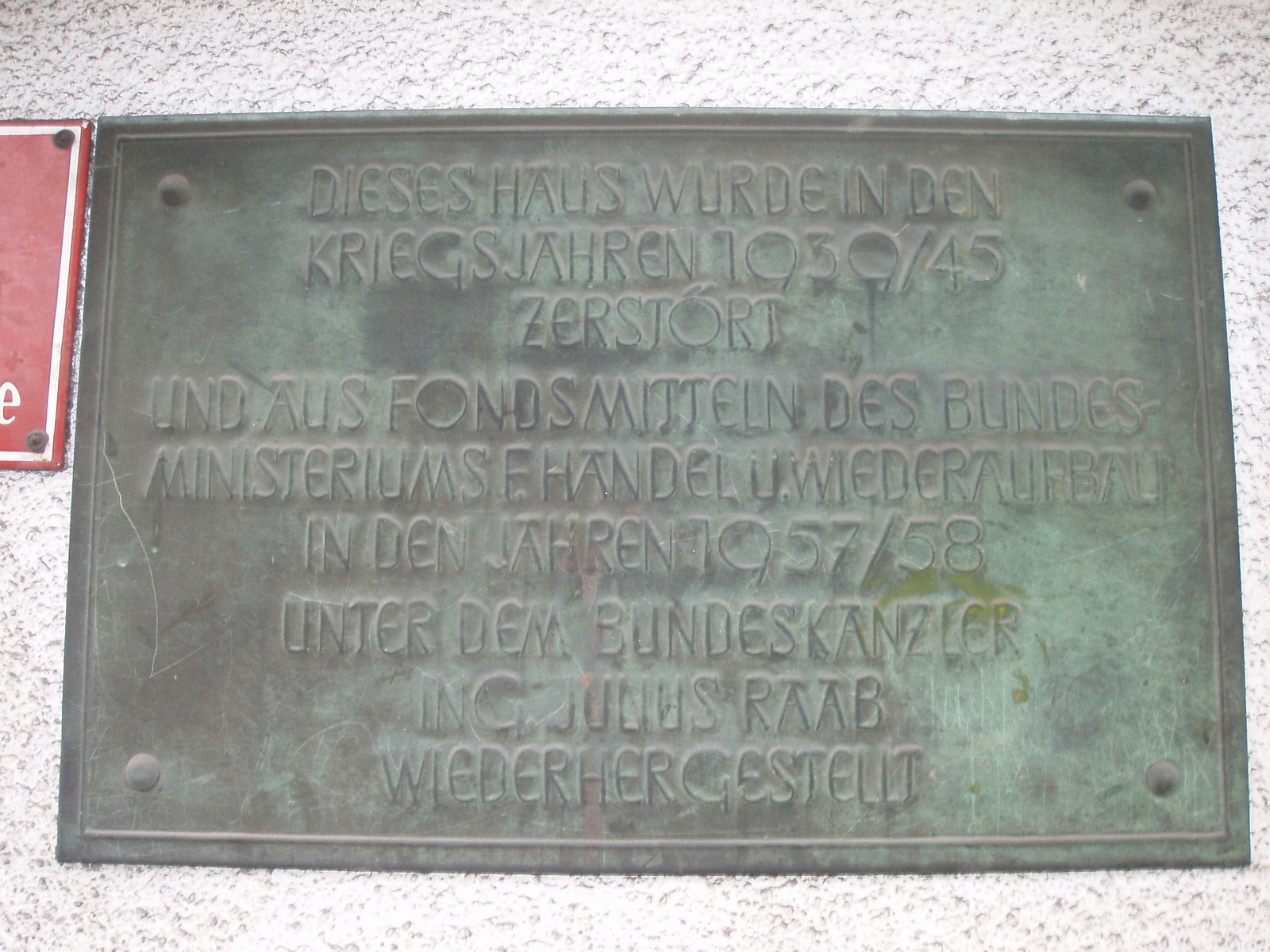
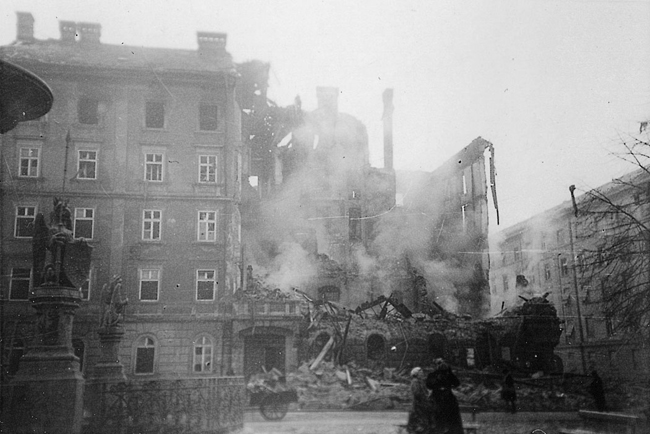
>This plaque happens to be on the front of my own apartment building, but it’s something you see often in certain parts of town, and in many Austrian towns. It says “This building was destroyed in the war years 1939/45, and rebuilt in the years 1957/58 under Chancellor Julius Raab, funded by the Federal Ministry for Commerce and Reconstruction.”

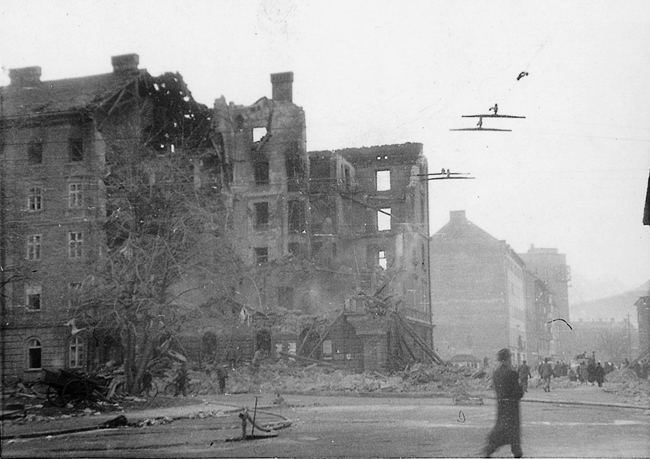
The Firestorms and massive wholesale destruction suffered by many German cities did not reach Innsbruck, but there were heavy bombings, and substantial damage inflicted upon the city. Innsbruck had begun to take on some of the armaments production, and had always been a strategic hub between Italy (via the Brenner Pass) and Germany (via the Inn Valley.)
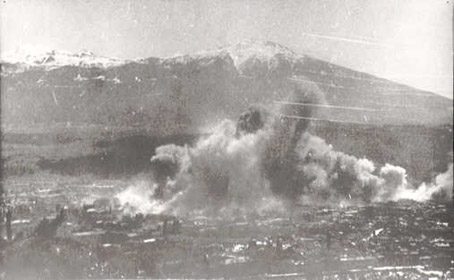
On December 15th, 1943, the first air raids came with 48 B-17 (“Fortress”)Bombers and 39 P-38s (Jägers), dropping 126 tons of bombs on the city, mainly targeting the railways. On this day 269 Innsbruckers were killed, 500 wounded, 1,627 left homeless. Incomprehensibly, not long before the first attacks occurred, the regional government (Gaubezirksgruppe) expressly forbade the construction of tunnels in the mountainsides for bomb shelters.
A second wave of bombing came 4 days later, on December 19, leaving 70 people dead. Only after January, 1944 did work begin on the bomb-shelter tunnels, thanks to approximately 600 forced laborers and Soviet prisoners of war.
Attacks continued intermittently until the war’s end. In December 1944 bombs destroyed many central, public buildings including the railway station, town hall, cathedral, courthouse, and
municipal hall (Stadtsaal), killing 35. This time the NS press accused the enemy of “being no different from the Asiatic animals in the east”, for supposedly targeting civilians.


The mass evacuations out of Innsbruck and into the surrounding countryside led to further chaos and misery. The detention camp in Reichenau filled up. Seven foreign teenagers were hanged for “plundering”, having been caught with bread and marmelade, presumably purloined. A 34-year-old woman from Tirol was sentenced to death for stealing clothing from another woman’s suitcase.
By the time the American tanks rolled in (to much rejoicing, particularly because the townspeople had heard terrible things about the Russian soldiers and feared they would get there first), over 500 of Innsbruck’s citizens had been killed by Allied bombs, over 50% of the city’s buildings were destroyed, 2,062 of its young men had fallen in battles all over Europe, 1,228 returned wounded. These numbers do not include those killed by the NS government for racial and/or political reasons, nor the unknown number of forced laborers who died either during the air raids or “in custody.”

Horst Schreiber, “Im Bombenkrieg. Tirol und Vorarlberg 1943-45”, Innsbruck 1992 (Innsbrucker Forschungen zur Zeitgeschichte, volume 8)

Photos 2-5 from Peter Helfer’s CD-Rom, included in the book “Zeit — Raum — Innsbruck: Schriftenreihe des Innsbrucker Stadtarchivs,” Band 3, Universitätsverlag Wagner, Innsbruck.

>Spuren des Anschlusses 4 : Der Tummelplatz

>
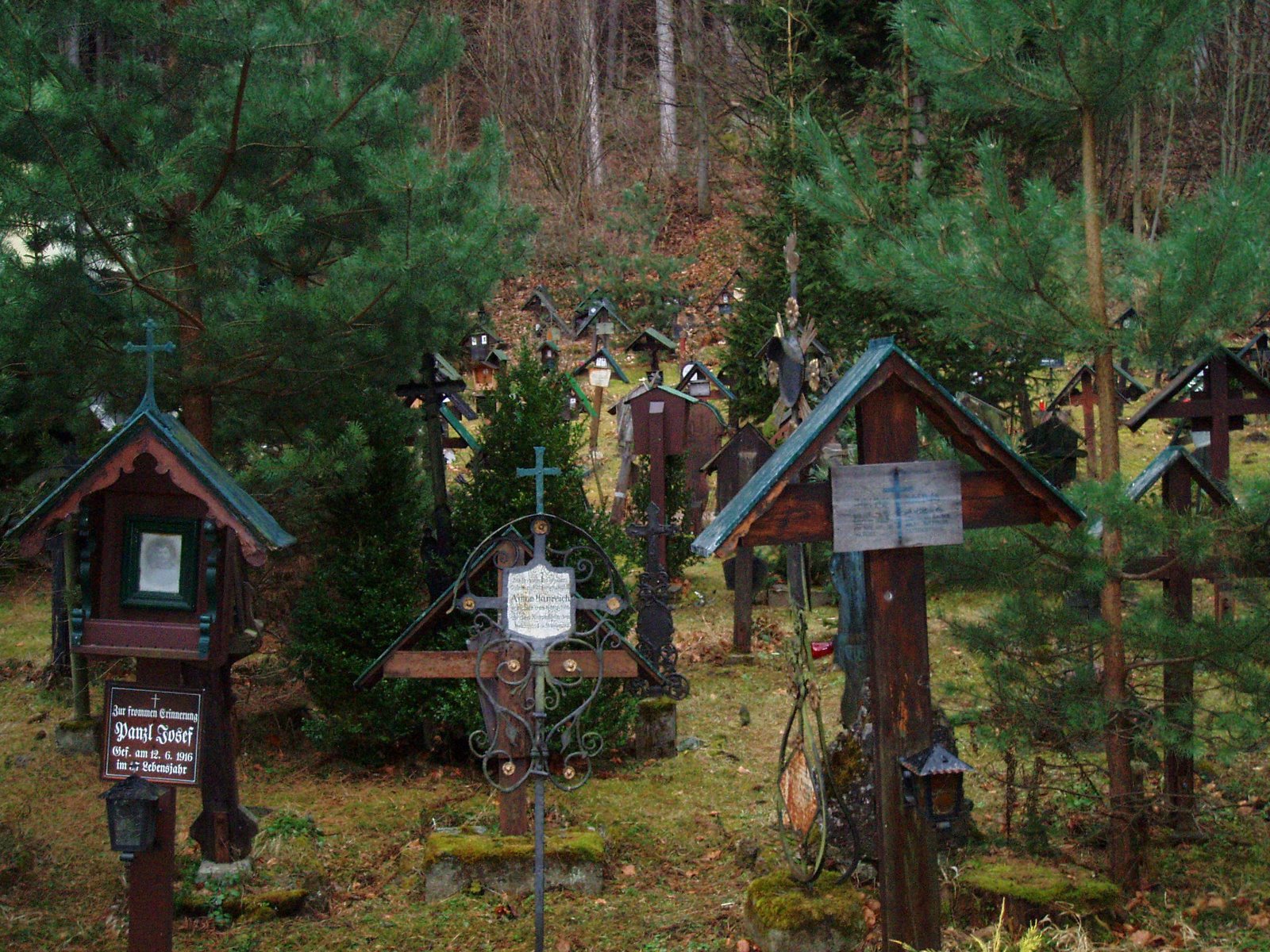
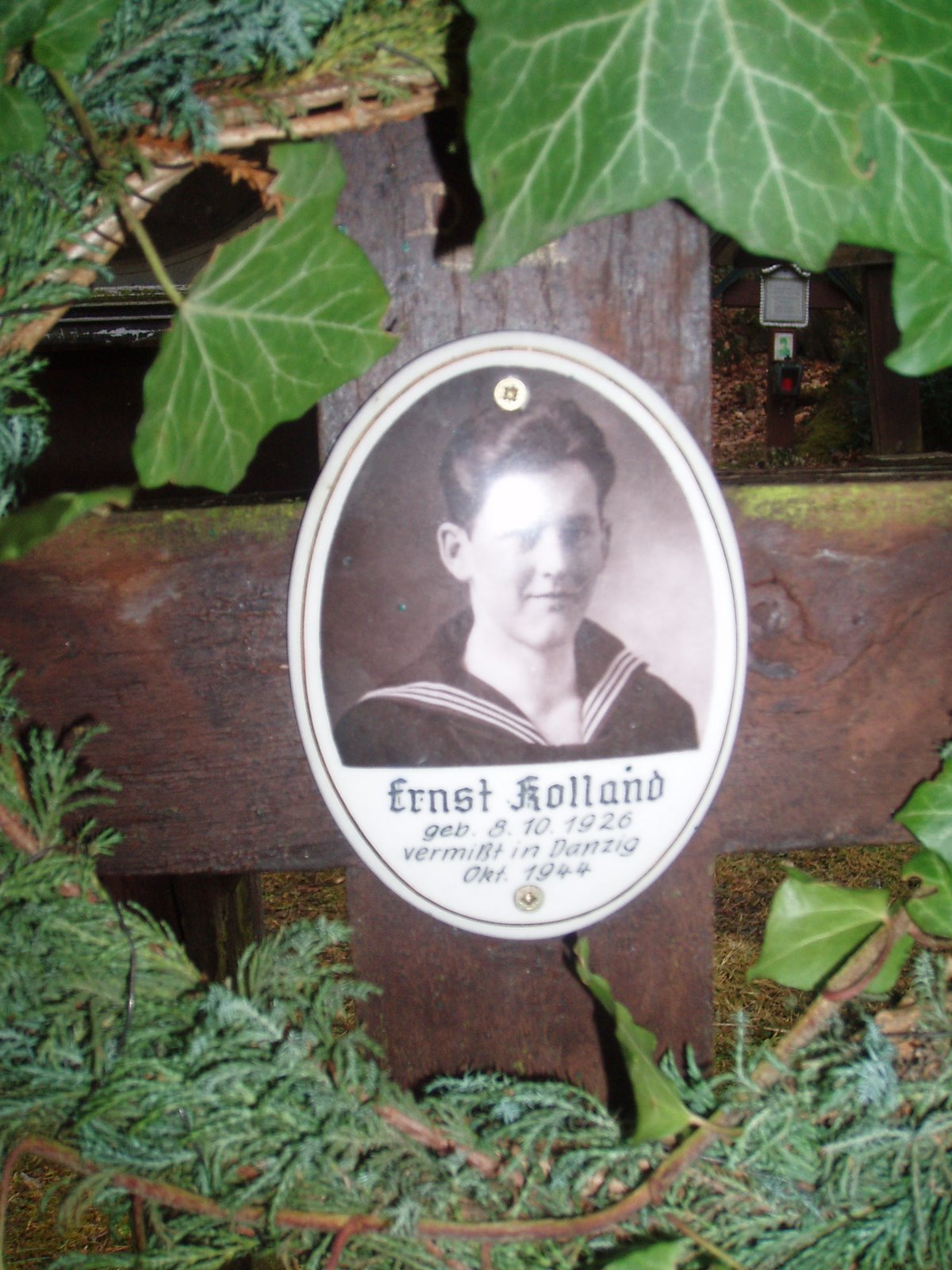
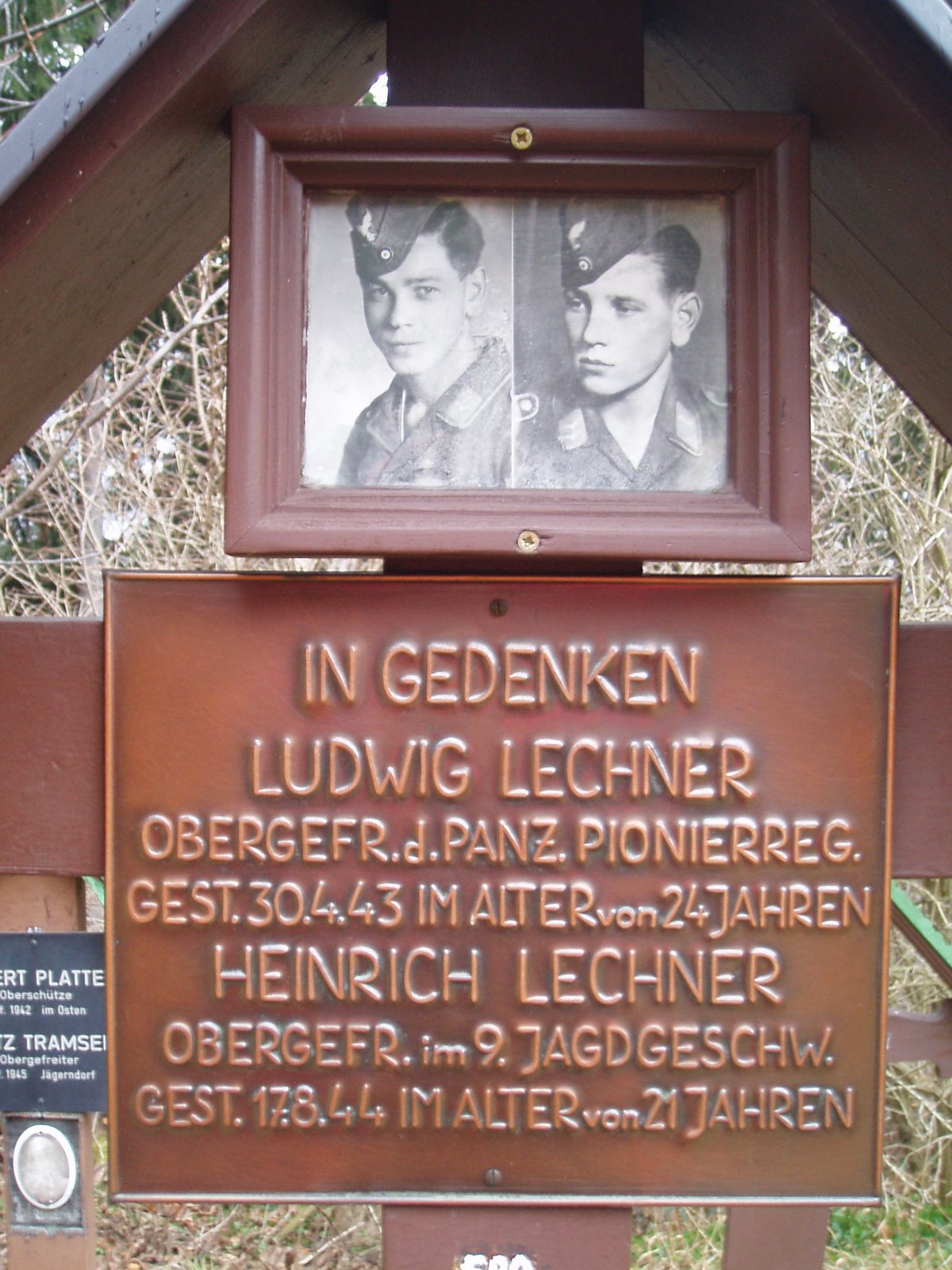
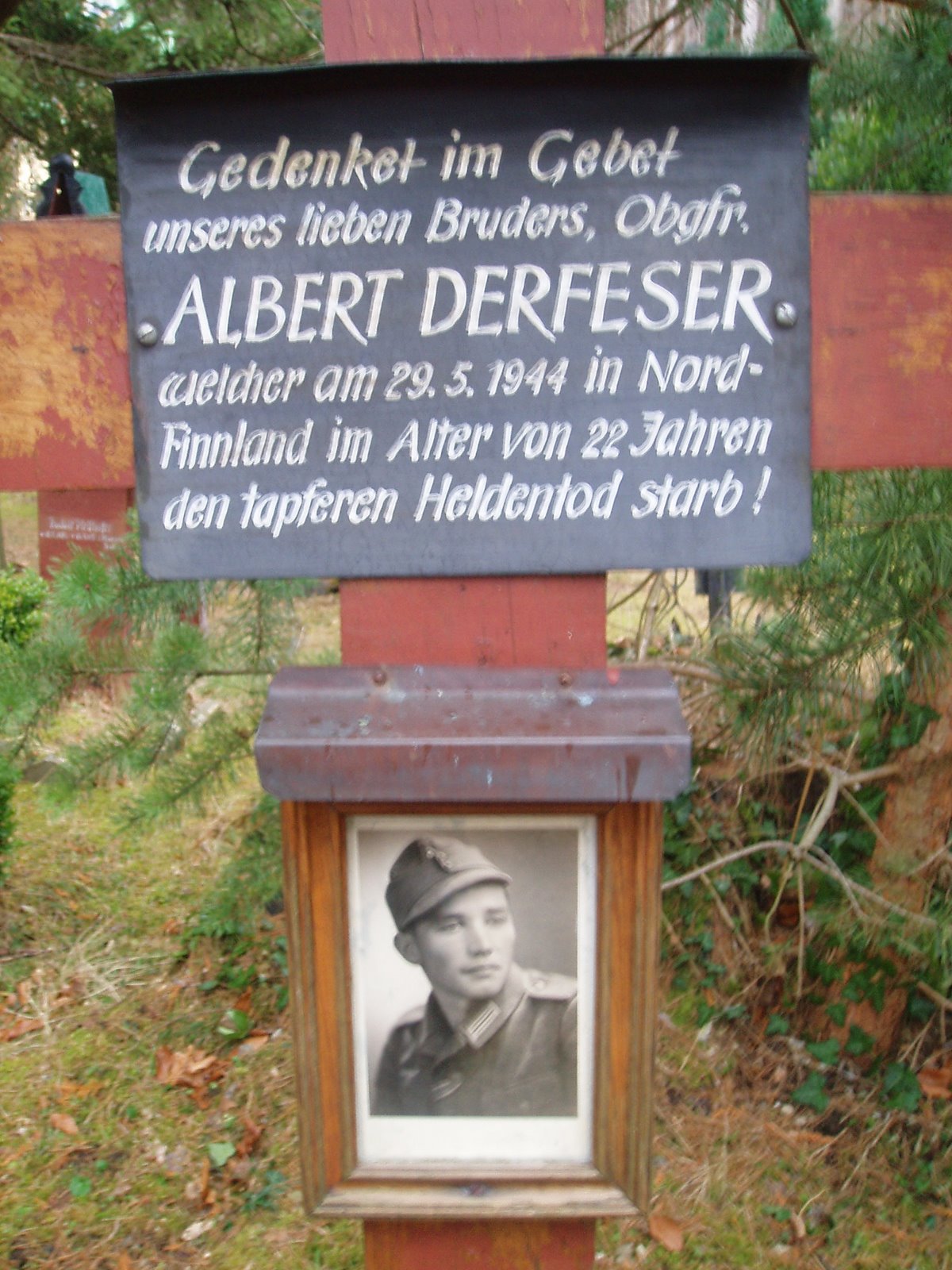
The “Tummelplatz” is a small field of memorial markers for fallen soldiers, tucked away in the wooded hills just above town. Originally a riding area for nobility, it was used as a war cemetery from 1797 to 1856. Since that time it has been filled with hundreds of markers honoring soldiers who have fallen on foreign soil, and whose bodies were never recovered, in the First and Second World Wars.
I have visited the Tummelplatz often; it’s just along one of my favorite hiking paths to the lake at Lans, and an interesting place to see. Each marker is individually designed, and often with a photograph of the fallen attached to it, with a few words: his name, age, and where he fell. As is the case with those missing in action, often this place was the only kind of “grave” the family had. I have included a few photos here, so that you can take a look at these “Nazis” yourself. Most of them were no more than boys, and none of them have the stiff, menacingly serious look that American military portraits have these days. They were young, and had absolutely no choice in the matter of joining up (refusal led in many instances to arrest, imprisonment, trial, execution.) Many of the markers speak of a “heroe’s death”.


Swastikas or any kind of Nazi symbols are nowhere to be seen (except, sadly, where someone defaced a chapel wall with spray paint.)
Is it wrong to honor a dead soldier if he died for an ignoble cause? Is it wrong to grieve for a son who shipped off to the Russian front, never to be heard from again? Of course it isn’t. The Tummelplatz reminds me that the last war is still a bit of an unhealed wound that people would rather forget than be confronted with regularly. There’s much to learn in the faces of these boys, which they themselves never had the chance to learn.

>Spuren des Anschlusses 3

>
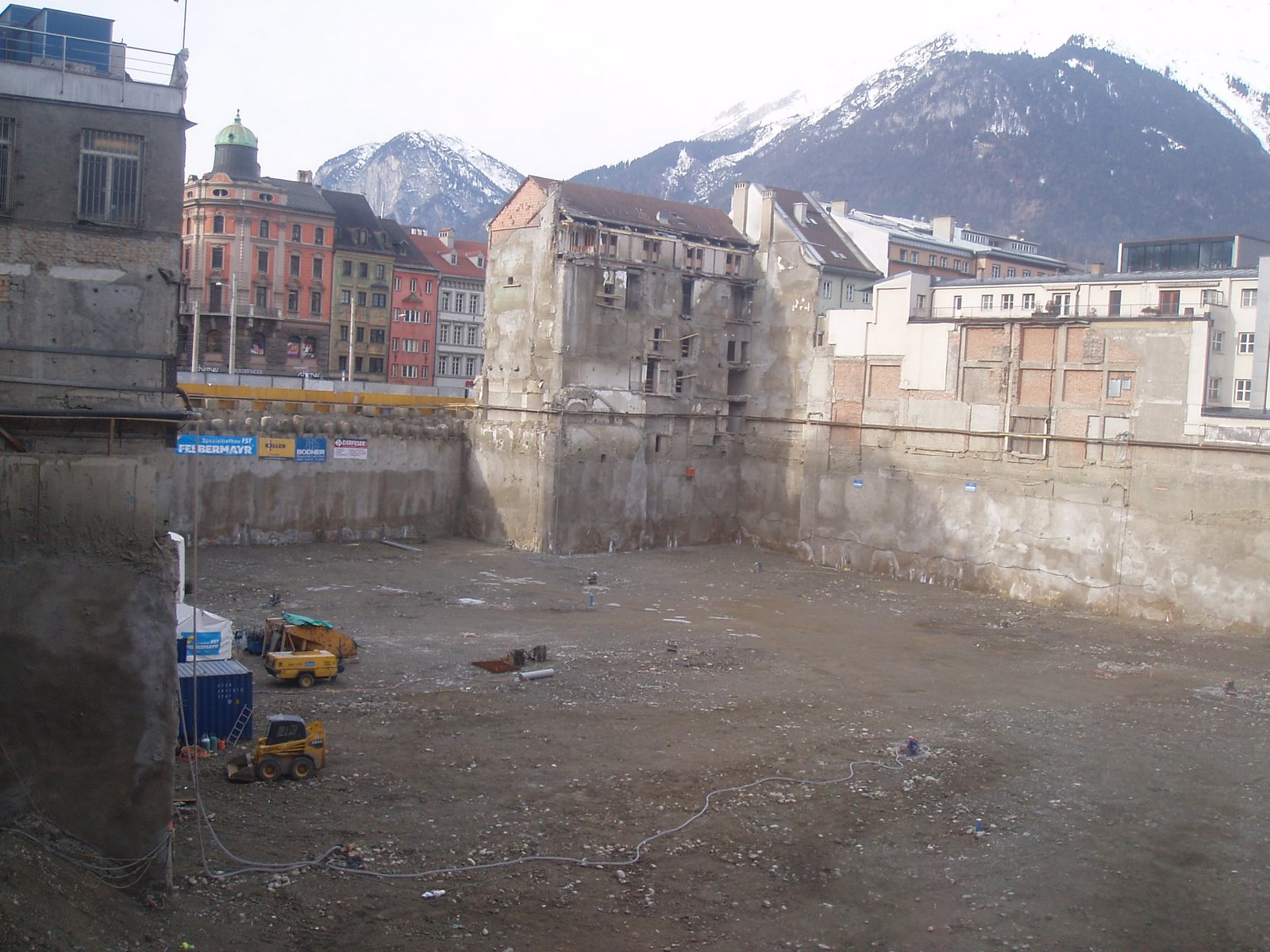
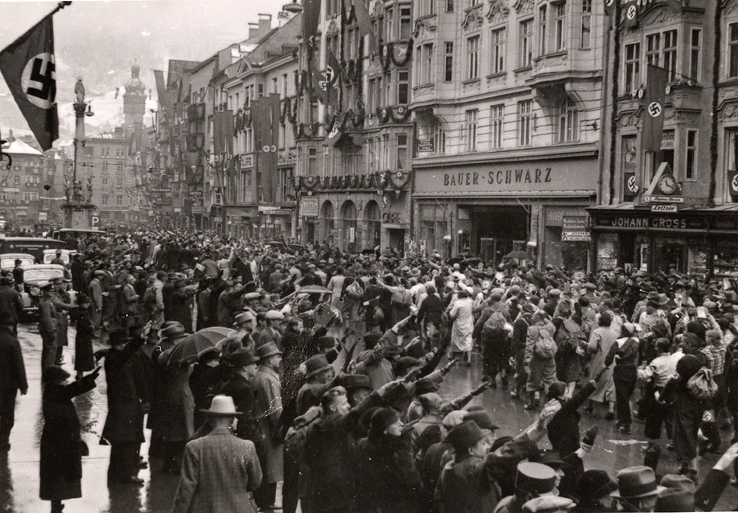
This empty lot is the once-and-future home of Kaufhaus Tirol, the only bona fide department store in the area. Its original name was Bauer & Schwarz, and was, among dozens of others, a very successful Jewish family-owned business. In April 1938, one month after the Anschluss, the owners succumbed to pressure from boycotts and “aryanized” the business by installing an aryan bookkeeper as director. Within 2 months the business was bankrupt, and bought for a song by a German company.
Co-owner Wilhelm Bauer was one of the victims of the terrors of Kristallnacht, murdered in his home. Many of the family were able to flee the country.

Back to modern times. Although not the only formerly-Jewish-owned business in Innsbruck, this one seems to have had permanent bad luck. Since I have lived here it’s been closed for long-term renovations twice, and now they’ve gone and plowed the whole thing under to start again. Last year there were artist’s renditions of the planned new facade shown in front of the construction site, something that resembled a giant igloo (all white and round) — at some point these plans were scrapped and now the building is to have a more traditional-looking facade, something which will fit in better with the old buildings surrounding it.

As far as I’m concerned, Mayan priests chanting ancient spirit-cleansing prayers couldn’t help this place — it’s cursed. The ghosts of the victims of Nazi terror in Innsbruck are going to hang around and give the place Bad Karma for a long time to come, no matter what fancy new building is erected there. I’m just sayin’.

( On April 10, 1938 Austrians got to vote on whether to join the German Empire officially, and there was much fanfare for the occasion. Notice that the only store in the photograph not decorated to the hilt with swastikas was Bauer & Schwarz, which was not yet aryanized. )

Photo from Peter Helfer’s CD-Rom, included in the book “Zeit — Raum — Innsbruck: Schriftenreihe des Innsbrucker Stadtarchivs,” Band 3, Universitätsverlag Wagner, Innsbruck.

Update: Kaufhaus Tirol has been open for a while now and it’s been doing steady, good business — no longer as one department store but as a mall. Nice to have a Peek & Cloppenburg here.

>Spuren des Anschlusses 2

>
In my second or third month in Innsbruck, I was driven home by a new colleague after a party, and while we were waiting for a traffic light to turn, I noticed a small sign which said “KZ Mahnmal (memorial) Reichenau.”
Me: Was there a concentration camp in Innsbruck??
Colleague: I DON’T LIKE JEWS.
Me: (speechless.)

Well, that colleague turned out to be a good friend, and a bit of a human project for me, gently bringing her around to being open to the idea that maybe all the stuff she heard growing up (that the rich American Jews were making endless demands on poor Europe, all those reparations for their vacation cruises, they didn’t want to see that we all suffered, yadda yadda yadda) might not have been the whole truth.

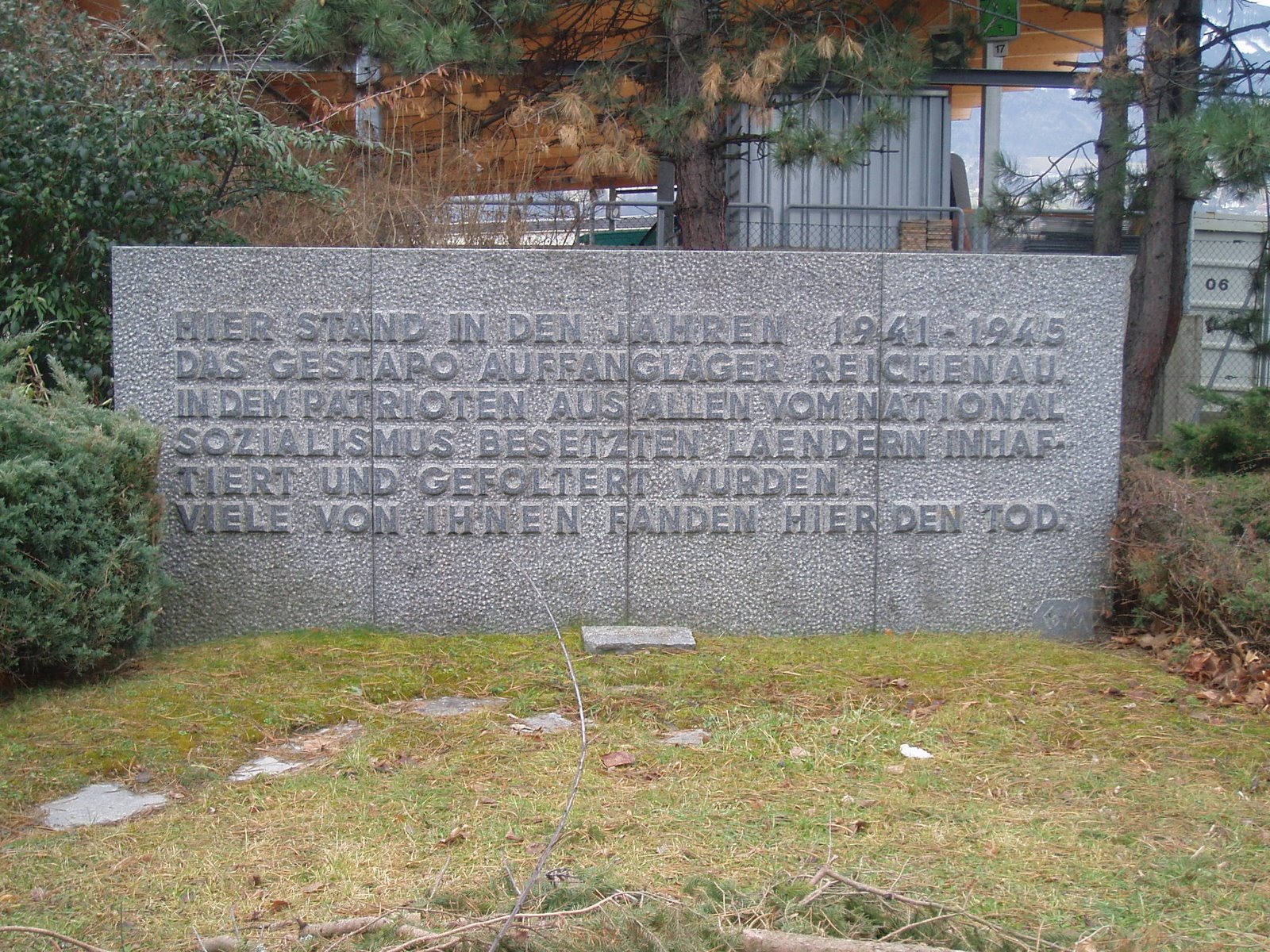
Much later, I went back to that sign and followed the arrow to this stone memorial, on the outskirts of town and on what is now property belonging to the town waste management services (trash and recycling center.) It reads:

Here stood, in the years 1941-1945
the Gestapo transit camp “Reichenau”
where patriots from all Nazi-occupied lands
were interned and tortured.
Many of them died here.

I don’t have any numbers but I’m willing to bet that very few Innsbruckers even know that this memorial exists.

Update — here is some more information gleaned from Wikipedia.de: the camp was created for the use of the Gau Tirol/Vorarlberg, for the rehabilitation of persons deemed guilty of refusing to work, skipping work or otherwise shirking their duties into useful civilians, “through strict discipline and hard work.”
As the war progressed, more and more political prisoners were taken there. From 1943 on it was used as a transit camp for Jews deported from northern Italy.
A total of 8,500 persons were interned at the KZ Reichenau, 130 of whom were murdered or died from inhumane treatment.