
>Travel Blogging 4

>From “Theophilus The Battle-Axe: A History Of The Lives And Adventures Of Theophilus Ransom Gates And The Battle-Axes”, by Charles Coleman Sellers, 1930:

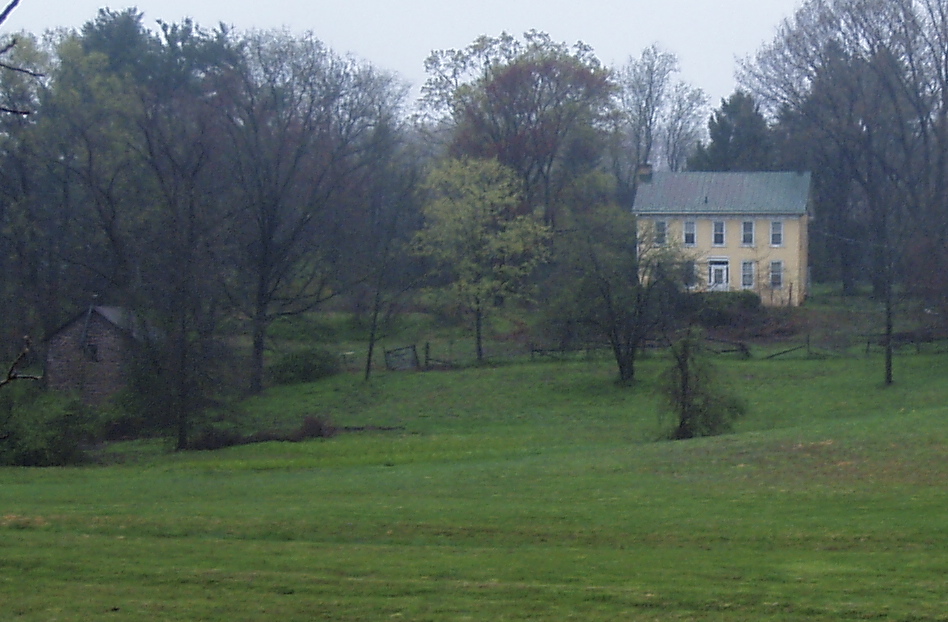
“A highly eccentric old lady of sixty-one years, Hanna Shingle [or Schenkel, or Shenkel]  lived alone at the head of the Valley, just above the old church, in a little stone house surrounded by rocks and brambles and in a state of general disrepair. She had a few acres of ground which the neighbors tilled in return for a share of the produce. Her eccentricity [had] been traced to stern parents. It is said that she had been very handsome once, with curls down her back, and had ridden to church on horseback, to the admiration of all who saw her. Some of her wedding clothes had been made, and the time of the wedding near, when her parents found fault with her lover and intervened.

The Shingle (or Shenkel) Homestead

 “Now we find Hannah Shingle a very peculiar old person, with a very small and slovenly farm, three cows, a sow and some pigs …. Small boys would come sneaking through the briars to steal her pears, scattering like startled deer as the old woman would rush from her door, an ancient and quite harmless musket in her hands, threatening death in her shrill voice. She had two weapons for her protection, the old gun and an axe. The gun was chiefly for small boys, the axe she kept under her bed, against more formidable intruders. There were rumors abroad that the old soul had laid away a hoard of gold, and an attempted robbery had increased her watchfulness. In October [1855] her sister visited and sought to persuade her to live with relatives, but Hannah had her gun and her axe and would not think of leaving.
 
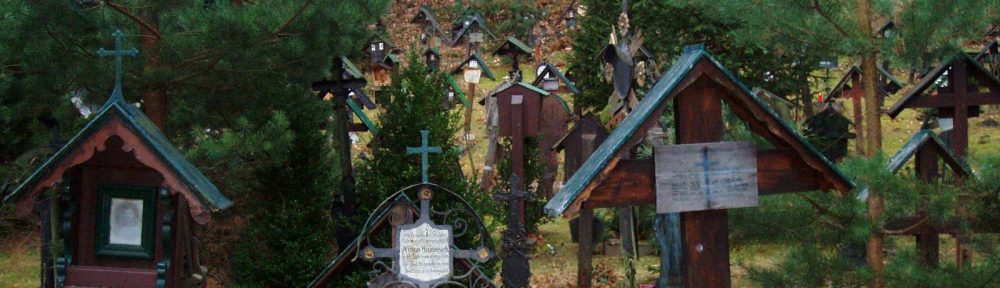
She’s here somewhere, I used to know where the headstone was. Unfortunately many more are illegible now.

“A week later, John Miller, who was helping with the farm, found the door locked, and could get no answer to his knocking. He brought some neighbors and they forced an entrance. [Finding prepared food cooling in the otherwise empty kitchen,] …they stamped hastily up the narrow stair. In a little whitewashed bedroom above lay Hannah Shingle, her feet on the floor, her body and crushed head stretched out on the bed. There were marks of fingernails on her throat. The furniture was in disorder, the white walls splashed with blood, and there was a crimson pool on the floor, flowing out from under the bed. On a pillow, the murderer had left a bloody print of his bare foot, showing even the toenails. The robber had climbed a ladder to an upper window, probably in the early evening, and the old lady had left her cooking below to show him her prowess with the axe. It seemed obvious that the murderer was familiar with the ground, was someone in the Valley.”

(The culprit was never found. This is part of a somewhat longer history of the Valley which includes a naturalist, spouse-swapping religious sect, but that’s for another day.)

>Travel Blogging 3

>

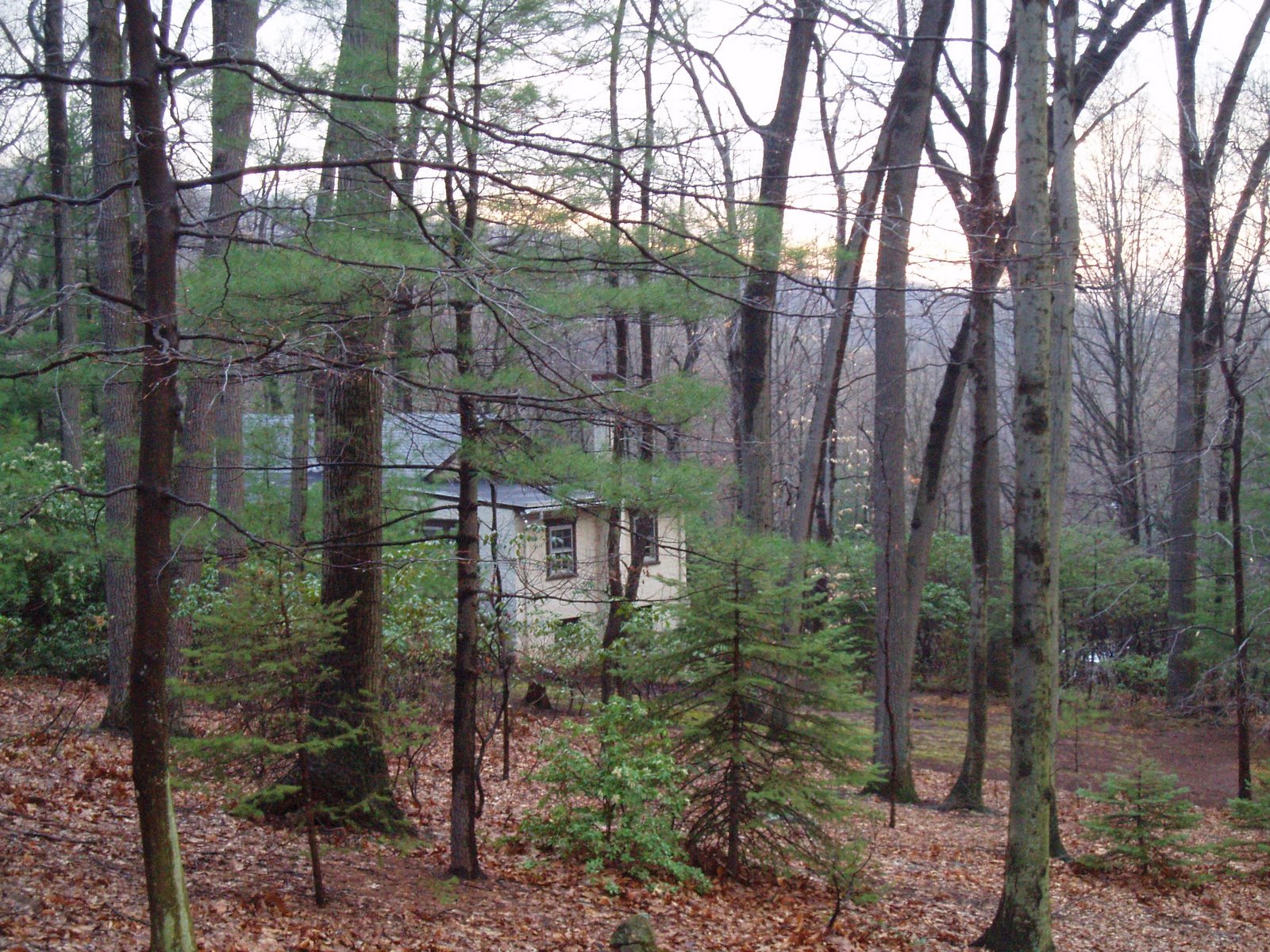
The local “spooky house”; building began sometime in the early 1960s, according to local sources, for an older man who had bought the land and who had planned to live there alone. However, he died before the house was finished, and it has sat there ever since, quietly falling apart. As kids, we were discouraged from setting foot onto the property, and mostly we avoided it. One assumes that the heirs either have no idea that they have the land, or it’s tied up in a contested will, because otherwise who would hang on to this nice quiet patch of woodland and let a little house there fall to pieces?

>Travel Blogging 2

>

A little village near here, known for its historic gingerbread facades, fancy restaurant and rock falls, sprang up originally due to an iron mine and a quarry, both closed long ago. Behind the village are traces of the abandoned railroad which serviced the operations.

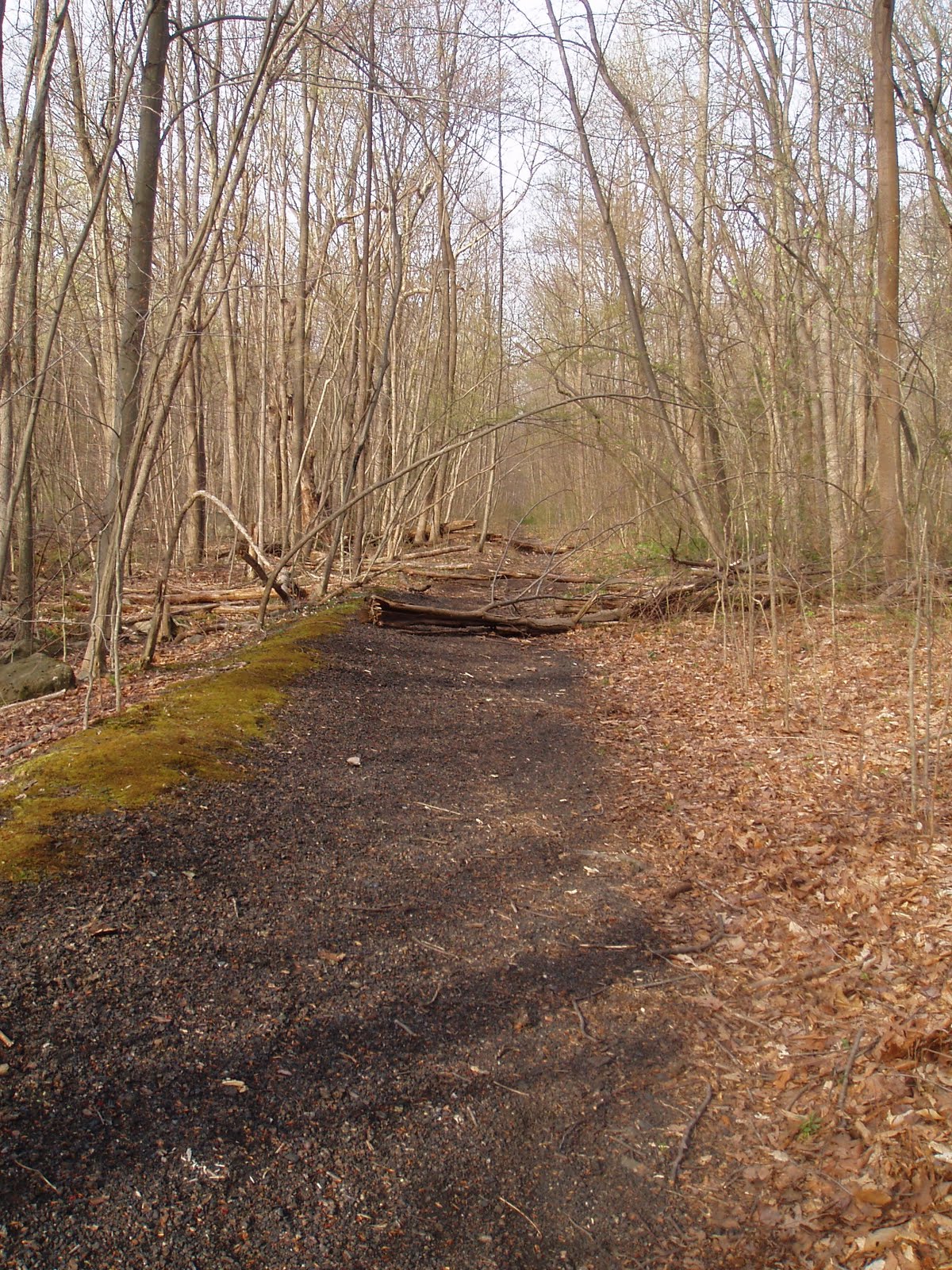
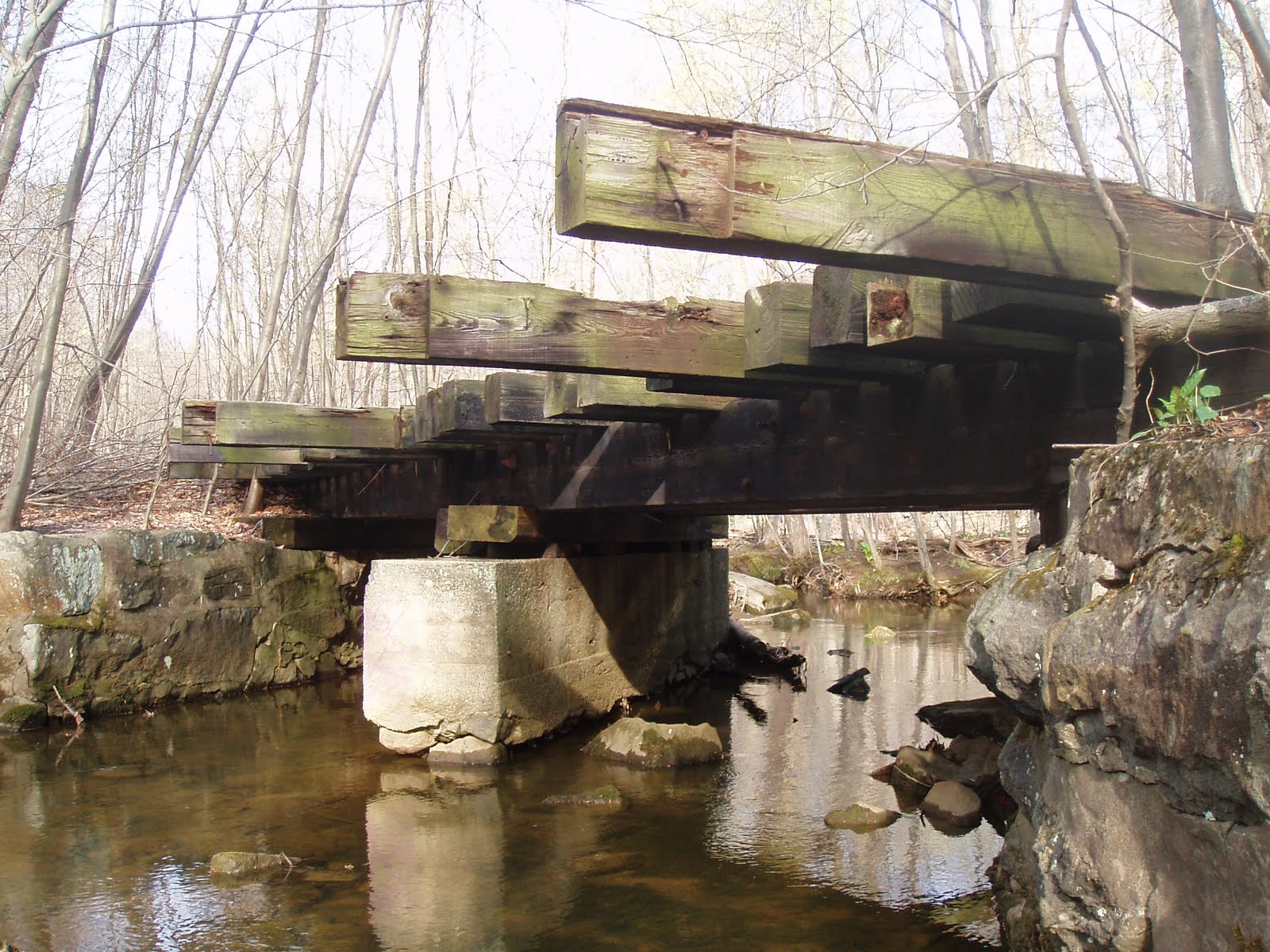
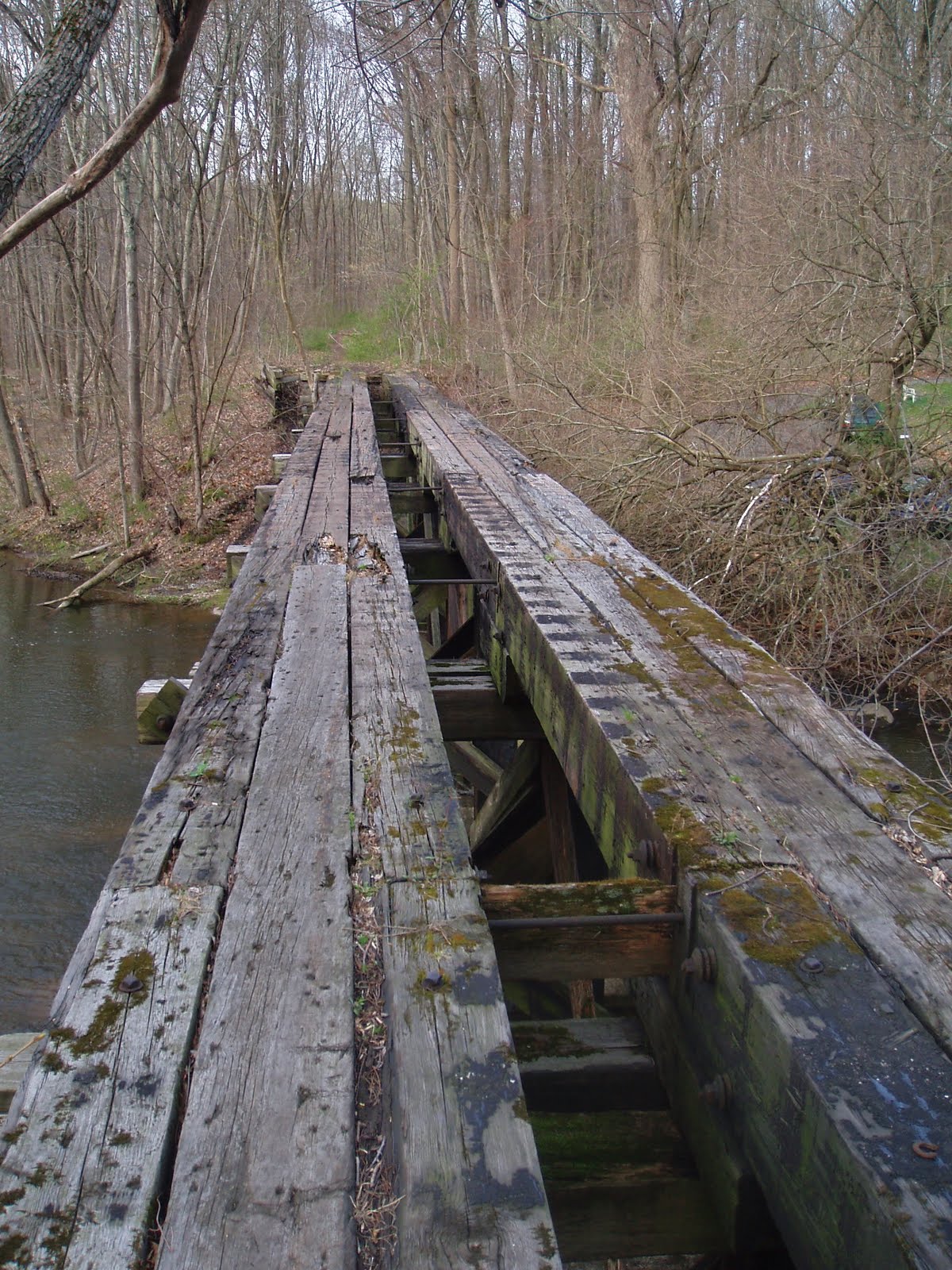
 Most of the rail bed is now unmarked trail. The cinder bed remains visible, and some wooden ties here and there. The largest remains are the wooden bridges over the creek.

Above and below, two views of the same bridge.

A second bridge encountered closer to the road. When the mines were open (from 1845-1928), the hillside was barren. When they closed, the forest began to take over. The land now belongs to State Game Lands.

Pagans In Tirol: Goldbichl

>Thanks to a recent post by a fellow local blogger, I was diverted from my studies by a desire to see a nearby ancient sacrificial burning site, just minutes up the road from town.

Sacrificial burning was, in the Bronze and Iron Ages and into antiquity, a fairly common pratice. The ancient Hebrews did it, and the Greeks, and so did the people of Tirol. Just as the funeral pyre allowed the deceased to leave his or her earthly shell and head off for the great beyond, the ritual sacrifice operated on the same premise; that the sacrificed animal — or object — would lose its material composition and rise as smoke for the gods to receive.
The oldest ritual sacrificial burnings found on the Goldbichl (Bichl is an old alpine word for hill) date back to 2000-1500 B.C. The first altars were clay/mud platforms ringed by stone blocks. Later, a high stone altar was built over the platforms. As clay was necessary to ritual cleansing of the fires, more was applied each time. In this way, the altar grew in height over time.
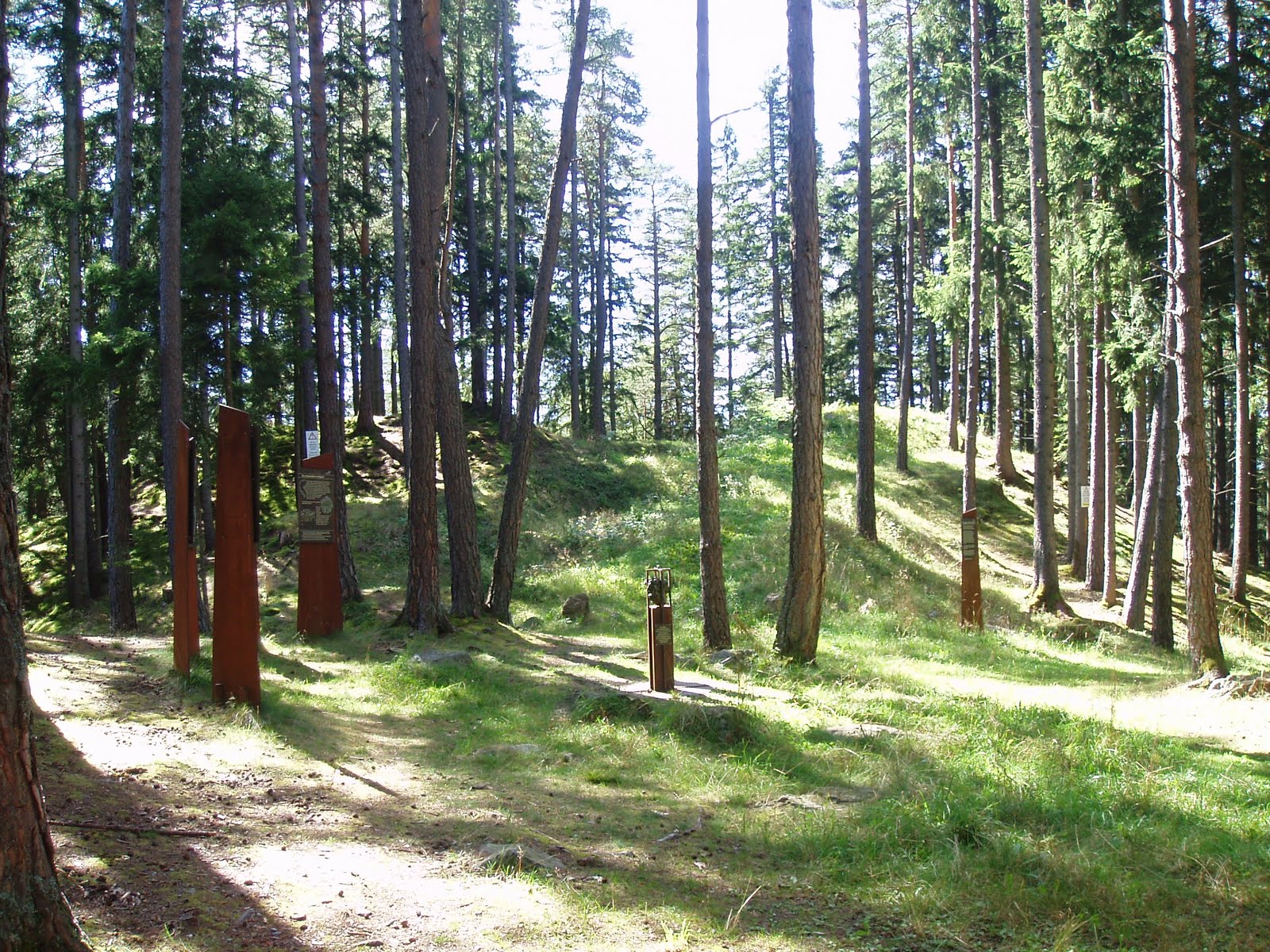
In the photo above, the level at which the metal signs are found is the natural height of the hill. The mound beyond it is the altar site.


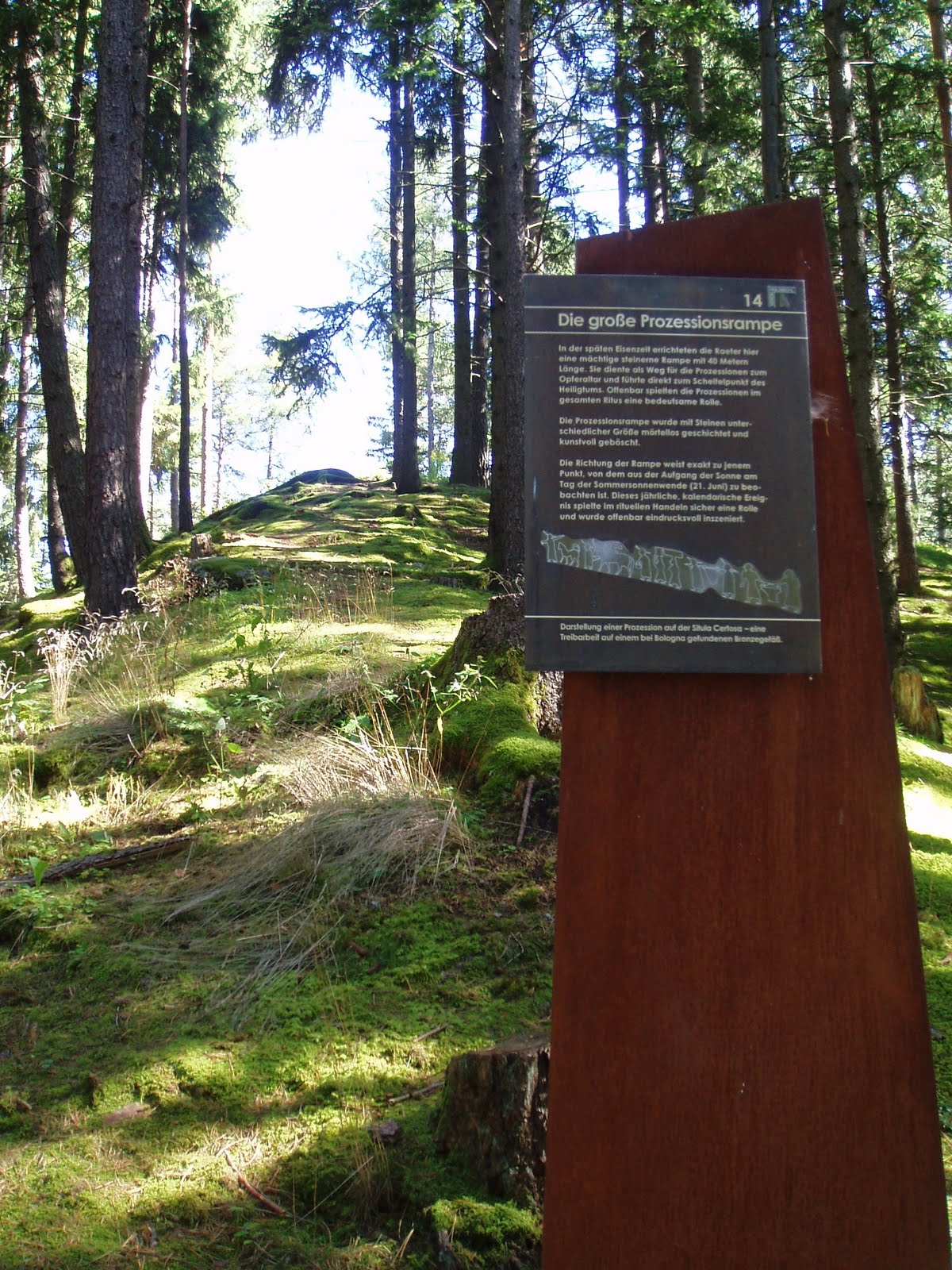
At some point the site fell out of use — possibly its people moved on or were forced away. After a few centuries of disuse, the Raeti crossed the Brenner Pass and settled in. They revived the ritual fires on the Goldbichl, and did some work on the place — they added ramparts, and rose the altar site to a 7-meter-high pyramid. To this height they added a 40-meter-long ramp up the side, which was used as a processional path to the top and led directly to the altar. The ramp lines up exactly with the point at which the sun rises on the summer solstice. Cool, no? I imagine a dawn procession, where the sun rose right up over the fire. Very theatrical.

Archaeologists discovered one Bronze-Age grave within the walls of the site. It contained the burnt remains of a young woman, along with broken pot shards and an intentionally smashed stone loom weight. Beyond its use in looms, which was to keep the vertical threads taut, the loom weight had symbolic value. In Greek mythology, spinning and weaving were analogous to the unfolding of destiny. Zeus’ daughter spun the thread of each human’s life. With this in mind, it is possible to imagine that the woman here was perhaps a priestess.

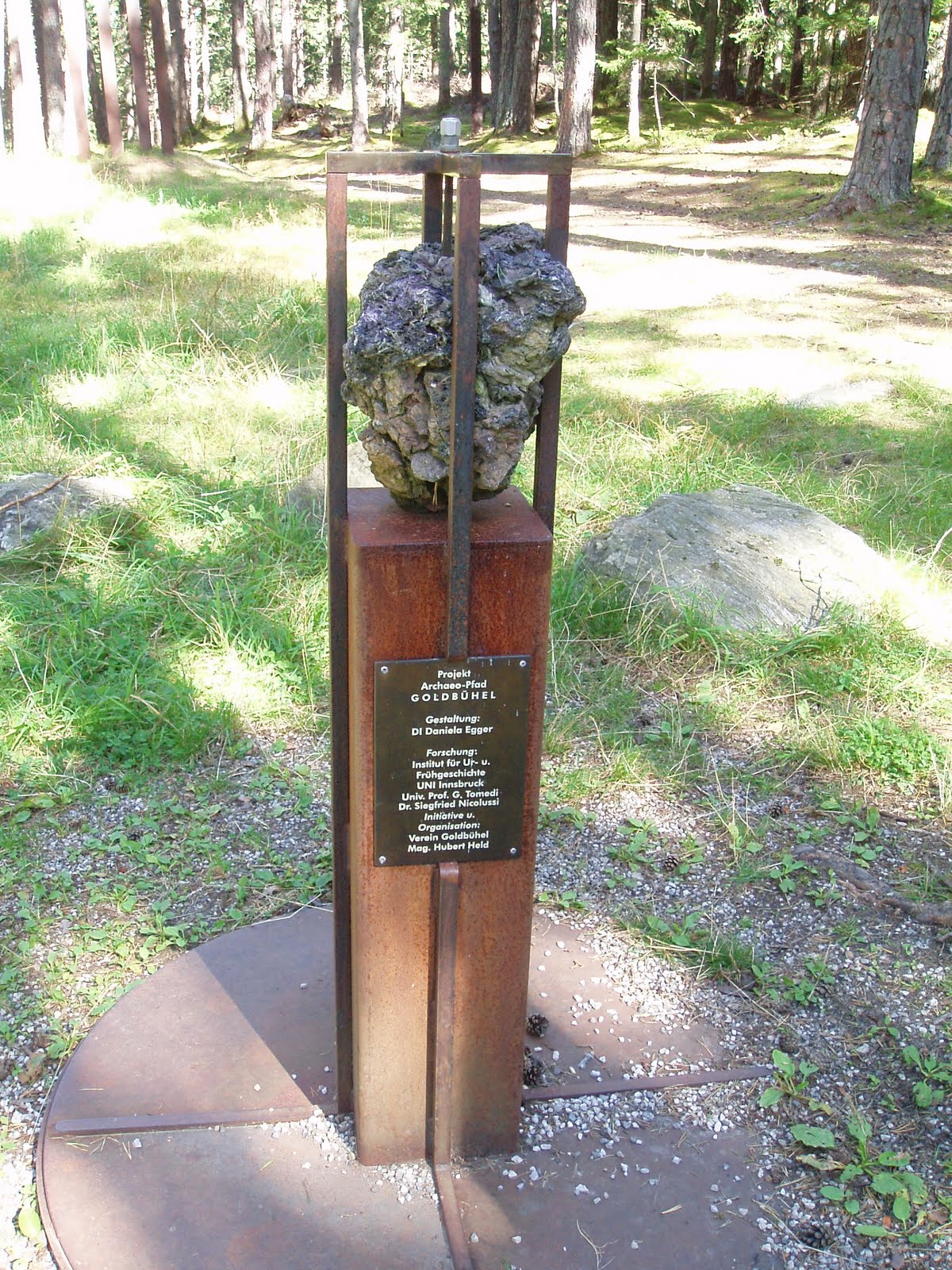
This is a rock which was covered with molten slag. The fire on the Goldbichl reached 1200°C (over 2000°F) which melted nearby rocks. It really must have been quite a show.

The site was destroyed around the time when the Romans pulled in. Drusus and Tiberius, stepsons of Caesar Augustus, led their legions through here on their way to the upper Danube in 15 B.C. It seems that the Raeti, like their Celtic neighbors just to the north, lived on as a subjects, and sent men to fight as soldiers in the Roman army. What happened to them after that, I don’t know. They mingled with everyone else in the Dark Ages and came out as Swiss, and probably there’s some Raeti in modern day Tiroleans as well.
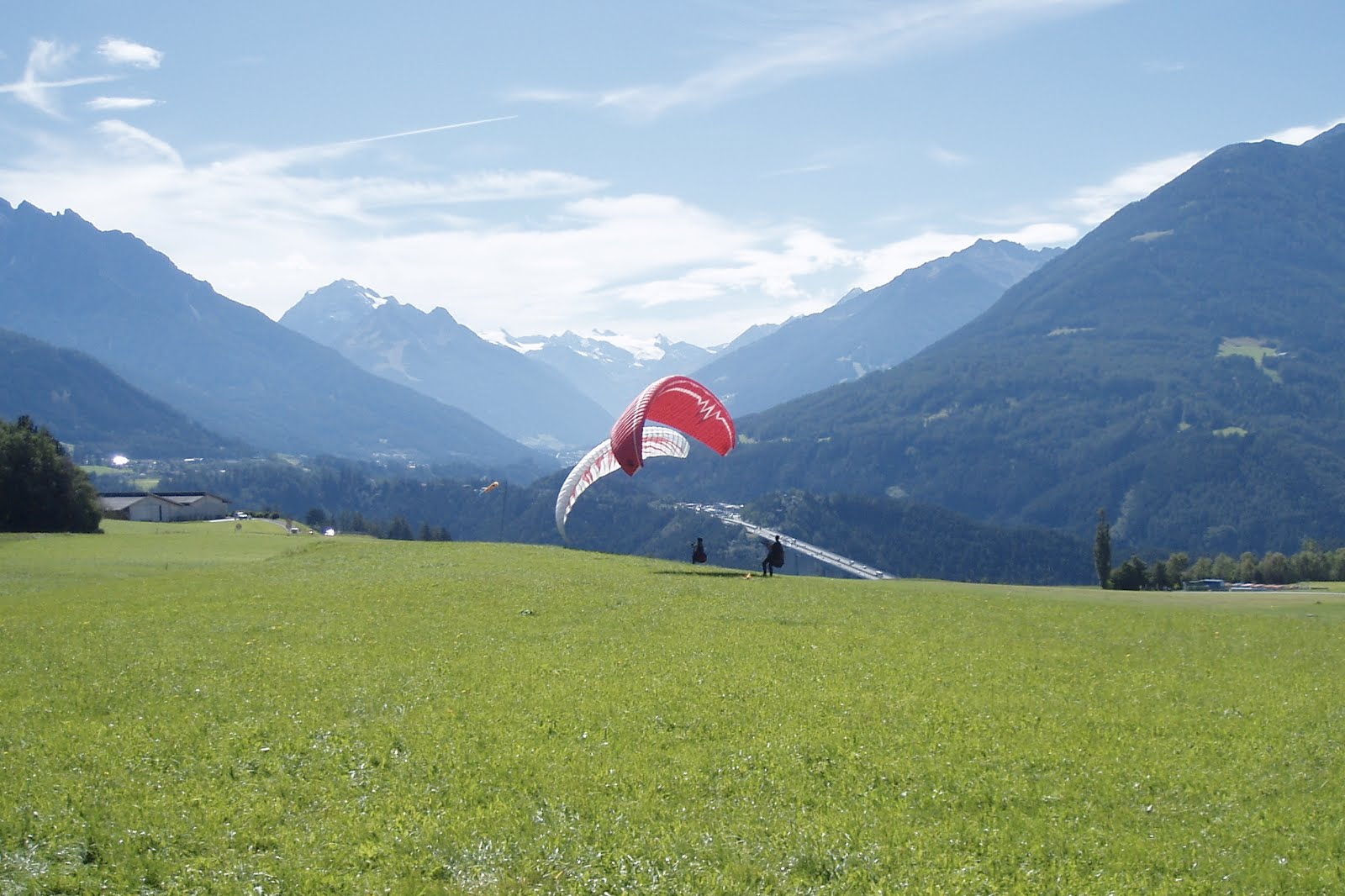
Just up the road toward Patsch we lunched at the oh-so-nice Hotel Grünwalderhof, which has a pretty impressive view. I’m pretty sure we’re looking at the Stubaier Glacier, right above the sails.

More information about the Goldbichl, as well as archaeological finds on display, can be found at the tourist office in Igls.

>Innsbruck’s Passive Houses

>The Lodenareal, a new neighborhood of apartment blocks in Innsbruck, is featured in an article lauding their low-energy, high-quality Passivhäuser, or “passive houses”; the premise behind these buildings is that they are so well insulated that the heat generated from lights and electrical appliances is enough to warm the rooms, and at the same time having enough fresh air coming in to avoid unwanted moisture. This way, you keep cool in the summer and warm in the winter, and your heating bill is basically zero.
An acquaintance of mine lives in one of the apartments, and she loves it. I hope more of these get built.

http://www.worldchanging.com/archives/011549.html

>Beate Uhse: Pioneer of Aviation AND Sex Ed.

>
When you move to a new country as an adult, there are many things from that country’s history that you are expected to know, somehow. For me it was stuff like Sissi (Empress Elisabeth), the partition of Tirol, and Andreas Hofer. But 15 years in, you never stop discovering new things, if you keep looking, I guess.

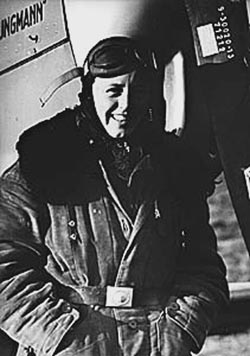
Recently a book fell into my hands, a pretty little memoir by the actress Luise Ullrich about her time in South America in the 1940s. Knowing nothing about her, we looked her up on Wikipedia, which led us to Elly Beinhorn (Ullrich’s mother-in-law, and an aviation pioneer in Germany — you could call her the German Amelia Earhart, maybe) and from there to other female pilots in the Luftwaffe, including Melitta, Countess of Stauffenberg (sister-in-law of Claus, of “Valkyrie” fame) and Beate Uhse.
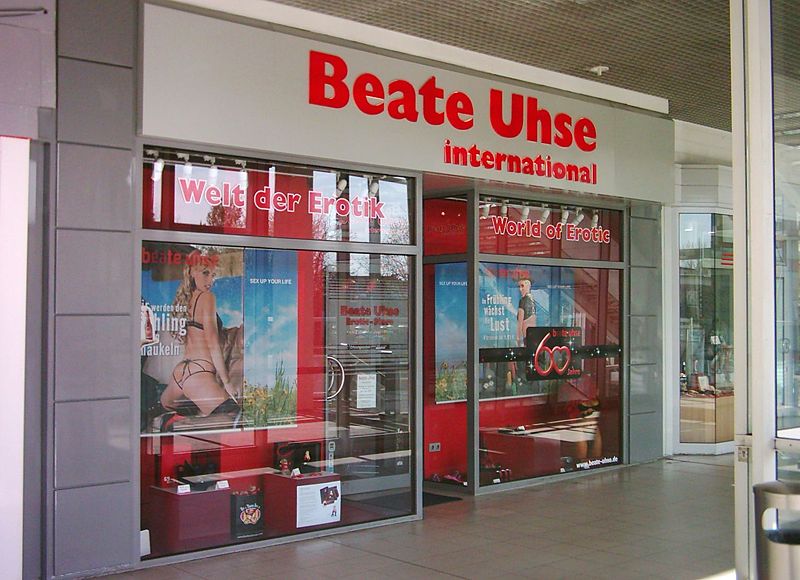
Beate Uhse?? That’s the name of a chain of sex shops all over Germany and Austria. Well, it turns out she was also a stunt pilot for UFA, the German film studio, and flew in transport squadrons with the Luftwaffe.
Barred from flying after the war, Uhse, by now a widow and single mother, started her second career with a mail-order business dealing with contraception and sex education. From Wikipedia:

She was selling products door-to-door and met many housewives and learned of their problems: the men returning from the front were impregnating their wives, not caring that there was “no apartment, no income and no future” for the kids. Many of the women went to untrained abortionists to “get rid” of their children. Beate Uhse remembered lectures her mother (who had died during the war) had given her on sexuality, sexual hygiene and contraception. She searched for information on the Knaus-Ogino method of contraception (rhythm method), and put together a brochure which explained to the women how to identify their fertile and infertile days.


Her first “specialty store for marital hygiene” opened in 1962, not without problems from the local law enforcement, but over the years her business grew in such bounds that the name Beate Uhse is now a widely respected brand name. Five years before her death, she fulfilled a long-held dream with the opening of the Beate Uhse Erotic Museum in Berlin.

I will never giggle nervously in front of her store again.

>Discussing racism, back in the 1920s

>My grandfather died before I was born, and my grandmother then married a widower in town who had been lucky enough to have married a woman with family money the first time around. This means that my grandmother, having been born in working-class immigrant circumstances, spent the last 50 years of her life (she almost made it to 92) in a lovely woodland cottage with very nice antique furniture and heirloom jewelry.
The cottage had once been part of a private club, started in 1920 when a group of people bought up several acres of woodland and built summer bungalows there, presumably to drink in peace (during Prohibition) as well as enjoy the country air. The club had disbanded for good some 30 years ago, and the lots were divided up and claimed by their current occupants. When my grandmother died and we took possession of her papers, we found quite a bit pertaining to the club, some of it quite old.
One of the most interesting from this archive is a letter dated August 11, 1926 and written by a club member to one of its officers. I quote the body of the letter in its entirety:

Dear Bob: Because of important business engagements Tues. the 11th I shall be unable to attend a meeting of [ ] Club. Since my talk with you I realize that most items to be discussed at the meeting have to do with actions of mine I regret that I cannot be present. Shall try to make my position clear therefore in this letter.

I am now aware of the animosity towards me since I moved to [ ] and brought Percy over to the unoccupied house because I wanted to make it easy for him to take care of the horses and the work about the bungalow. When I mentioned the fact that I wanted to fix up the house for him I certainly did not try in any way to mislead anyone as to his color — that evidently being the main objection to him. Am only sorry that I did not get to the Club meetings to as to bring it before all the members.

It became my unpleasant duty on the strength of the objections made to him going in swimming with some of his friends to ask him to keep from doing it in the future. He assured me he would not give any case for complaint in the future.

Perhaps I am prejudiced in Percy’s favor, but I feel I have done him an unintentional wrong — stirred up in him a feeling of bitterness because of this evident dislike to his color. We have appreciated him so much and have noted the whiteness of his character — that it has really spoiled our desire to stay here.

As soon as we can dispose of the horses which we are now trying to do Percy intends moving back to town and when necessary repairs are made to our home in town we shall also be going over. This will possibly be the end of August.

Would appreciate having a statement of what I owe the Club so that prompt settlement may be made.

Cordially yours,

I find this letter a fascinating glimpse into the prevailing attitudes about race in the 1920s, including the well-meaning racism of the writer — he seems to have had his heart in the right place, yet he refers to his employee only by his first name, and refers to the “whiteness of his character”. I do not hold this against him — this was, after all, 1926. It’s just interesting to me. What do you think? — Comments are welcome.

>Lola-gate

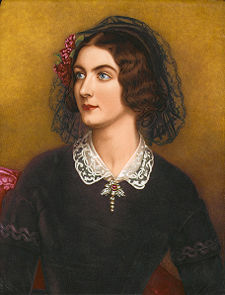
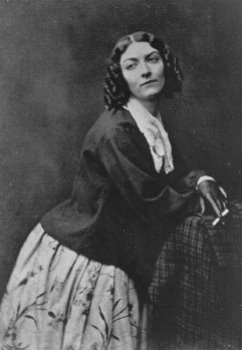
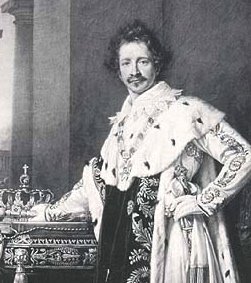
>I was at the Munich City Museum last week, and came across large portraits of King Ludwig I of Bavaria, and of Eliza Gilbert, better known to the world as the “Spanish dancer” Lola Montez. A mistress of Ludwig’s who led to his eventual abdication, I first thought of her as a sort of 19th-century Monica Lewinsky, but she was a bit more — imagine Clinton having an affair with, say, Madonna.
Born in Ireland, raised in India, schooled in England, Ms. Gilbert was not known for being a well-behaved little girl. After a short-lived marriage to an Englishman (which went under in Calcutta,) she wafted around bohemian Paris for a while, and had an affair with Franz Liszt. After the death of another lover she moved to Munich and hit it off with King Ludwig, who made her “Countess of Landsfeld” as a birthday present to himself. Her presence in his life fed the mounting opposition to his rule, and in 1848 he stepped down in order to stave off a revolution.
Lola fled Bavaria for Switzerland, hoping Ludwig would follow her. When he didn’t, she went to London, re-married (scandalously, as it violated the terms of her divorce, and they had to leave England), and eventually split again for the USA. After more adventures in California and Australia, in ill health, she lived out her last days in New York, and died at the age of 42. She’s buried in the Green-Wood Cemetery in Brooklyn.

>Künstlergespräch; Christa Ludwig

>This morning I had the opportunity to hear two living legends talk about their careers — Brigitte Fassbaender interviewing Christa Ludwig, who turned 80 recently. She’s in fine form, and was a joy to hear as she reminisced about her early career (which began with standards like “Stormy Weather” for American G.I.s in bombed-out Germany); a crisis period which included a divorce, menopause and a burst capillary on the vocal chords all at the same time, and how she felt about ending her career while still in top form (just fine, apparently. She went outside, opened her collar and thought, “At last, I can just catch a cold and not fret about it!”)
Between topics, we got to see and hear a few of her greatest moments on film, including a clip of a concert performance of Bernstein’s “Candide”, with Bernstein himself at the podium and Ludwig singing the Old Lady’s “I Am Easily Assimilated.” It was wonderful, and especially meaningful to me because I had sung that very role on that very stage where she was now sitting, a few years back.
She was wittily honest about what her future plans are (“Nothing!”) and why she doesn’t give many voice lessons (“I’m too lazy”) brutally self-critical at times but not in a self-flogging way, but rather in the way one sees her own “flaws” objectively and strives for improvement. There was a special moment right after a film clip was played of her singing Leonore in “Fidelio”; beforehand she had mentioned that there was a certain note she was never quite happy with. As the clip ended, Fassbaender turned to Ludwig with a silent hand gesture of “Na? What was wrong with that?“, and Ludwig returned with a hand gesture of “Eh, it was so-so!
I was particularly attentive to her discussion of getting through menopause, at it requires a great deal of re-figuring things out for singers, and every women experiences it sooner or later, although it’s not something that everyone talks about openly. Back in my student days, someone told me that Christa Ludwig is a “real mensch”, and this morning confirmed that for me — a warm, funny, feet-on-the-ground kind of artist, and a very special musician. A real living legend.