Samuel Schaffer, b. sometime before 1810, d. sometime between 1839 and 1841.

Since I am not traipsing about the Bavarian countryside inspecting historical sights, I might as well put this blog to use for my genealogy hobby.

Several years ago, I stumbled on a Pennsylvania genealogy bulletin board online from, I think, the 1990s. A user had posted that they were looking for a particular ancestor of mine and would welcome any information. By the time I’d discovered the post, the email address was no longer working (or, who knows, maybe the author was no longer among the living) and my message went unanswered.

Anyway, the Internet’s being forever has its advantages, and since I can no longer find that plea for help, I’ll post my own. Every genealogist has what are called “brick walls”, where the line stops. I have a few, and two of them have been driving me nuts for years. Someday someone will read one of these posts and contact me. Maybe. So, here goes:

I am looking for information about my 4th great grandfather, Samuel Schaffer. He was born probably sometime around 1800, probably in southeastern Pennsylvania.

What I know from genealogical records:

Samuel Schaffer married Margareta Rebecca Thomas around 1827. They had one son, Augustus Hugh in 1828. Rebecca’s parents were Jacob Thomas and Maria Royer/Reyer, who were connected to the church in New Hanover, Montgomery County, Pennsylvania. Rebecca died in 1828 when her son was 4 months old.
In 1831, Samuel was wed to Christiana Hartranft by the minister of St. Gabriel’s/Morlatton Church in Douglasville. Christiana was a descendant of Tobias Hartranft, one of the Schwenkfelder Exiles who arrived in America in 1734, and a cousin of John F. Hartranft, Governor of Pennsylvania from 1873-1879.

St. Gabriel’s 1801 Chapel. St. Gabriel’s started out as the first Swedish Lutheran church in the vicinity, then joined the Church of England in 1760.

According to a Schwenkfelder genealogy, Samuel and Christiana lived “near Glasgow”, a small settlement with an iron forge on the Manatawny Creek just west of Pottstown. According to a newspaper article about his son Mahlon later in life, our Samuel had been an innkeeper. Which, a kind volunteer at the Pottstown Historical Society explained, could almost mean anything, as there were any number of establishments that could be called “inns”, some as small as a front room in a house.

Samuel and Christiana had a family—Mahlon, John, David, and Mary Ann, and possibly another son named Jacob (He’s listed in the Schwenkfelder genealogy, but I can’t find evidence of him. There was a local boy with that name who died in the Civil War, but he had other parents.)

Then, just as mysteriously as he entered the scene, Samuel disappeared from the records, sometime between the conception of Mary Ann (born January 1839) and the 1840 census, in which a woman named “Janah Schaffer” (pronounced Yanna in German, like the end of Christiana) is living in the Pottstown area with her children. Christiana remarried in March, 1841, moved to neighboring Berks County, and had more children with her new husband. Around that time Augustus, who now no longer had a mother nor a father, took off, joined the army as a teen, and eventually settled in Michigan.

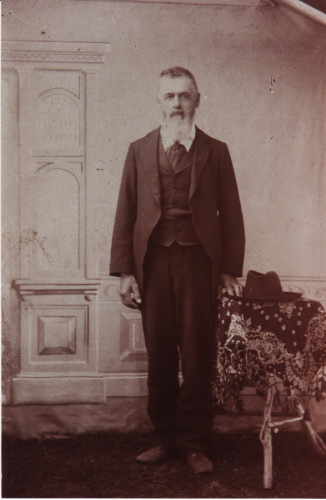
Augustus Hugh Schaffer, my 3rd great-granduncle. Photo posted on Ancestry by a distant cousin. He is the closest I can get to an idea of what Samuel might have looked like. And he does bear a passing resemblance to Samuel’s grandson, my 2nd great-grandfather, Samuel Hill Schaeffer (now with an “e”).

That is what is definitely known about Samuel. There are unfortunately lots of men named Samuel Schafer/Schaffer/Schaeffer in the area at that time, at least two living close by. Many Ancestry users link him to a Christian Schaffer of Berks County due to a baptism record, but that Samuel died in 1820. My Samuel may well have been orphaned or illegitimate. As young men, Mahlon, John and David learned to work in the iron forges.

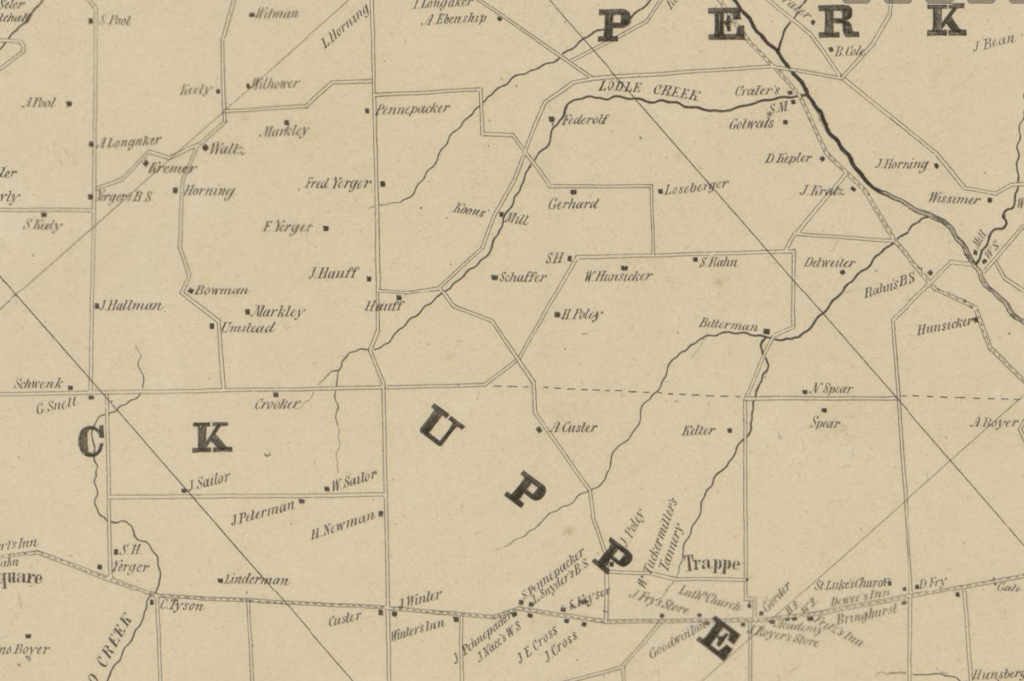
Cropped from an 1849 map of Montgomery County. The area is close to the church where Rebecca Thomas was baptized. Maybe the Schaffer there in the middle is connected. I’m working on it.

The next post will be about another Samuel, my other brick wall.

Happy Birthday, Mom

Today would have been my mother’s 93rd birthday. It’s the first without her. Last November, I flew home to spend some time with her. Being able to work from anywhere allowed me to do that. Even though she was very old, she was still fairly sharp and independent. But on my third day there, she collapsed. We took her to the hospital where, 9 days later, she died, determined not to live any longer, if living meant medical problems and visiting nurses. She wasn’t having any of it. “Let me go. I’ve lived a good life.”

Indeed, she’d had, although she was a baby of the Great Depression, born in 1931 to a single mother who had left home (or was kicked out) and had gone to live with her Slovak grandparents. There’s a story that the doctor who delivered my mother offered to adopt her, but my grandmother said no, I’m keeping her, and so little Margaret was raised by a village of loving great-grandparents, great aunts and great uncles on Pottstown’s South Side. Times were hard, but she was surrounded by a generous and supportive family, and when her parents did eventually marry, that loving family got bigger.

In school, Mom originally considered studying art. But then something happened to change the trajectory of her life. She had been singing in a girl’s choir at school, and one day her teacher put her in front of the choir and had her conduct it. Mom said that, in that moment, she knew exactly what she wanted to do.

She studied music education at West Chester State Teacher’s college, and the way she told it, she just managed to squeak by in her academic subjects. She told me about a geography course she had to take in college. One day the teacher gave a surprise quiz: the students had to identify lakes of the USSR solely by their shape. She was completely lost (even though her classmates took pity on her and surreptitiously lifted their papers so she could see their answers) and failed the test. Music was a different story, although she somehow allowed her piano teacher to believe that she was a voice major — and let her voice teacher believe she was a piano major —so that she wouldn’t have to prepare and perform a degree recital. She wanted to conduct choirs, and that’s what she did. Then her Dad got sick, and graduation seemed uncertain, but the village pulled together once again, and word went out, and her tuition was paid for.

She met my Dad on a blind date, set up by their two best friends who happened to be going steady with each other. The date was for New Year’s Eve at local country club, and we know, from a poem that Mom wrote a year or two later, that they kissed at midnight. I think that’s why she always had a special liking for the song Auld Lang Syne.

They got married and had a family, four kids in all. Eventually she decided to get back to work and landed a teaching job at a good local school. She started a choir, then a show choir, then convinced the school to let her direct musicals. Mom loved her job. She’d come home from school, get dinner ready, eat with us, and then drive back for an evening rehearsal. Every summer, she’d sit down at the piano and get to work putting together her show choir’s next program: arranging songs, working out transitions, writing narration, thinking up the kids’ costumes, and by September it was ready to be learned by a new crop of young performers.

Her students loved her. She didn’t realize it back then (we’d talked about it recently), but she gave them a safe space to be themselves, be creative, be silly, when they had nowhere else. Some of them came from unhappy homes. She gave them music, roles in the musical, songs and lines to learn, and for some of them it was life-changing. The great irony in this is that, while her students were getting away from unhappy situations at home, unhappiness was brewing in her own home. The oldest child dove into rock music and drugs, the next into literature and dreams of departure. It was the seventies. It was a difficult time for parents who expected that their kids would do as they were told, just as they themselves had done. My father was often angry. Maybe her students weren’t the only ones who were looking for a brief escape.

But there was always the next school year, the next crop of kids, the next musical to plan. When she retired, she started traveling, going overseas several times with me or with friends. She waded in the Black Sea, talked to strangers in German beer gardens, watched the Love Parade pass our Berlin hotel, marveled at the bones in the chapel at Halstatt, drank mulled wine at the Christmas market in Salzburg. Eventually she talked my Dad into joining her, and they visited his ancestral village in Sicily, sailed up the Danube, and happened to be in Paris for a Three Tenors concert on the night that France won the World Cup and Paris exploded in joyful celebration. Their tour companions stayed back at the hotel, rather terrified, but my parents went out into the street to bask in the festivities.

The year she turned 80, one of Mom’s former students contacted my sister and me about arranging a surprise lunch for her that summer, with all her old show choir members in attendance. Over a hundred of them came, and there was singing and speeches, and she was so taken with this reunion, this re-living of old times, that she started planning them herself five years later. She hosted three in four years, the last one being a concert in the auditorium of our old high school, which felt steeped in memories. Then the COVID-19 pandemic hit, and my father got sicker and the reunions were put on ice, with some light discussion about whether we would have another one this summer. Mom liked to be busy, she always liked to have a project down the road. Planning those reunions got her through my Dad’s last years.

We’ll be having that reunion this summer, but not the way we’d hoped. Instead, it will be a celebration of her life, and held in the fellowship hall of a local UCC church. She had been raised Roman Catholic and stopped going to church decades ago, but I think she’d like the UCC’s liberal, peace-and-love vibe. And after that memorial, while the family is still together, we’ll honor her last wishes: to take her and Dad’s ashes, mix them together, and scatter them on the two acres of woods that they both loved so much and called home for over 60 years.

Happy Birthday, Mom.

Out with the old year, in with the new

2023 was quite a year for us, friends. Here’s a sampling of what went down for us in the past 12 months:

February: My husband found that his employee was moonlighting while calling in sick, and fired him. The employee tried to file charges, but then dropped them. Bad feelings all around.

April: My husband had routine surgery, but complications arose and he ended up in the emergency room on Easter Sunday, and in the hospital for the following week.

May: I took a DNA test, basically on a lark, and found that my maternal grandfather (who died long before I was born) was not biologically related to us. This was a shock to my mother, who then had to come to terms with the idea that everyone in the family who was around at the time of her birth must have known this, and kept it from her. To protect her, naturally. But it was hard on her to find out now.

Also in May: The translation company where I worked full-time hit a few snags, and my boss said she couldn’t afford to pay me in full. It’ll just be for a couple of months. Except it went on for much longer, and as far as I know the company never fully recovered. I am living from freelance work again.

June-August: We hired a bookkeeper to help us with my husband’s business taxes. The bookkeeper recommended a tax advisor she’d worked with. The tax advisor took us on, then a month later told us that he was cutting all ties with the bookkeeper, no reason given. This led to emails from the bookkeeper that started out normally, then escalated into bold, underlined and in sizes/colors to emphasize her points. She completed her work for us but then left everything at her front door for us to pick up. We never did fully understand what the problem was.

November: I flew to America to visit family. On my third day there, my mother collapsed and went into the hospital, where she died 10 days later. I am devastated but at the same time grateful that I was there and not on another continent, that I could sit by her bed and talk with her, hold her hand, and simply be there until the end. I will be grieving for a while.

December: Covid-19, just in time for Christmas.

OK, the year wasn’t all bad. The DNA surprise came in tandem with a lot of confirmation about the other branches of my family, so I’ve been digging into records and archives to find out more about my family tree. In doing so, I’ve learned a lot more about Pennsylvania history as well as Pennsylvania Germans – not the Amish, but rather the Lutherans and Reformed congregations that populated Montgomery, Chester and Berks Counties. I’ve learned that we are related to two Pennsylvania governors, the first early Swedish settlers, Revolutionary War and Civil War soldiers, and even triplet babies that were regionally famous for a year (until two of them died). I also began to connect with not-so distant relatives – second cousins, first cousins once removed – whom I knew about but had never had a relationship with.

One generation passes, and the next picks up the torch.

Summer of Cicadas

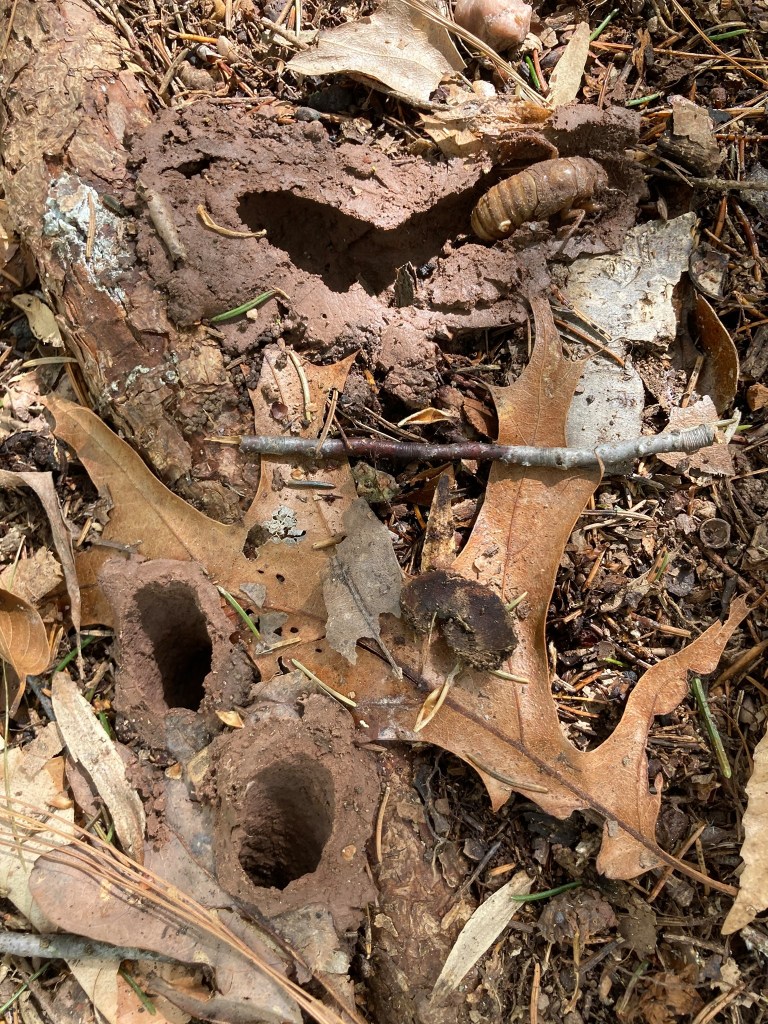
I just spent three months in southeastern Pennsylvania, visiting family. One day while raking leaves, I noticed lots of little holes in the ground – perfect little circles, like bullet holes, all through the woods, even underneath the leaves. And in some places there were also what looked like miniature earthworks — little vertical tunnels, maybe a few centimeters long, made of what appeared to be hard, dried brown mud. What on earth was going on here?

Ah, yes. I hadn’t realized. It’s 2021, and the 17-year cicadas were back!

At first I was looking forward to the experience – the first time I encountered them, in 1971, I was too young to have much interest. In 1987 I was in California. In 2004 I’d flown back from Europe after they’d already hatched. So this would be the time I could observe at least part of their lives, from nymphs through fully mature creatures. I also remembered that they were loud.

Well, loud they certainly were.


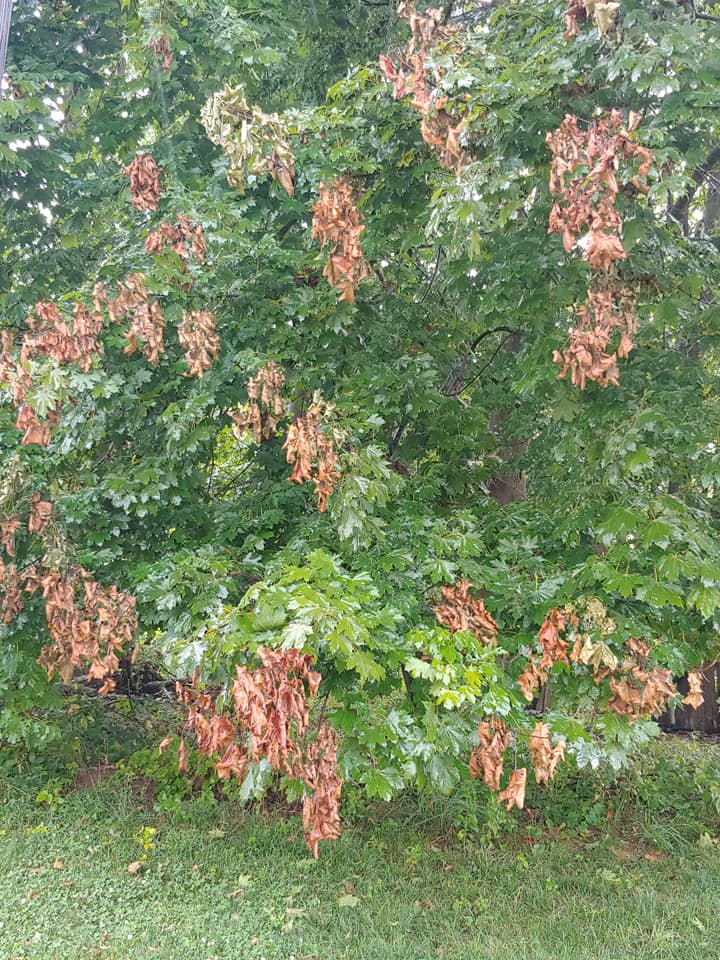
The 17-year cicada starts its life as an egg, deposited in a slit that its mother has made near the end of a tree branch. The ends of the tree branches turn brown (this is called “flagging”), die and eventually fall to the ground, allowing the tiny, newly hatched worms to burrow into the ground and stay there for 17 years, living off tree roots and probably working off the trauma from that long fall.

“Flagging”

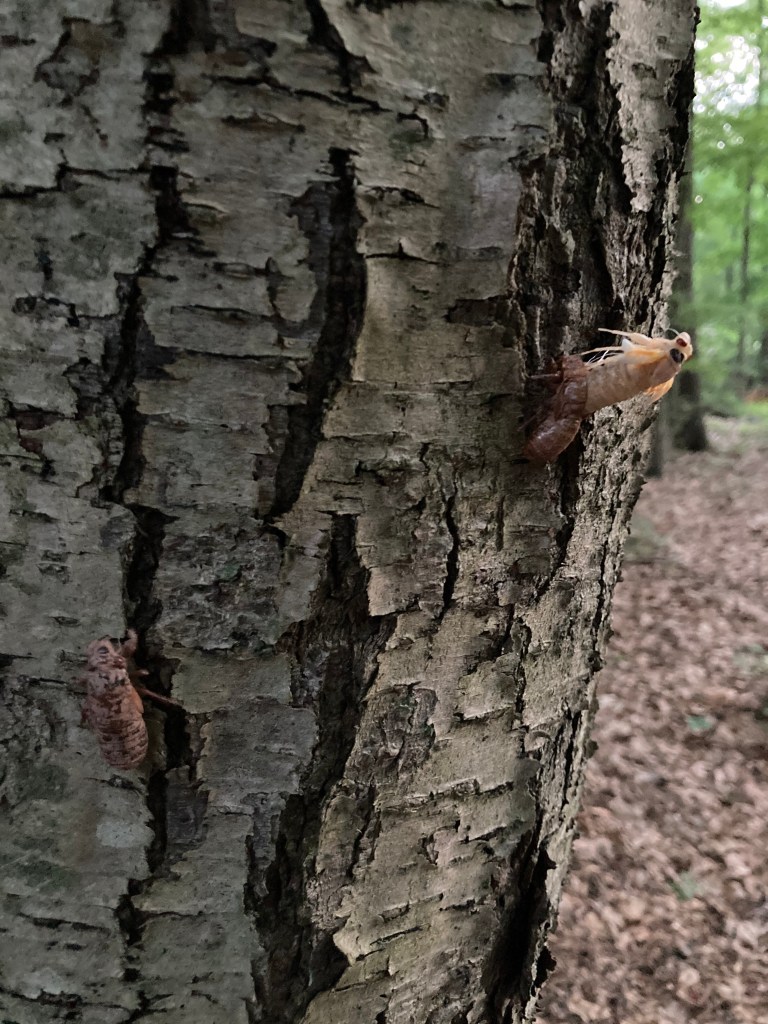
When the time is right, the cicadas nymphs emerge from the ground in waves over several days, crawling up the barks of the trees in the evening twilight.

Look for the four traveling in formation later near the top of the screen

They seem to have their own individual reasons for stopping their upward march where they do – some get to the end of a fern frond or a bush, and that’s that. But some stop just a few feet up a very tall tree, while others continue on 100 feet further. When they stop, they attach themselves to whatever they’re climbing – tree, frond, fence, side of house – and begin their final metamorphoses into fat, flying insects. A few days later they emerge from their dead shells and buzz off into the trees to look for mates.

Freshly emerged cicadas are white, then soon turn black and brown

The males, according to Wikipedia, congregate in choruses to entice females. The sound can be unnerving. It’s like something out of science fiction, high and eerie, like spaceships landing, and at peak periods they “sing” through the day and in the wee hours of the night.

The spaceships have landed somewhere

But cicadas only live for a couple months, and so by July this entomic Woodstock comes to an end. Their noise grows fainter as more and more of their corpses collect on driveways and lawns. They’d found mates, made slits in trees to lay their eggs, and died. And the cycle beings again.

In Memoriam

On the 13th of January at 7:50 in the evening, my father slipped the bonds of earth and left us.


My father’s first name was Joseph. People called him Joe. His parents had always called him Son. My mother called him Smitty. He was the only child of a Depression-era, multicultural marriage. My grandfather was the oldest child of Italian immigrant parents. He might have been a happier man in his youth but I didn’t see much of that as his grandchild – he was always kind to me, but he could withdraw into a cold anger, and his way of dealing with that anger was to stop speaking to you. This was a trait he passed on to my father (and in turn to all of us children, each one of us dealing with it differently). My father’s mother was a Pennsylvania Dutch farm girl who eloped with my grandfather before she was 20. The marriage was not a happy one – and ended after 50 years when my grandmother learned that she qualified for subsidized housing. I used to say that my father inherited a fiery Sicilian temper and the German talent for keeping it all inside, but course it was much more complicated than that. In some ways he was Sicilian to the core, and at the same time an affable, hard-working local boy. Not that those things are in any way mutually exclusive; it just depends on who’s on the receiving end.
My parents met on a blind date on New Year’s Eve, fell in love, got married, and had children. My mother became a school music teacher, eventually getting her master’s degree. My father had attended a military academy but not college, and served in the Navy before settling into sales jobs back home. He was a sales rep for grocery stores, driving around his territory, taking orders, checking the displays. He would bring home overstocks – lemonade mix, soap. He would do paperwork at home at his desk, just off the kitchen, filling out forms printed on pastel-colored paper. He must have had lots extra, because I was allowed to take it for drawing, something I did a lot as a child. I was always doodling, so maybe this was my parents’ way of keeping the margins of their books undecorated. Although I don’t remember Dad being much of a reader. He read the newspaper, of course, and maybe magazines. I don’t remember ever seeing him read a novel.
There were four of us children, spread out over eight years, with the first three coming one after the other in quick succession. My Dad came from a generation that must have felt like the rug had been pulled out from under them in the late 60s. As children, they had been shown tough love, were disciplined for any infraction, formed into adults through fear and respect for their elders. They did everything expected of them because there was little alternative, and yearned to be free by becoming adults. But they then watched as their own children grew their hair long, took drugs, dissed the establishment, took an interest in socialism, played loud rock music in their bedrooms, talked back. And no amount of iron fist was going to make things go back to the way they used to be. His relationships with his older children grew strained. The younger ones learned by watching and walking on eggshells when necessary.
My Dad enjoyed hunting, and kept a small collection of rifles and other firearms. Deer mostly, also pheasant (and once a rabbit that I remember being prepared by my Mom for dinner – his dinner, as none of us would dare to eat poor Thumper.) When hunting season rolled around he would spend evenings in the “gun room” he’d staked out in the basement, filling shells. He’d been an NRA member but left the organization when it started getting political and survivalist.
He was very adept with tools of all kinds, including power tools. With a house on two acres of woodland, you had to be. Chainsaws, wood chippers, pressure cleaners, the ATV with the trailer to haul logs up the hill and the plow to clear snow from the long driveway. And he was as strong as an ox, even into his eighties.
In retirement, he and my mother did a bit of traveling. They bought a van that was outfitted for camping and took a couple of road trips around the country, including a long one to Alaska and back. Despite my Dad’s fear of flying, they even visited Europe a few times. Looking back, I suspect that by their last trip, to Germany to visit me, the dementia was starting showing itself in subtle forms. A year later, it was noticeable in ways that I still didn’t associate with illness. My father was not one to share his internal life with us, or to ruminate about the state of the world or ask us probing questions about our lives. Like the fathers of many of my friends, if he answered the phone when I called, we’d talk about the weather for 2 minutes and then he’d say “I’ll get your mother.”
But one time he surprised the heck out of me. I was living in Salzburg in the 1990s, when cell phones and home internet weren’t things that everyone had yet, and so many of us expats had fax machines to send messages that were quicker than mail and cheaper than a long-distance phone call. One afternoon, my machine started spitting out… a love poem. One or two pages of it, and then a note from my Dad, explaining that my Mom had written it for him back when they were young. He’d kept it safely tucked away in a drawer and their anniversary was coming up in a few months, could I make a song out of it and record it for him? That he thought out this plan still astounds me today, not least that he knew how to use the fax machine without being able to ask my Mom for help, since she was the main communicator in the household.
But back to now – he held steady for several years, but the inevitable slide came over time, and in the end he died at home, cared for by my mother and my sister, two heroes to the end. Thank God he didn’t contract Covid-19, as his condition would not have allowed him to understand what was happening, and he wasn’t always cooperative with nurses.

About three days after his death, I was busy working at the computer. Suddenly, I distinctly felt that he was there, or somehow the essence of who he was, as if he had swooped down on his way out, just to communicate that he was OK, and that he loved me. It lasted for about a minute. And then he was gone.


Rest in peace, Joe.

Time Travel with the BayernAtlas

We often drive through a Bavarian village with a bypass running east-west just of north of it, created so that cars (and trucks) on the main road from the lake to the next town don’t have to navigate all those crooked village roads. On the west side, a short stretch of the older road was left intact (ending in grass), so that you can see how the current main road used to connect to it (and now continues to the left). The east side always puzzled me, though, and for years I wondered if the road we use to reach the bypass was the road that had always been used, or if that had been somewhere else.

I recently found the answer (it’s the former), and I’m only telling you about it because the search led me to the discovery of this website of the Bavarian Ministry of Finance and Home Affairs.

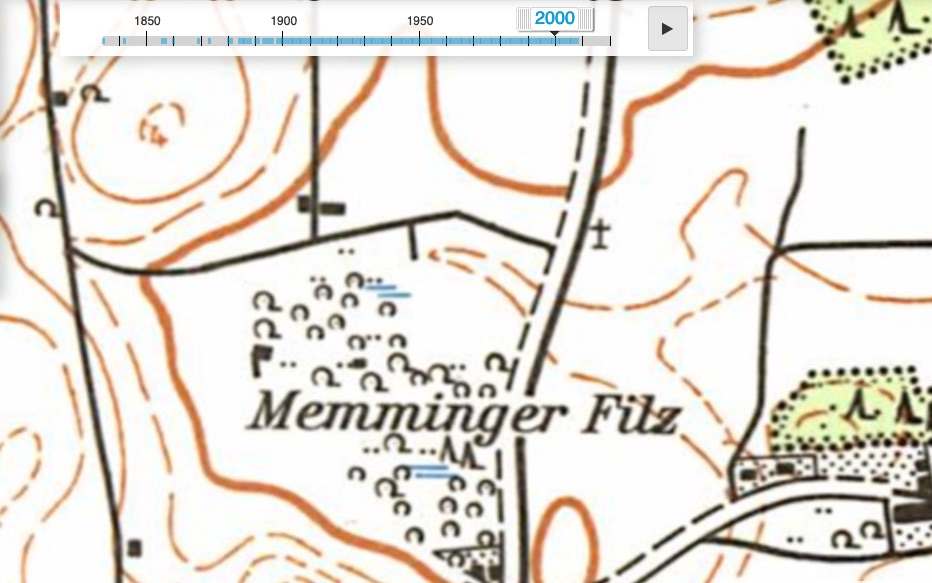
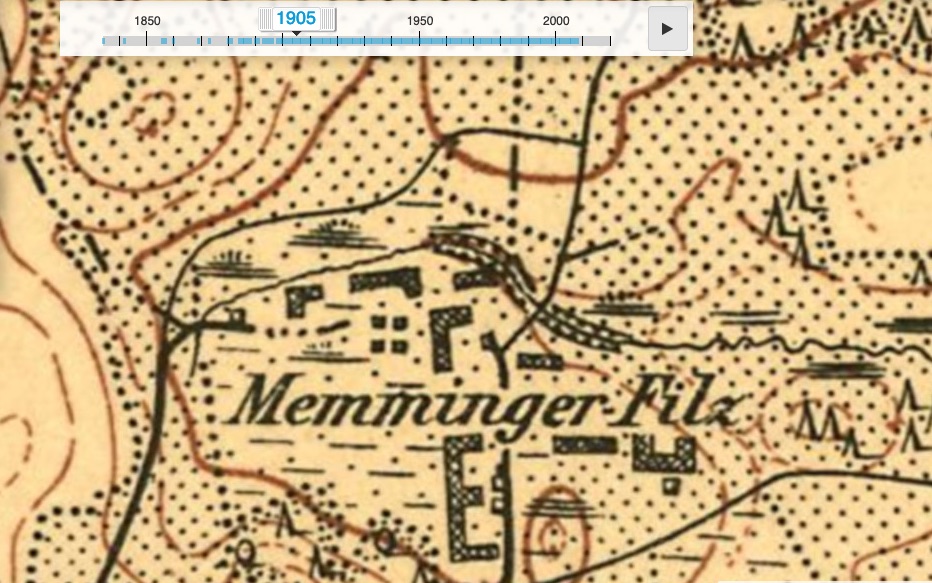
The BayernAtlas website has a nifty function called “Zeitreise” where you can travel through time (virtually) by zooming in to the area you want to view and then clicking on the time bar to bring up digitalized versions of maps that would be current for that time frame. This way you can see when buildings were erected, when new roads were put in or when existing roads were realigned (to bypass villages, for example). You can even play with the transparency to see how two maps line up.

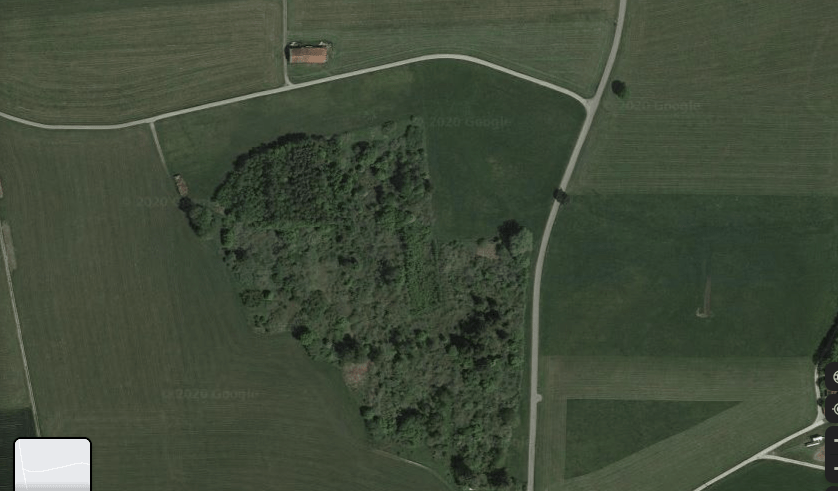
Here’s an example of what I mean. Today, the site of a small patch of managed forest…

…evidently once held a complex of building structures – most likely barns or stables.

What I haven’t yet been able to do is learn what the symbols – for example the circles and tepees, not to mention those things that vaguely resemble steam ships – represent.

A satellite image from Google Maps.

A visit to the Horse World Expo

About two years ago my freelance translation work brought me in contact with the owner of a boutique agency specializing in translations for the equine sector, i.e. all things horses. She was looking for an English-speaking translator who had some experience with horses or at least interest in learning more, and I was looking for a new challenge. Our collaboration has continued and last summer I became a full member of the team. I’ve learned more about the equestrian world that I ever believed possible, and there still so much to learn. I’m still a crappy novice rider, however, and that won’t change any time soon!

Anyway, we’re adding a blog to the agency’s website and I’m permitted to cross-post my own contributions here if I wish. The following post is my first blog post for Anima Translation.

I was home visiting my parents in eastern Pennsylvania just before the United States government began to take the coronavirus seriously, and on 29 February drove to nearby Harrisburg to visit the Horse World Expo 2020.

The Horse World Expo attracts exhibitors from all over the country, however its flavor is distinctly regional. Many of the companies are local, as are the visitors. This isn’t a trade fair for horse snobs. The halls and arenas were filled with regular folks, including Mennonites (in their distinctive garb and the men with beards without mustaches) and lots of teenage girls.

My original mission had been to visit with the people running the stands and ask if they would be interested in expanding their market with translation services, but it didn’t take long for me to realize that this was not the right crowd for foreign expansion, and after getting a few bemused looks I decided to just enjoy the event and learn from it.

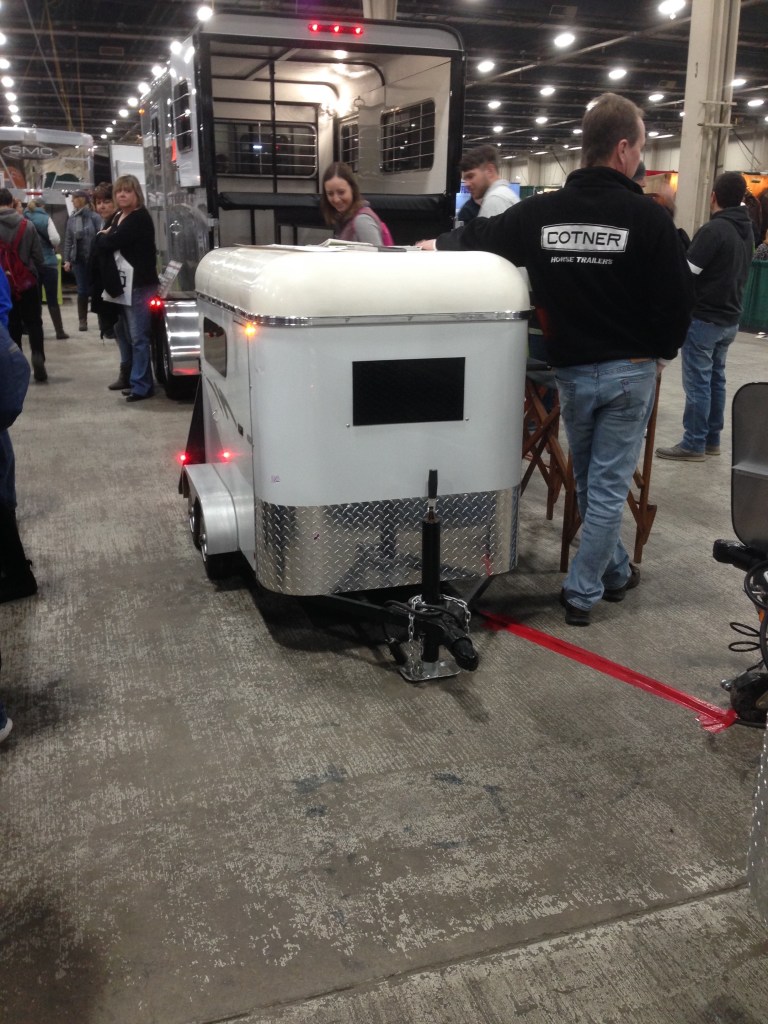
Trailers for all sizes, even the mini-est of minis.

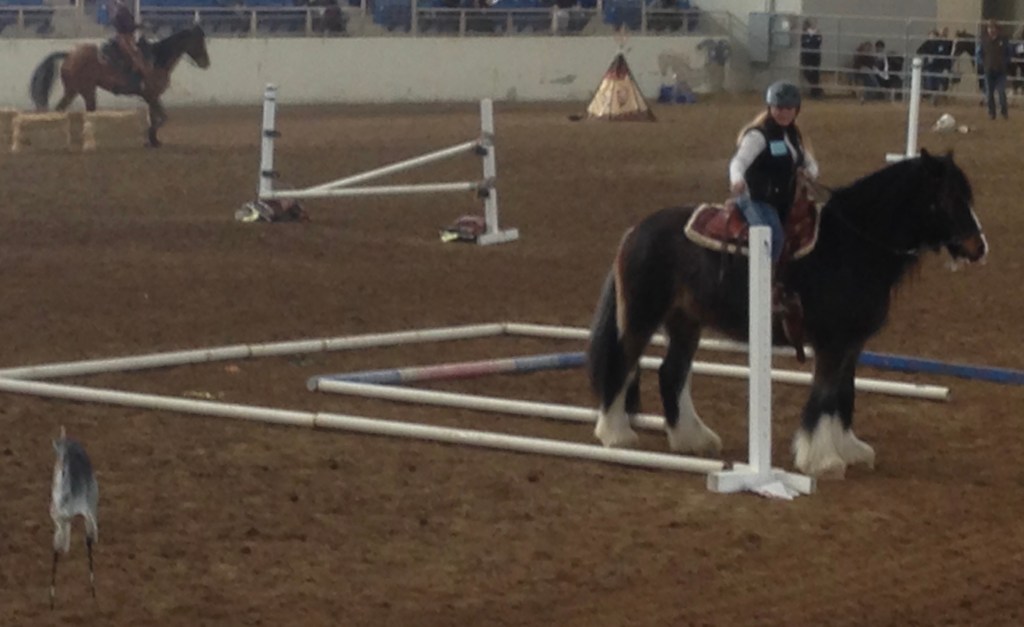
The Farm Show building is divided into two general areas. On one side there is the trade fair hall:  large enough for hundreds of stands, with an area dedicated to the latest innovations in supersized horse trailers, a couple of seminar areas, and a (small) roundpen for presentations with horses. On the other side are two large arenas with stadium seating, and here is where the larger events took place. These included the Trail Champions Challenge, a timed competition for horse and rider to accomplish some country-themed tasks (mending a fence or shooting a cap gun in the saddle, backing up one’s horse through a U-shaped alley without stepping over the poles). The most entertaining for the audience was the last task, where the rider had to dismount her horse at a free-standing wall with a window, walk over to the other side of the wall, pick up a camera and take a flash photo of her horse, and then return and get back in the saddle. (Many horses felt that enough was enough at this point and headed for the exit, with their riders trotting after them.)

Here the contestant has to take a cap gun from the post and “shoot” at a prop deer without her horse panicking, and then back him out of the alley.

What could I take away from the Expo in general? English style riding was certainly well represented, but most people there seemed to be primarily interested in Western riding. Many of the arena presentations, such as the Trail Champions Challenge and the session on gaited horses – Tennessee Walking Horses and others – came with a heavily Western flair. The “regional” country atmosphere was mainly enjoyable (I was able to buy my parents some good old Pennsylvania Dutch Whoopie Pies), but sometimes extended a little too far into the camo crowd for my comfort, for example the stand selling T-shirts bearing Confederate flags. But that, too, was a lesson learned – horse lovers come in all kinds of packaging.

“A visit to the Horse World Expo” is cross-posted at http://anima-translation.com

The Voices of Our 1960s-70s Childhoods

Are you the kind the person who has songs running through your head at all times? I am. Not every single second of the day, but most seconds of most days there’s something playing in the background (or foreground) of my consciousness. When I was involved in opera productions there would be a whole minutes-long passage that would loop back to the beginning at some convenient harmonic convergence, so that it might not end until some other music took its place. Since I left the business most of my “ear worms” have ended up being fragments of songs from recently-played CDs (yes, we are dinosaurs and still buy CDs).

Sometimes they go way back in time, however. (For several months, “You Never Give Me Your Money” from the Beatles’ Abbey Road album switched on in my head pretty much every time I entered the kitchen. No idea why.) This past Christmas Eve, I pulled out my old DVD (like I said, dinosaurs) of the 1966 animated cartoon special “Dr. Seuss’ How the Grinch Stole Christmas”, which we never missed when it was broadcast on American television during my childhood. That was nearly 2 weeks ago, and I thought nothing more of it, but then something very strange happened this morning.

I had woken up around 6:30; it was still dark so I was just letting my thoughts roam where they would, when for some reason I recalled the theme song to the early 1970s TV series “Love, American Style”. And then…wait, I thought, those back-up voices. Don’t they sound just like the same voices on the Partridge Family Album? Now, I haven’t heard that album since I was maybe 10 years old, but I remember listening to those songs and thinking that the singers sure didn’t sound like a group of kids. They sounded like adults. OK, but who were they?

Well, here we are in 2020 and Wikipedia is indeed a wonderful thing (and I need to make a donation to them!) Get this: it’s the same constellation of singers, concentrated around the brothers Tom and John Bahler, here in a group called The Love Generation but more often generally part of the Ron Hicklin Singers, a group of studio singers who were hired to record pretty much everything we late Baby Boomers – the generation portrayed in the old TV series “The Wonder Years”, actually – heard on television during the sixties and seventies. Commercials, theme songs, you name it. Along with the Beatles and the pop artists on WFIL and American Bandstand, these singers more or less sang my entire childhood.

Here are some examples of where you can hear the voices, collectively or individually, of the Ron Hicklin Singers (courtesy of their Wikipedia entry): the theme songs for the TV shows Love, American Style, Batman, Flipper, That Girl (Season 5 opening), Happy Days. There they are backing up lead vocalist Cyndi Greco in the theme song to Laverne & Shirley . They recorded songs for the show The Partridge Family and the cartoon spin-off The Brady Kids, songs for the Monkees, including “I’m a Believer” (!!), for Paul Revere & the Raiders, and probably about a thousand other songs and jingles that flowed out of TVs and into American ears during the 60s and 70s. Of special note: Thurl Ravenscroft, the brilliant and unmistakable bass voice of “You’re a Mean One, Mister Grinch” from the above-mentioned DVD and Kellogg’s Tony the Tiger (“They’re grrrrrrreat!”) was a Ron Hicklin Singer. And Jackie Ward, the group’s alto, was by her own accounts “the voice of Rice-a-Roni” for 20 years.

The Bahler brothers allegedly can be heard in the song “MacArthur Park” (there were male back-up singers on that? I pulled it up for a listen on YouTube. I didn’t notice any. Unless they sing those super high notes at the end?) and “Suicide is Painless” from the 1970 film M*A*S*H*.
And especially Burt Bacharach’s swinging “South American Getaway” from the 1969 film Butch Cassidy and the Sundance Kid. Listen to this song on YouTube. Listen with headphones or earbuds if you can. They’re terrific. And there’s Thurl Ravenscroft, of Grinch and Tony the Tiger fame, singing bass, PLAIN AS DAY. [Wait, stop the presses: the soprano on this song, Sally Stevens, recently commented on YouTube that it’s herself, John Bahler, Jackie Ward, Sue Allen, Ron Hicklin and Bob Tebow.]

It only took me literally 50 years to realize this. Sure, it all sounded similar. As a kid, they all sounded like a bunch of grown-ups to me. I never realized they were the same singers, doing it all.

About this blog

Featured

The articles found below include a sampling from over ten years of writing originally posted on the blog The Practice Room, as well as newer writing originally posted here, generally dealing with culture and history in the regions of Tyrol (Austria) and Upper Bavaria (Germany).

In Via: Milestone, Via Claudia Augusta

IMG_3996It’s not an original, of course, but a replica, with historical information written in German. This milestone is placed next to the route of the Via Claudia Augusta, here an unassuming gravel road, where it crosses Bahnhofstrasse near Leeder, west of the Lech (The Bahn in question is the old rail line between Landsberg and Schongau, which is only used for special tourist trains a few times in the summer.)

Via Claudia Augusta
The Roman state road was built in 46/47 A.D. by Emperor Claudius and ran from Northern Italy through the provincial capital of Augsburg and [to] the Danube
To Augsburg: 34 miles